Home Blog Page 34

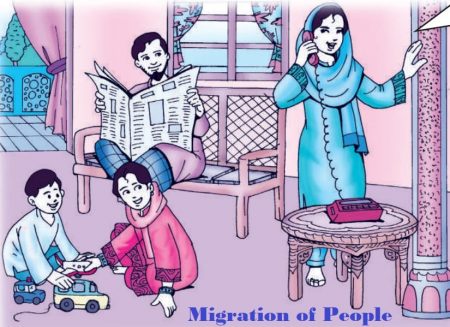
Migration of People Class 5 EVS Chapter-1 New and Best Notes

0
Migration of People Class 5 EVS Chapter-1 New and Best Notes

Migration of People Class 5 EVS Chapter-1 New and Best Notes , Migration of People Class 5 EVS Chapter-1 Notes, 5th class evs notes  chapter 1, Migration of People  chapter 1, Migration of People  AP Class 5 Chapter 1 notes. Here is the best notes for class 5 children and we hope this will helpful. Class 5 EVS Chapter-1 Migration of People.

Migration of People Class 5 EVS Chapter-1 New and Best Notes

Key Points:-

– Natural calamities, poverty, unemployment are the basic reasons for migration.
– Slums are formed due to migration.
– A family budget is a statement which shows how the income is spent in families.
– Saving is a good habit.
– Education is the right of a child. Natural calamities, poverty, unemployment are the basic reasons for migration.
– Slums are formed due to migration.
 – A family budget is a statement which shows how the income is spent in families.
– Saving is a good habit.
– Education is the right of a child.
– Population density in urban are as is increasing due to migration of people from rural are as.
– In olden days a family is led by the elder most person and they lived in a joint family.
– Pie chart or a circle chart is a circular graph; which is divided into parts to show proportions in numbers:
– Poverty is not a barrier to get success in life.

CONCEPTUAL UNDERSTANDING – Migration of People Class 5 EVS Chapter-1  Notes

1. What is migration? Give some examples.
A. 1) The seasonal movement of people is called migration.
2) People migrate from one place to another place in search of livelihood.
3) For example some people migrate to Hyderabad to work in construction field.
4) Some people migrate to Chennai to work in automobile field.

2. What are the advantages and disadvantages of migration?
 A. Advantages :
1) People migrate to get more money.
2) That money may fulfil their needs.
3) They can educate their children.
4) They may buy a farm when they return to their village.

Disadvantages:
1) Population density increases in urban areas.
2) Difficult to plan the economy to the Government.
3) Slum areas increase.
4) Very difficult to sanitation etc.

Migration of People Class 5 EVS Chapter-1  Notes

3. Raju says that sometimes migration happen in our lives. Do you agree with this  statement? Why?
A. 1) Yes! Raju said the truth. Migration can happen in any family.
2) Some times it may already happened, in their fore father’s time.
3) Because of economic or natural calamity reasons.

4.If you meet a migrated family in your village, what type of questions would you ask them to find out the reasons for migration?
A. I found a migrated family in my village. It is a family of my classmate Ramesh. I asked  him the following questions.
1) Where did you study upto IV class ?
2). Why did your family leave that village ?
3) What are the causes to migrate to this village ?
4) Whether all facilities are comfortable to you in this village?
5) What are the things that you feel missed from that village?

5. Observe the migrated families in your village and write about one incident that changed their lives.
A. I observed the family of Mohan in our village. They migrated to our village from Prakasam district. His father is a bank employee. And he got transferred to our village to work in that bank.

VI. Appreciation –  Migration of People Class 5 EVS Chapter-1  Notes

8.Suresh is going to work with his father. He stopped going to school. How do you motivate him to rejoin the school?
A.   Because of poverty, Suresh is also going to work along with his father. So first I request my class teacher to talk with his parents and explain them about different schemes  which are offered by the Government for poor people and also I explain Suresh about  the importance of education. Education is the only way getting a wealthy and valuable life.

       And getting education in a prescribed age only is useful to any one. And I will also  explain him about different advantages and provisions in our school for getting free and compulsory education. And I will tell him the disadvantages of getting many by small works in childhood which may lead to bad habits etc. And I will tell him that I accompany him to school every day.

QUESTIONS GIVEN IN THE LESSON
– Have you seen any family in your neighbourhood which moved to a new place? (Page No.1)
A. Yes. I saw. Nandini’s family moved to another place by getting a new job to her father.


Are there any new comers to your class who migrated from another place? Discuss the reasons for migration? (Page No.2)
A. Yes. There are two new comers in my class. Ravi and Asifa. Both of them came to our village to work in a garden.


Did Babulu’s life change due to shifting from his village to a town? (Page No.4)
A. Yes. In olden days Babulu lived together with their relatives and friends in their village. Here in the city he did not get any such friends. They enjoyed a lot working on the agriculture farms or catching fish, but here in factories, it is very difficult to get free time. Babulu’s family life became mechanical due to shifting to this town

Does your mother or father make a list of their expenses?(Page No.5)
A. Yes. My mother always makes a list even for a single rupee of her expenses.

How do you save your pocket money? (Page No. 5)
A, I save my pocket, money in my money purse/coin box.

Do your parents have bank account ? (Page No. 5 )

Yes. Both of my father and mother have bank accounts.

 A pie-chart showing the budget of two families are given below. Let us observe.

Whose expenditure is high ?
A. Rakesh’s family expenditure is high.

Which family saves money? (Page No. 6)
A. Veeraiah’s family saves money.

Can you identify the family that has a proper economic planning? (Page No. 6 )
A. Yes. Veeraiah’s family has a proper economic planning.

Economic planning of which family will you follow in your future? (Page No. 6)
A. I will follow the economic planning of Veeraiah’s family in my future.

Can you mention any other schemes provided by our government for education? Write YES’ if you have used them or write ‘NO’ if you have not, in the brackets provided. (Page No. 8)
1. I have taken ‘uniforms”, (YES)
2. I have taken ‘text books’. (YES)
3. I have benefitted from ‘scholarships’ (YES)
4. I take Mid-Day Meals’. (YES)

THINK & DISCUSS
What are the effects of migration?
A. New jobs, life settlements, new opportunities in studies, poverty, informal economy, and slums.

 Krishna says that migration improves the economic status. Do you agree?
A. No. It is not correct. May be it is true in one or two cases, but the problems occur because of migration of families in a huge amount.

Does it have any effect on the basic needs of a family? 
A. Yes. Actually families migrate only to get basic needs such as food, clothes and shelter.

Which is preferable, saving money or spending money?
A. Saving money instead of spending money for waste reasons is always preferable.

What will you do with the money you saved ?
A. Generally I use the money which I saved for doing different project works, buying stationery and some times buying new clothes for celebrating different festivals.

What is interest?
A. Interest is defined as the amount of money paid for the use of someone’s money.

 Did you notice any unnecessary expenses in your family budget? If so, list them out.
A. I found the expenses like going out for dinner and parks as unnecessary expenses in our family budget. And with this spending money for fuel for our vehicles is also increasing.


IIT Foundation Class VI & X


Family Class IV EVS Notes AP New Text Books Best Solutions Unit-1

0
Family Class IV EVS Notes AP New Text Books Best Solutions

Family Class IV EVS Notes AP New Text Books Best Solutions – AP Class 4 EVS notes, ap class iv evs notes , 4th class evs notes, iv class evs notes text books activities and answers, class 4 environmental studies notes , class iv environmental studies. Her is the best answers and notes for class iv students. AP Class 4 EVS notes chapter -1 solutions for class evs chapter

Family Class IV EVS Notes AP New Text Books Best Solutions ncert solutions for class evs class 4 evs book pdf

Family Class IV EVS Notes AP New Text Books Best Solutions

KEY POINTS
– We all live with our families,
– A family consists of grand father, grand mother, father, mother, brothers and sisters. Sometimes, pets also,
– The people who live together in a family are called family members.
– Every member of the family has a different role to play,
– Everyone in the family shares the work and help each other.
– Helping each other, develops love and affection among family members.
– We get love, care, support and affection from our family,
– Children can resemble their parents or other family members.
– A good family member brings respect to all the family members.
– All professions should be respected.
– The village has people doing different kinds of work.
– The right place of children is the school and not the work place. All children should go to school.
– Child labour is a punishable crime.
– The relationship among the members of a family in a family tree.
– Our relatives are also a part of our family. We call them our extended family.
– A wedding, the arrival of a new born baby and transfers etc. are reasons  for changes to the structure of a family.
– A family with mother, father and children is called a nuclear family.
–  A family with grandparents, parents, uncles, aunts and cousins is called a joint family.
– In our society there are many types of families like single parent family, grandparent family, mother dependent family.
– To help us in our household work, we use home appliances.

Family Class IV EVS Notes AP New Text Books Best Solutions

Family Class IV EVS Notes AP New Text Books Best Solutions

Answers – Family Class IV EVS Notes AP New Text Books Best Solutions class evs chapter changing families

Family Class IV EVS Notes AP New Text Books Best Solutions

___-Do you think there will be any change in Anil’s family after this wedding?  :- Yes , because a new person 

Who are the new arrivals in Komala’s family?  – A new born child.

Write down the reasons for these changes
• In Komala’s family? A new born child.
• In Anil’s family ? Anil’s wife.

A family with mother, father and children is called a nuclear family. A family with grandparents, parents, uncles, aunts and cousins is called a joint family.

Family Class IV EVS Notes AP New Text Books Best Solutions

Improve Your Learning 

I. Conceptual Understanding.

1. State two reasons for the increase of nuclear families.
i) Due to marriages, transfers to other towns.
ii) Due to business, studies and employment. Baton

2. Write the reasons for changes in a family?
1. A wedding, the arrival of a new born baby and transfers etc are reasons for changes in a family.
2. Business, studies, death of someone in the family also causes change in a family.


3. Give two reasons how the use of home appliances changed the life style of people?
1. In olden days people did all the house hold works manually.
2. But now a days, we use different appliances that make our work easier and faster.
3. Home appliances have changed the method of working. Due to this we have  reduced physical exercise to the body.

Family Class IV EVS Notes AP New Text Books Best Solutions

II. Questioning and Hypothesis. 

A new family moved to your neighborhood. What questions do you ask to know about their family?
1. Where do you come from?
2. Why are you come here?
3. What do you do?
4. Who are your family members?

VI. Appreciation. VI. Appreciation.

Family Class IV EVS Notes AP New Text Books Best Solutions

8. Whom do you like most in your family, write a few lines about them ?

I like my mother and father very much in my Familly
i) My Mother cooks my favourite dishes.
in) She helps me in my studies
in) My father bought books clothes and groceries for us. 

Family Class IV EVS Notes AP New Text Books Best Solutions.


AP class IV Notes, AP Class V Notes, AP Class VIII Notes, AP Class IX Notes, AP Class X Notes  ,   Class 3 notes    , class VIII Notes English   

Rani’s Happy Family – AP Class 3 EVS Chapter-1 New and Best

0
Rani’s Happy Family - AP Class 3 EVS Chapter-1

Ranis Happy Family – AP Class 3 EVS Chapter-1 New and Best – Here is the best notes for class III Environmental Studies  with all activities.

Rani’s Happy Family - AP Class 3 EVS Chapter-1

Key Points : Ranis Happy Family 

– We all live with our families,
– A family consists of grand father, grand mother, father, mother, brothers and sisters., Sometimes, pets also,
– The people who live together in a family are called family members.
– Every member of the family has a different role to play,
– Everyone in the family shares the work and help each other.
– Helping each other, develops love and affection among family members.
– We get love, care, support and affection from our family,
– Children can resemble their parents or other family members.
– A good family member brings respect to all the family members.
– All professions should be respected.
– The village has people doing different kinds of work.
– The right place of children is the school and not the work place. All children should go to school.
– Child labour is a punishable crime.

Improve Learning  – Ranis Happy Family – AP Class 3 EVS Chapter-1

I Conceptual Understanding (Tell and write)
Answer the following questions.

I. What is a family? How many members are there in your family?

Ans: 1) A group consisting of two parents and their children living together as a unit is called a family.
2) A family may consists of grand father, grand mother, father, mother, brothers, sisters and pets.
3) There are 4 members in my family.

2. Do you have any pet animals? Name them..

Ans: 1) I have a parrot as my pet. Its name is ‘Tinku’.

2). My sister has a dog as her pet. Its name is “Chintu.”

3. Whom do you love the most in your family? Why?
Ans: 1) I love my parents and grand parents.
2) As they shower their love, care, support and affection on us, we love and respect them.

Rani’s Happy Family – AP Class 3 EVS Chapter-1

Questioning and Hypothesis. Questioning and Hypothesis.
5. You went to your friend’s house. You want to know the best practices of his/ her family. What type of questions would you ask your friend about his/her  family?

1) Where do you leave your slippers before your enter the house?
2) How do your parents wish your grand parents before leaving the house?
3) How do you celebrate your birth day?
4) How do you take your supper with your family ?
5) What do you do before you go to bed ? 


AP class IV Notes, AP Class V Notes, AP Class VIII Notes, AP Class IX Notes, AP Class X Notes  , For IIT Foundation Class click Here


The Loyal Mongoose : Class 3 English New & Best Notes

0

The Loyal Mongoose : Class 3 English New & Best Notes , AP Class 3 Unit 3 notes, AP Class 3 The Loyal Mongoose notes. Here is the complete notes and solutions. Here is the best actives and examples. we hope our notes will help students. If you have any quarry or  suggestions feel free to message us.

The Loyal Mongoose : Class 3 English Notes

Activity – 1 

Answer the following questions orally.
1. What animals do you see in the picture ?
A. I see a number of animals such as dogs, goats, pigs, cows, oxen, she-buffaloes, he-buffaloes, a hare and a cat in the picture.

2. Do you have any pet animal?
A. Yes, I have a pup as my pet animal.

3. What is the name of your pet animal ?
A. Browny is the name of my pet animal.

4.Which animal do you like ?
A. I like puppies very much.

5. Name the animals you see in your area.
A. In our area, I see the animals such as cats, dogs, buffaloes, cows, oxen, goats, sheep, pigs, etc.


The Loyal Mongoose : Class 3 English New & Best Notes

Glossary: 

trust : belief
cradle : a baby bed
guard : save
return : come back
stains : a coloured mark

Activity – 2 – Comprehension 

Answer the following questions.

1. What was the farmer’s pet ?
A. A mongoose was the farmer’s pet.

2. Which animal entered the farmer’s house ?
A. A long snake entered the farmer’s house.

3. Why did the mongoose kill the snake ?
A. The snake was moving towards the cradle. The mongoose thought that the snake would bite the baby in the cradle. So, it attacked the snake and killed it.

4. Who sent the mongoose out ?
A. The farmer’s wife sent the mongoose out.

5. How did the farmer’s wife feel when she saw the baby alive ?
A. When the farmer’s wife saw the baby alive, she felt sorry for the mongoose.


The Loyal Mongoose : Class 3 English New & Best Notes

Activity – 3 

Classify given animals.
Domestic animals – dog, cat, goat, horse, rabbit, sheep, pig, buffalo

Wild animals – elephant, giraffe, lion , tiger, deer, fox, camel, crocodile .

Fill in the blanks with the word ‘domestic’ or ‘wild’ and say it aloud.
1. The cow is a …………………… animal. ( Domestic )
2. The snake is a ………………………. animal. ( wild) 
3. The giraffe is a …………… animal. ( wild )
4. The dog is a …………………… animal. ( domestic )
5. The cat is a …………………… animal. ( domestic )

Grammar 

Observe the underlined words in the following.
1. A small baby is in a cradle.
2. The baby is playing with a round ball.
3. The ball is brown in colour .

These words are called describing words or adjectives.

The Loyal Mongoose : Class 3 English New & Best Notes

Activity – 4

The Loyal Mongoose : Class 3 English New & Best Notes

Answer 

The Loyal Mongoose : Class 3 English New & Best Notes

The Loyal Mongoose : Class 3 English New & Best Notes

Activity -5 

Fill in the blanks with suitable adjectives.
1. This is a …………………..puppy.
A) blue       B) round         C) small

2. The leaf is ………………. in colour.
A) green    B) white       C) blue

3. The box is …………………. in shape.
A) round       B) triangular     C) square

4. The elephant is …………………… in size.
A) small        B) big        C) little

5. The bag is ……………. in colour.
A) pink     B) green       C) blue

Read the following examples.
1. What is your name?
2. How old are you?
3. Do you want water?
4. Can you speak English?
5. Will you come tomorrow?

The Loyal Mongoose : Class 3 English New & Best Notes

Activity – 6

Read the following sentences and put a full stop (.) or a question mark  (?) wherever necessary.
1. Who is your teacher ?
2. I am a boy .
3. This is my book .
4. What is your father ?
5. Why are you crying ?
6. We are playing .
7. Is it true ?
8. Will you go to the market ?
9. She is reading .
10. Can you speak English ?

The Loyal Mongoose : Class 3 English New & Best Notes

Activity – 7 

Change the following sentences into question form and put a question  mark at the end of the sentence. One is done for you.

Eg. We will go to picnic.
Will we go to picnic?

She is a doctor.
Is she is a doctor?
They are playing.
Are they playing?
I can dance.
Can I dance?
You are coming.
Are you coming?
He can run fast.
Can he run fast?

The Loyal Mongoose : Class 3 English New & Best Notes

Activity – 8

Write five lines about the picture. Use the following clues. One is done  for you.
( black cat,  tall tree,  big house,   small plant,  blue clouds, )
e.g.: There is a small bird in the picture.
1. There is a __________________ in the picture. ( Black Cat)
2. There is a __________________ in the picture. ( Tall tree )
3.  There is big house _ in the picture.
4. _There is small plant in the picture. 
5. _There are blue clouds in the picture. 

Activity -10 -Conversation –

Anitha : Praveen, can you give me your pencil ?

Praveen : Sorry, I have no pencil.

Anitha : It’s O.K. Sravya, can you give me your pencil ?

Sravya : Yes, here it is.

Anitha : Thank you , Sravya

Sravya :  It’s alright.

AP class IV Notes, AP Class V Notes, AP Class VIII Notes, AP Class IX Notes, AP Class X Notes  , For IIT Foundation Class click Here


Kalam with Children – Class 5 New English Best Notes

0

Kalam with Children – Class 5 New English Best Notes –  AP Class V English Kalam with Children Notes, Kalam with Children Notes , Class 5 notes Kalam with Children Here is complete notes and activities and also answers and solutions.  Here class 5 chapter 1 notes ,  Class 5 chapter 2 notes , Class 5 Chapter 3 notes, Here complete notes for Class 5 English, Class V English Notes, English notes for class 5.


Kalam with Children - Class 5 New English Best Notes

Activity – 1  – Kalam with Children – AP Class V English Kalam with Children Notes

1. What are the children doing in the picture?

Ans: The children are happy spending with Kalam .

2. Who is the man in the picture?

Ans: A P J Kalam

3. What do you know about him?

Ans: He was a great scientist. He served as the President of India.

Glossary :

fortune : luck
callipers : a metal support for weak or injured legs
bliss : happiness
etched : fixed something permanently in
spirituality : appreciation for religious values
give away : to present something
bravery : fearlessness in dangerous situations
disaster : an unexpected natural or man-made event  causing great damage.

Here class 5 chapter 1 notes ,  Class 5 chapter 2 notes , Class 5 Chapter 3 notes, Here complete notes for Class 5 English, Class V English Notes, English notes for class 5.

Activity – 2 – Comprehension – Kalam with Children – Class 5 New English Best Notes

I. Answer the following questions.
1. Who was the best friend of Abdul Kalam in his school days?

Ans: A. Pakshi Ramanatha Sastry was his best friend in his school days.

2. How can we remember the formulae of mathematics and science?

A. By constant application, one can remember various formulae of mathematics and science..

3. How did Abdul Kalam explain courage?

A. Saving others from disaster without minding about your own safety is courage.

4. How did Subramania Iyer inspire Kalam?

A. He showed Kalam real life examples at the seashore of Rameswaram.

5. What would be your question if you were there with Abdul Kalam?

A. What was your favourite subject in your school days?

II. Fill in the blanks with appropriate words.
1. According to Kalam ____________comes first. ( hard work )
2. Child is the first __________________. ( scientist  )
3. Shri Siva Subramania Iyer taught us how __________ fly.  ( birds )
4. One can remember various formulae of science and mathematics by _____. ( constant application )
5. Kalam advised children to see ___________ in others. ( good things )

Here class 5 chapter 1 notes ,  Class 5 chapter 2 notes , Class 5 Chapter 3 notes, Here complete notes for Class 5 English, Class V English Notes, English notes for class 5.

Activity –  3 – Kalam with Children – Class 5 New English Best Notes

III. Read the newspaper article aloud.

Answer the following.
1. What is this newspaper article about? Ans: This article is about a 3-day Flamingo festival at Pulicat lake
2. Who participated in the rally? Ans: Administrators and visitors
3. Why did Siberian birds visit the region? Ans: For breeding
4. Where do we celebrate the Flamingo festival? Ans: At Pulicat lake
5. When do we celebrate the Flamingo festival? Ans:  Once in a year

Activity –  4 – Kalam with Children – Class 5 New English Best Notes

Match the following words with their synonyms.
1. bliss             (       e       ) a) luck
2. success       (        g       ) b) begin
3. fortune       (         a       ) c) popular
4. award          (       f         ) d) attitude
5. famous        (       c        ) e) happiness
6. temper         (       d       ) f) prize
7. first               (        b       ) g) victory


Here class 5 chapter 1 notes ,  Class 5 chapter 2 notes , Class 5 Chapter 3 notes, Here complete notes for Class 5 English, Class V English Notes, English notes for class 5.

Activity –  5 – Kalam with Children – Class 5 New English Best Notes

Write the opposites of the given words using the words in the help box.

(  unreal, misfortune, first, enemy, failure, forget )

1. fortune x ___ misfortune
2. success x _______ failure
3. remember x ______ forget
4. last x ______ first
5. real x _______ unreal
6. friend x _____ enemy

Activity –  6 – Kalam with Children – Class 5 New English Best Notes

Fill in the blanks with correct prepositions of movement choosing the word
given in the bracket. One has been done for you.
e.g. I like to walk along the canal. (along / over)

1. The cat jumped ________ the stool. (in / over)
2. The earth is revolving ________ the sun. (around / over)

3. The train is passing __________ the tunnel. (out / through)
4. The girl is walking _____________ the road. (in / across)
5. They are going _____________ the building. (towards / on)
6. There is a cat __________ two tables. (along / between)

Activity –  7 – Kalam with Children – Class 5 New English Best Notes

I. Tick ( T ) the sentences that are written in the simple present tense and
underline the words. One has been done for you.
e.g. Fortune favours the hard working. (    T     )
1. God helps those who help themselves. (      T      )
2. I think the child is the first scientist. (    T     )
3. I once worked with doctors. (   X     )
4. They started running. (      X         )
5. He taught us in his lectures how birds fly. (   X      )

II. Complete the sentences with the simple present as well as simple past
forms of the verbs given in brackets. One has been done for you.
e.g. Kalam likes to spend time with children. (like) (simple present)
Kalam liked to spend time with children. (like) ( simple past)
1. The teacher _____shows______ real life examples. (show) (simple present)
The teacher ______showed______ real life examples. (show) (simple past)
2. Fortune _____favours_______ the hard working. (favour) (simple present)
Fortune ______favoured______ the hard working. (favour) (simple past)
3. They _____start_______ running. (start) (simple present)
They ____started________ running. (start) (simple past)
4. He ___teachs______ us in his lectures how birds fly. (teach) (simple present)
He ____taught_____ us in his lectures how birds fly. (teach) (simple past)


Here class 5 chapter 1 notes ,  Class 5 chapter 2 notes , Class 5 Chapter 3 notes, Here complete notes for Class 5 English, Class V English Notes, English notes for class 5.

Activity –  8 – Kalam with Children – Class 5 New English Best Notes

I. Rewrite the following sentences inserting commas wherever necessary.
Underline where comma is inserted. One has been done for you.

e.g. Akshada visited Delhi Mumbai Agra and Kolkata.
Akshada visited Delhi, Mumbai, Agra and Kolkata

1. My mother bought fruits sweets and new clothes for the festival.
My mother bought fruits, sweets and new clothes for the festival.

2. My mother says “Do not tell lies.”
My mother says, “Do not tell lies.”

3. My date of birth is 26 August 2010.
My date of birth is 26 August; 2010.

4. Fathima please help me.
Fathima, please help me.

II. Rewrite the following sentences inserting quotation marks and commas  wherever necessary. One has been done for you.

1. Sri Vidya asked will you give your pencil?
Sri Vidya asked, “Will you give your pencil?”

2. Teacher asked what is your name?
Teacher asked,”What is your name?”

3. My sister cried I want two chocolates.
My sister cried, “I want two chocolates.”

4. Pavan said I will submit my progress report tomorrow.
 Pavan said, “I will submit my progress report tomorrow.”

5. Who will answer this question? the teacher asked in the class.
“Who will answer this question?” the teacher asked in the class.

6. Sravan asked what can I do for you?
Sravan asked, “What can I do for you?”


Here class 5 chapter 1 notes ,  Class 5 chapter 2 notes , Class 5 Chapter 3 notes, Here complete notes for Class 5 English, Class V English Notes, English notes for class 5.

Activity –  9 – Kalam with Children – Class 5 New English Best Notes

Now write six sentences about A.P.J. Abdul Kalam using the information
given.
1. The full name of Kalam is ___

The full name of Kalam is Avul Pakir Jainulabdeen Abdul Kalam

2. He was born _______

He was born on 15 October, 1931 in Rameswaram, Tamil Nadu, India.

3. He studied ________

He studied Physics and Aerospace Engineering.

4. He worked _____

He worked as aerospace scientist and the 11th President of india.

5. He died ______

He died on 27th July, 2015 at Shillong, Meghalaya, India.

6. He received awards like__________

He received awards like Padma Bhushan (1981) Padma Vibhushan (1990), Bharat Ratna (1997), NSS Von Braun Award (2013) and Hoover Medal (2009).


Here class 5 chapter 1 notes ,  Class 5 chapter 2 notes , Class 5 Chapter 3 notes, Here complete notes for Class 5 English, Class V English Notes, English notes for class 5.

Activity –  10  – Kalam with Children – Class 5 New English Best Notes

Read the following interview of a student with a gardener.
Student : Good evening uncle!
Gardener : Good evening my boy!
Student : I want to grow a small garden at our school along with my friends.
Gardener : It’s a good idea.
Student : Uncle, can I get some useful tips from you to grow a good garden?
Gardener : With pleasure, my boy.
Student : Where do you get seeds and plants for the garden?
Gardener : I get them in the market.
Student : What tools do you use in the garden?
Gardener : I use spade, shovel, watering can etc.
Student : How often should you water the plants?

Gardener : Once a day in the evening.
Student : How do you make the soil fertile?
Gardener : By using manure.
Student : Thank you very much for giving me valuable information.
Gardener : Welcome!

Now frame some questions to interview your grandfather or a librarian.

1. Tell us about yourself ?
2. How do you maintain discipline in library?
3. What is your favourite book in this library?
4. Why do you prefer this job?
5. Do you need any special skills to do this job?
6. What is the importance of the library?
7. What kind of challenges have you faced in this profession?
8. Do you have children’s books in this library?
9. How many books are there in this library?
10. How do you collect the books?
11. Which newspapers are available in the library?
12. What are the timings of the library?
13. What about the weekly holiday?
14. How can we get a membership card?


Here class 5 chapter 1 notes ,  Class 5 chapter 2 notes , Class 5 Chapter 3 notes, Here complete notes for Class 5 English, Class V English Notes, English notes for class 5.

Activity –  11 – Kalam with Children – Class 5 New English Best Notes

Here is Sravan’s daily schedule. Go through it.

Now respond to the following questions about your daily schedule.

1. When do you get up?

I get up at 6 in the morning.

2. At what time do you go to school?

I go to school at 8.30 in the morning.

3. How long do you stay at school?

I stay at school from 9 a.m. to 3.30 p.m.

4. When do you play?

I play at 4 in the evening.

5. At what time do you do your homework?

I do my homework at 6 in the evening.

6. How many times do you take meals?

I take meals three times a day. Sing and Enjoy

Here class 5 chapter 1 notes ,  Class 5 chapter 2 notes , Class 5 Chapter 3 notes, Here complete notes for Class 5 English, Class V English Notes, English notes for class 5.

Paper Boats

Glossary : 

running : flowing
stream : a small narrow river
blooms : flowers
shiuli flower : parijatha flower

Activity –  12

1. Mark the sentences as true (T) or false (F)
1. The poet floats his paper boats in a small stream. (      F    )
2. The poet lives in a town. (    F         )
3. The poet wants someone to know who he is. (      T      )
4. The poet loads jasmine flowers in the boats. (     F      )
5. The shiuli flower blooms in the evening. (         F        )

2. Read the lines from the poem and answer the questions.

1. Do you make paper boats?

Yes, I make paper boats.

2. When do you play with paper boats?

I play with paper boats in a rainy season.

3. Why does the poet write his name and his village name on the paper boats?

The poet writes his name and his village name on the paper boats to make others know about him and his village.

4. The poet loads the boat with  flowers. Why does he do so?

The poet wants to reach them to a strange land.

5. Which line of the poem do you like the most? Why?

I like the following line most. In big black letters I write my name on them and the name of the village where I live. also like to write my name and my village name on my paper boats. So I like this line.


For IIT Foundation Classes Click Here


Light of reflection and refraction Notes New and Best for IIT Fondation.

0
LIGHT – REFLECTION AND REFRACTION

Light of reflection and refraction Notes New and Best – Here is the complete notes of Light of reflection and refraction. You can completely get the information of Light of reflection and refraction notes and you can also clarify your all doubt about Light of reflection and refraction notes.

LIGHT
An object reflects light that falls on it. This reflected light when received by our eyes, enables us to see things.
Reflection of light
Reflection of light is the phenomenon of bouncing back of light in the same medium  on striking the surface of any object.
There are two types of reflection:
1. Regular reflection or Specular Reflection
2. Irregular reflection or Diffuse Reflection

Light of reflection and refraction Notes

Regular Reflection: When the reflecting surface is smooth and well polished, the   parallel rays falling on it are reflected parallel to one another, the reflected light goes in one particular  direction. This is Regular reflection or Specular reflection see below  figure.  Irregular reflection: When the reflecting surface is rough, the parallel rays falling on it reflected in different direction, as shown in below fig. Such a reflection is known as diffuse reflection or irregular reflection.

Light of reflection and refraction Notes New and Best

LAWS OF REFLECTION OF LIGHT
According to the laws of Reflection of light,
(i) The angle of incidence is equal to the angle of reflection, and
(ii) The incident ray, the normal to the mirror at the point of incidence and the
reflected ray, all lie in the same plane.

Light of reflection and refraction Notes


These laws of reflection are applicable to all types of reflecting surfaces including  spherical surfaces.
OBJECTS
Anything which gives out light rays either its own or reflected by it is called an  object.
LUMINOUS OBJECTS: The objects like the sun, other stars, electric bulb, tube light etc. which emit their own light are called luminous objects.
NON – LUMINOUS OBJECTS: The objects which do not emit light themselves but only reflect or scatter the light which falls on them, are called non-luminous objects.
A flower, chair table, book, trees, etc are all non-luminous objects.
IMAGES
Image is an optical appearance produced when light rays coming from an object are reflected from a mirror (or refracted through lens).
REAL IMAGE
The image which can be obtained on a screen is called a real image. In a cinema hall, we see the images of actors and actress on the screen. So, the images formed on a cinema screen is an example of real images.
VIRTUAL IMAGE
The image which cannot be obtained on a screen is called a virtual image. A virtual image can be seen only by looking into a mirror. The image of our face in a plane mirror is an example of virtual image.
LATERAL INVERSION
When an object is placed in front of a plane mirror, then the right side of object appears to become the left side of image; and the left side of object appears to become the right side of image. This change of sides of an object and its mirror image is called lateral inversion. The phenomenon of lateral inversion is due to the reflection of light.

Light of reflection and refraction Notes

CHARACTERISTICS OF IMAGES FORMED BY PLANE MIRRORS
The characteristics of images formed by plane mirrors are:

1. The image of real object is always virtual. Such image cannot be taken on a screen.
2. The image formed in a plane mirror is always erect.
3. The size of the image in a plane mirror is always the same as the size of the  object.
4. The image formed in a plane mirror is as far behind the mirror, as the object is in front of the mirror.
5. The image formed in a plane mirror is laterally inverted i.e. the left side of the objects becomes the right side of the image and vice-versa.

Light of reflection and refraction Notes


The Necklace AP Class 5 English Unit-3 New and Easy

0

The Necklace AP Class 5 English Unit-3 New and Easy , The Necklace Notes, AP Class 5 English Unit-3 Notes, The Necklace AP Class 5 English Unit-3 notes – Here is the complete solution of The Necklace with complete text book activities  and comprehensions. We hope this answers will help our students and teachers. We think it will be like a source to Teachers. ap class 5  lesson 3 English notes, ap class V English unit 3 notes.

The Necklace AP Class 5 English Unit-3

Look at the picture and answer the following questions.

1. What do you observe in the picture?
A. The elder people are busy decorating children.

2. Name the ornaments shown in the picture.
A. Ear rings, waist belt, bangles, neck chains, hair bands and clips

3. Are the girls wearing any ornaments?
A. Yes, the girls are wearing some ornaments.

4. Do you buy costly ornaments?
A. Yes, we usually buy ornaments for mother and sister.

5. Which metals are used to make ornaments?
A. Gold, silver, steel, platinum, etc.

6. Is it good to spend more money on ornaments?
A. No, it is not good to spend more money on ornaments.

Glossary

artisan (n) = a person who does skilled work with hands
delicacy (n) = something good to eat
faltered (v) = spoke in a hesitating way
francs (n) =  French currency
lamented (v) = expressed sadness
discover (v)  = find
anxiously (adv) = in a nervous way
furiously (adv) = in an extremely angry way
clasp (n) = a link or a hook
ghastly (ad) = unpleasant
abject (ad) = terrible
imitation (n) = a copy (not real)

The Necklace AP Class 5 English Unit-3

Activity -2 Comprehension 

Answer the following questions.
1.. What kind of a girl was Matilda?
A. Matilda was a pretty and admirable girl.

2. Why did Matilda’s husband come home happily?
A. Matilda’s husband came home happily because he had an invitation to a birthday

3. Who helped Matilda to go to the party?
A. Jane, her rich friend helped Matilda go to the party.

4. What was the price of the replaced necklace?
A. The price of the replaced necklace was thirty six thousand francs.

5. How did the couple get the money to buy the diamond necklace?
A. The couple had eighteen thousand francs. They borrowed the rest.

6. Was the lost necklace a real one?
A. No, the lost necklace was not a real one. It was imitation.

7. What was the cost of the necklace given by Jane?
A. It was worth about five hundred trances.

II. Read the following sentences and state whether they are TRUE or FALSE.

1. Matilda was born in New York. (   False      )
2. The husband of Matilda was a secretary to the minister. (  False    )
3. Matilda chose a pearl necklace. (   False      )
4. Matilda borrowed eighteen thousand francs. (    True     )
5. The couple worked with the help of a maid to pay off the debts.  (    False     )

Activity -3 – Vocabulary

Adjectives can be formed from nouns and verbs. Now, we are going to learn to form adjectives from verbs.

Here is a list of verbs which are formed as adjectives by adding suffixes like able, ful, ible, ent, ant, ive, ing etc.

I. Match the following verbs given in column ‘A’ with the suitable suffixes given in column ‘B’ and write the words in column ‘C’.

The Necklace AP Class 5 English Unit-3

Answers.

The Necklace AP Class 5 English Unit-3

The Necklace AP Class 5 English Unit-3

Activity – 4 My word List

The Necklace AP Class 5 English Unit-3

My word list:
You can write new words from the story. Refer to a dictionary, put them in
Words :  suitable, trembled ,debt ,familiarly , replace ,innocent, grabbed.

Meaning

suitable =  Apt / appropriate

debt  = Money owing

familiarly = Casually

grabbed = Took hold of / snatched

innocent =  Not guilty

trembled = Shook / shivered

replace = Restore / substitute

Order of adjectives : Adjectives generally describe the nouns, but there is an order in using the adjectives if they are more than one in a sentence.

1. Number (one, two, three…)

2. Size (big)

3. Shape (round)

4. Origin (Venetian)

5. Purpose (Shining)

6. Opinion (beautiful)

7. Age (old)

8. Colour (blue)

9. Material (diamond)

The Necklace AP Class 5 English Unit-3

Activity – 5  Complete the table by using the examples given above. One has been done for you 

The Necklace AP Class 5 English Unit-3

Answers:

The Necklace AP Class 5 English Unit-3

Activity – 6 : Fill in the blanks with appropriate words. The answers for the questions are given with in brackets.

1. ________ is your brother? (Who / What)
A: Sujay is my brother.

2. ________ does she finish work? (When / Who)
A: She finishes work at 5 o’clock.

3. ________ did you keep your money? (When / Where)
A: I keep money in my purse.

4. ________ will you meet your friend? (Who / Where)
A: I meet my friend at school.

5. _________ much did you pay for that dress? ( How / when)
A: I paid 1000 rupees for the dress.

Activity – 7 :  Rewrite the story by adding ‘describing words’ to the underlined words.

A beautiful sparrow laid small eggs in the nest on a big green tree. An egg hatched. A cute small chick peeped out. The sparrow brought ugly brown worms for the baby bird. The baby bird ate them with its red beak. Days passed. One morning, the mother sparrow flew out of the lovely nest. The chick opened its cute eyes and looked out. She saw attractive yellow flowers, leaves and fruits on plants and trees. She opened her wings and flapped them.

Activity – 8  Here are some pictures with dialogues. Read them carefully and write the story.

Be Happy with What You Are
Once in a forest, there lived an elephant. The elephant was unhappy because of its grey colour. It requested its friends to paint its body white. The friends helped and painted. When the elephant was moving happily, the king’s  soldiers  caught it to present the white elephant as a gift to the king. The elephant felt  sorry for that. Luckily on the way, it rained suddenly. The white colour on its body was washed off because of rain water. On seeing the grey colour, the soldiers left the elephant. The elephant felt happy and said that its colour was its blessing.


For Class IV English notes  Click Here

For IIT foundation Classes Click Here


Natural Resources- AP Class 10 Biology New Notes

0

Natural Resources- AP Class 10 Biology New Notes. Here we are providing complete notes of Natural Resources class 10 Biology chapter 10. we hope this notes will help the students in their ssc examination and other exams. If you want suggest us please feel free send us message. management of natural resources class 10 project, management natural resources class 10 notes, natural resources class 10th, what is natural resources class 10, management of natural resources class 10 notes pdf download, sustainability of natural resources class 10, conservation of natural resources class 10

Natural Resources- AP Class 10 Biology New Notes

Natural Resources- AP Class 10 Biology New Notes

Natural Resources- AP Class 10 Biology New Notes

Natural Resources- AP Class 10 Biology – Key Points

• Management of resources is essential for their conservation and restoration.

• Resources are usually local specific and local people need to have control over them.

• People need to be motivated to reduce pressure on the environment by reducing utilization of resources and reusing some of them.

• We must use our resources judiciously especially fossil fuels, coal and petroleum as they will be ultimately exhausted.

• Interstate and intercountry disputes should not hamper availability of a resource.

For more

Unit 1 Nutrition Notes

Unit 2 Respiration Notes

Unit 3 Transportation Notes

• Unit 4 Excretion Notes

Unit 5 Coordination Notes

• Unit 6 Reproduction Notes

• Unit 7 Coordination in Life Processes Notes

• Unit 8 Heredity Notes

For Practice exams Click here

Thank you.

“The interest in conservation is not a sentimental one but the discovery of a truth well known to our ancient sages. The Indian tradition teaches us that all forms of life – human, animal and plant are so closely inter-linked that disturbance of one gives rise to imbalance in the other”. (By Srimati Indira Gandhi, while launching the world conservation strategy in India on 6th March 1980). In the 1960s most countries lived within their ecological resources. But the latest figure shows that today three-quarters of the human population live in countries which consume more than they can replenish.

The issue of replenishment is large yet we have our individual roles. Small steps could become great efforts at conservation. What does  the Kothapally experience tell us about step towards management and conservation?
You may have already come across the four R’s to save the environment. They are Reduce, Reuse, Recycle, Recover.

1. Reduce: That is useless if you can afford to say water, by repairing leaky taps and avoiding a shower or switching off  unnecessary lights and fans. Think of other things that you could reduce usage of.  • Do you think it is necessary to have a lot of lighting for decoration during celebrations?

2. Reuse: things that you often tend to throw away, like paper and  wrapping papers. This would save plants and minimize pollution. • What other things could you reuse to save our resources?

3. Recycle: may not always be a very good option as recycling plastic is a tricky process and can cause havoc. The chief problem lies in plastics’ complexity. There are as many types of plastic as their uses. Since each type can only be recycled with its own kind, plastics need to be carefully sorted before they can be processed

4. Recover: when we cut trees to construct industries or roads for transportation, it is important to grow trees in another areas.

Conservation Groups
Governments enact laws defining how land should be used and which areas should be set aside as parks and wildlife preserves. Governments also enforce laws designed to protect the environment from pollution,  such as requiring factories to install pollution-control devices. Finally, governments often provide incentives for conserving resources.

Our environment Our concern – AP Class 10 Biology New Notes

0

Our environment Our concern AP Class 10 Biology New Notes. Here we are submitting new and completely CCE based answers and solutions of AP Class 10 Biology Our environment – Our concern. We hope that this Our environment – Our concern Class X biology answers will help you and clear all your doubts. If you want to suggest us please feel free post comment. Class 10 biology unit 9, class 10 biology chapter 9 , class 10 biology chapter 9,Class 10 biology unit 9 solutions, Our environment – Our concern answers, Our environment – Our concern solutions, Our environment – Our concern notes.

Our environment Our concern AP Class 10 Biology New Notes

Our environment Our concern AP Class 10 Biology New Notes

Our environment Our concern AP Class 10 Biology New Notes

Class 10 biology unit 9, class 10 biology chapter 9 , class 10 biology chapter 9,Class 10 biology unit 9 solutions, Our environment – Our concern answers, Our environment – Our concern solutions, Our environment – Our concern notes.

Our environment Our concern AP Class 10 Biology New Notes

Our environment Our concern AP Class 10 Biology – Key Points

• Food chain shows that how energy passed from one organism to another.

• The arrows between each item in the food chain always point from the food to feeder.

• Pyramid of numbers and pyramid of biomass are other ways to show food relationship and flow of energy among living things

• A pyramid is a structure whose shape is roughly that of a pyramid in geometric sense.

• Pyramid of number shows the population of organisms at each trophic level in a food chain.

• Pyramid of biomass represents the available food as a source of energy at each trophic level in the food chain.

• Biomass can also be used as a biofuel.

• Toxic material used to prevent the pest, fungus and other disease away from the food crop and grains do harms in many ways to ecosystem.

• Bioaccumulation is the entering of pollutants in the food chain.

• The tendency of pollutants to concentrate as they move from one trophic level to the next is known as Biomagnification.

• There are several alternatives for pesticides through which we can get more yields with less damage like rotation of crops, biological control, development of genetic resistant strains etc.

Class 10 biology unit 9, class 10 biology chapter 9 , class 10 biology chapter 9,Class 10 biology unit 9 solutions, Our environment – Our concern answers, Our environment – Our concern solutions, Our environment – Our concern notes.

For More

Unit 1 Nutrition Notes

Unit 2 Respiration Notes

Unit 3 Transportation Notes

• Unit 4 Excretion Notes

Unit 5 Coordination Notes

• Unit 6 Reproduction Notes

• Unit 7 Coordination in Life Processes Notes

• Unit 8 Heredity Notes

For Practice exams Click here


Heredity – From parent to progeny AP Class 10 Notes- New & Best

0

Heredity – From parent to progeny  AP Class 10  Notes, Here is the complete answers and solutions of  AP Class 10 Biology Unit 8 Heredity – From parent to progeny . we hope this answers will help you for your preparation. If you want to suggest us feel free to msg us. ap class 10 biology unit -8, ap class X biology unit-8 answers, ap class X biology unit-8 solutions, ap class x Heredity – From parent to progeny Notes.

AP Class 10 Heredity - From parent to progeny Notes, 

AP Class 10 Heredity – From parent to progeny Notes- New & Best

ap class 10 biology unit -8, ap class X biology unit-8 answers, ap class X biology unit-8 solutions, ap class x Heredity – From parent to progeny Notes.

AP Class 10 Heredity – From parent to progeny Notes- New & Best

ap class 10 biology unit -8, ap class X biology unit-8 answers, ap class X biology unit-8 solutions, ap class x Heredity – From parent to progeny Notes.

AP Class 10 Heredity – From parent to progeny – Key points.

• Variations are avident among closely related groups of organisms.

• In about 1857, Gregor Johann Mendel started working on the problem of how What we have learnt  Key words Variations, offsprings, traits, phenotype, genotype, heterozygous, homozygous,
independent assortment, allele, heredity, autosomes, allosomes, natural selection,  analogous organs, embryological evidences, Human evolution. characters were passed from one generation to other.

AP Class 10 Heredity – From parent to progeny Notes- New & Best ,ap class 10 biology unit -8, ap class X biology unit-8 answers, ap class X biology unit-8 solutions, ap class x Heredity – From parent to progeny Notes.

• Mendel had choosen seven distinguishing traits: flower colour, flower position, seed colour, shape of seed, pod colour, pod shape and stem length.

• In monohybrid experiment F1 generation which is result of a cross between pure bleeds of yellow seeds and green seeds. All pea seeds were yellow.

• In F2 generation about 75% seeds were yellow and about 25% seeds were green. This is called phenotype and the ratio is 3:1.

• In F2 generation out of 75%, 25% were pure yellow seeds, 50% were yellow seeds but, having  allele for green seeds. Remaining 25% were pure green. This is called genotype and the ratio 1:2:1.

• Every pea plant has two ‘alleles’ which are responsible for producing a particular property or trait called allele.

• The factors for each pair of characters assorts independently of the other pairs. This is known as “Law of independent assortment”.

AP Class 10 Heredity – From parent to progeny Notes- New & Best ,ap class 10 biology unit -8, ap class X biology unit-8 answers, ap class X biology unit-8 solutions, ap class x Heredity – From parent to progeny Notes.

• Crossing yellow and green seeds produced all yellow seeds. Because yellow is dominant factor.

• Each parent passes randomly selected copy (allele) of only one of these to its offspring.

• The process of acquiring characters or traits from parents is called ‘Heredity’.

• Each human cell contains 23 pairs of chromosomes. Out of these 22 pairs are called autosomes and one pair is called allosomes.

• Lamarck proposed that the acquired characters are passed to the offspring inherited in the next  generation.

AP Class 10 Heredity – From parent to progeny Notes- New & Best ,ap class 10 biology unit -8, ap class X biology unit-8 answers, ap class X biology unit-8 solutions, ap class x Heredity – From parent to progeny Notes.

• Each species tend to produce large number of offsprings.

• Homologous, analogous organs and embryological evidences explain evolutionary relationships.

• Some traits in different organisms would be similar because they are inherited from a common ancestor.

• Fossils are evidences of ancient life forms or ancient habitats which have been preserved by natural processes.

For More

Unit 1 Nutrition Notes

Unit 2 Respiration Notes

Unit 3 Transportation Notes

• Unit 4 Excretion Notes

Unit 5 Coordination Notes

For Practice Exams click Here