Home Blog Page 33

Eat Together Class 4 EVS Chapter 5 Notes New and Best

0
Eat Together Class 4 EVS Chapter 5 Notes New and Best 
Eat Together Class 4 EVS Chapter 5 Notes New and Best – class iv evs notes , Class 4 Chapter 5 Eat Together notes, Eat Together notes, Eat Together activities, Eat Together complete answers, Eat Together complete notes with actives. Eat Together Class 4 EVS Chapter 5 Notes New and Best 

Pupils will be able to:

–learn the importance of eating together on different occasions. —know the how food is wasted. —learn the process of preserving food.

What we learn:

• Eating together makes us happy. • Mid-day meal is a right of children. • It is improper to waste food and water. • Eating food without spilling is a good habit. • Food can be preserved by adding salt and oil or drying in the sun. • A mouthful of food that we eat is the sweat of lakhs of farmers and laborer’s behind it. CONCEPTUAL UNDERSTANDING 1. Name some occasions where people eat food together. A. Some occasions where people eat food together: † Marriage functions and Birthday parties † Mid-day meal at our school † Farewell parties and in hotels and meetings † Fairs and festivals of Gods and ceremonies 2. When does the food get wasted at home? A.† If food is cooked in excess at home, it gets wasted. + In our family members, if one or two persons are not eat the food, then it gets wasted. 3. Mention the people whose efforts are behind the process of producing the food we eat. A. The food we eat is produced with lot of effort and labour of people like farmers, agriculturalists, agricultural labourers, blacksmiths, carpenters, millers, vendors etc. QUESTIONING AND HYPOTHESIS 4.What questions would you ask a farmer about how they can keep food grains safe from rats, mice and insects? A. Questions: 1. What are the methods of storage? 2. What were the common ways to keep food grains safe from rats, mice and insects. 3. Which materials do you use to keep food grains safe from rats, mice and insects? 4, Do you use any insecticides to control insects? 5. Do you use any traditional storage containers to protect food grains from rats, mice and insects? EXPERIMENTS AND FIELD OBSERVATIONS 5. Observe the list of vegetables used at the mid-day meal for a week and write them in your notebook. A. Monday – Rice, Egg curry, Chickpea (a recipe for peanut lentil gingerbread) Tuesday- Puliohora, Tomato dal, Boiled egg. Wednesday : Vegetable Rice, Aloo Kurma, Boiled Egg, Chickpea. Thursday – Khichidi, Tomato chutney, Boiled egg. Friday – Rice, Asparagus, Boiled egg, Chickpea. List of vegetables : Tomatoes, potatoes, onions, tamarind, curry leaves, peanuts etc.  INFORMATION SKILLS AND PROJECTS 6. List out the food items that you preserve at home for a long periods. A.  +Pickles, chutneys, jams and fryums (vadiyalu) etc., are some of the common pre-served food items at home for a long period. + Some vegetables, meat and fish can preserved for a few days. For Videos Click Here   

Thank you for your Support Love Care

Sense Organs Class 4 EVS Chapter 4 Notes New and Best

0

Sense Organs Class 4 EVS Chapter 4 Notes New and Best. Class IV evs chapter 4 notes, Sense Organs , Sense Organs notes, Sense Organs activities answers, Sense Organs  questions answers, Class 4 EVS notes details. Here is the best answers and notes for your preparation.

Sense Organs Class 4 EVS Chapter 4 Notes

Pupils will be able to:-

– identify the sense organs.
– understand the functions of sense organs.
– understand safe, unsafe and unwanted touch.

POINTS TO REMEMBER :-

– Sense organs help our body to respond to different things.
– We have to take care, of our sense organs.
– The skin is the most sensitive part of the body.
– We should never make fun of people who are differently – abled.
– We should say no if it is a bad touch.

Sense Organs Class 4 EVS Chapter 4 Notes

CONCEPTUAL UNDERSTANDING
1. How many sense organs are there ? What are they ?
A. +  There are five sense organs.
+ They are eyes, nose, ears, tongue and skin.

2. Why are sense organs so important to us ?
A. +  We can see with eyes, hear with ears, taste with tongue, smell with nose and feel with skin.
+ In this way these sense organs help us to know about our surroundings and knowledge of different things.
+ Because of this sense organs are so important to us.

Sense Organs Class 4 EVS Chapter 4 Notes

QUESTIONING AND HYPOTHESIS
3. What questions would you ask a differently – abled person to know how he/she handles his difficulty?
A. Questions:
1. How can you walk without legs?
2. How can you do your daily works without eyes?
3. You are deaf and dumb person, but you deal with other people very nicely. How does it happen?
4. How do you do your daily works without hands?

Sense Organs Class 4 EVS Chapter 4 Notes

IIT Foundation Class VI & X

AP Class V Notes, AP Class VI Notes, AP Class IV Notes, 


The Food we Need AP 6th Class Science Chapter 1 New and Best Notes

0

The Food we Need AP 6th Class Science Chapter 1 New and Best Notes. AP Class 6 Science Notes Chapter 1 beat explanation with think and discussion answers also. We Hope this notes will help you for your examinations.

The Food we Need AP 6th Class Science Chapter 1 New and Best Notes.

Improve_ Your_ Learning

Fill_ in_ the_ Blanks.

  1. Salt_ is_ obtained_ from_ …………..
    Answer:
    seawater.
    2._ The_ materials_ which_ are_ required_ to_ prepare_ food_ are_ known_ as_ …………..
    Answer:
    ingredients.
    3._ We_ use_ ………….._ to_ preserve_ food_ for_ some_ time.
    Answer:
    preservatives.
    4._ Eating_ foods_ after_ the_ expiry_ date_ may_ damage_ our_ …………..
    Answer:
    health.


The Food we Need AP 6th Class Science Chapter 1 New and Best Notes


Choose_ the_ correct_ answer.

  1. The_ method_ of_ preparing_ idly_ is
    A)_ Roasting
    B)_ Fermentation
    C)_ Steaming
    D)_ Boiling
    Answer:
    C)_ Steaming
  2. The_ source_ of_ sugar_ is
    A)_ Plant
    B)_ Animal
    C)_ Sea
    D)_ All_ of_ these
    Answer:
    A)_ Plant


Matching.
Group-A                                           Group-B
A) Raagulu             ( )                   1. Pearl millet
B) Sajjalu                ( )                   2. Proso millet
G) Jonnalu             ( )                   3. Foxtail millet
D) Korralu              ( )                    4. Finger millet
E) Samalu               ( )                   5. Great millet
Answer:
Group-A                                              Group-B
A) Raagulu             ( 4 )                   1. Pearl millet
B) Sajjalu                ( 1 )                   2. Proso millet
G) Jonnalu             ( 5 )                   3. Foxtail millet
D) Korralu              ( 3 )                    4. Finger millet
E) Samalu               ( 2 )                   5. Great millet

Answer_ the_ following_ questions.

Question_ 1.
Write_ some:_ examples_ of_ animal_ and_ plant_ materials.
Answer:
Plant_ food_ materials:_ Grains,_ cereals,_ vegetables,_ leafy_ vegetables_ and_ fruits.
Animal_ food_ materials:_ Meat,_ egg,_ milk_ and_ honey.

Question_ 2.
Find_ out_ the_ ingredients_ of_ the_ given_ food_ items.
a)_ Potato_ curry
b)_ Coconut_ chutney
c)_ Gulab_ jamun
d)_ Pongal
Answer:

Sl.No  Food item Ingredients
1. Potato curry Potato, onion, chillies, salt, oil.
2. Coconut chutney Coconut, chillies, oil, salt, tamarind.
3. Gulab jamun Jamun mix, water, oil, sugar, cardamom.
4. Pongali Rice, jaggery, water, cardamom, cashew, kismis


Question_ 3.

How_ does_ food_ get_ spoilt?_ Write_ its_ effects_ on_ human_ health.
Answer:

  • If_ the_ food_ is_ not_ preserved_ properly,_ it_ can_ be_ attacked_ by_ germs_ and_ get_ spoiled.
  • Eating_ of_ such_ spoiled_ food_ causes_ food_ poison.
  • Eating_ such_ poisonous_ food_ causes_ abdominal_ pain,_ diarrhea,_ vomiting,_ etc.
  • And_ sometimes_ it_ also_ leads_ to_ death.

Question_ 4.
If_ you_ have_ a_ chance_ to_ meet_ a_ chef,_ what_ questions_ you_ will_ ask_ about_ preparing_ tasty_ food?
Answer:

  • What_ is_ the_ cheapest_ and_ healthiest_ food_ to_ eat?
  • When_ you_ are_ preparing_ the_ food,_ are_ you_ add_ colours_ to_ it?
  • Which_ ingredients_ do_ you_ add_ to_ give_ an_ extra_ flavour_ to_ the_ food?
  • In_ the_ preparation_ of_ sweets_ which_ ingredients_ are_ preferred_ to_ add_ taste_ to_ it?

Question_ 5.
Write_ down_ the_ process_ of_ making_ any_ food_ item,_ which_ you_ like.
Answer:

  • I_ like_ the_ food_ item_ vegetable_ rice.
  • Ingredients_ required_ for_ vegetable_ rice:_ Rice,_ onion,_ tomato,_ green_ peas,_ carrot,_ cinnamon_ cloves,_ turmeric_ powder,_ garam_ masala_ powder,_ chilli_ powder,_ coriander_ leaves,_ oil,_ ghee,_ salt_ and_ water.

Procedure:

  • Wash_ rice_ and_ soak_ it_ for_ 10_ to_ 15_ minutes.
  • Place_ a_ cooker_ on_ the_ flame._ Pour_ two_ spoons_ of_ ghee_ and_ oil_ in_ it.
  • Add_ cinnamon,_ clove_ and_ onion_ and_ heat_ it_ until_ it_ turns_ brown.
  • Add_ chopped_ tomato,_ green_ peas,_ and_ carrot.
  • Stir-and_ fry_ them_ for_ two_ or_ three_ minutes.
  • Add_ soaked_ rice,_ garam_ masala_ powder,_ turmeric_ powder_ red_ chilli_ powder_ and_ salt.
  • Stir_ and_ fry_ them_ for_ 2_ or_ 3_ minutes.
  • Add_ 1_ or_ 2_ cup_ of_ water_ and_ mix_ well.
  • Close_ the_ cooker_ with_ lid_ and_ cook_ over_ medium_ flame_ for_ 2_ whistles.
  • Turn_ off_ the_ flame._ Let_ it_ cool_ at_ room_ temperature.
  • Open_ the_ lid_ carefully_ and_ transfer_ it_ to_ a_ serving_ bowl_ and_ garnish_ with_ fresh_ coriander_ leaves.

The Food we Need AP 6th Class Science Chapter 1 New and Best Notes

Question_ 6.
Draw_ some_ fruits_ and_ vegetable_ diagrams_ which_ you_ like.
Answer:
Student_ Activity

Question_ 7.
Prepare_ slogans_ on_ “Wastage_ of_ Food”.
Answer:

  • Food_ is_ precious_ –_ Don’t_ waste_ food.
  • Think_ for_ those_ who_ are_ hungry_ before_ throwing_ your_ food_ into_ the_ dustbin.
  • Conserve_ food_ so_ that_ no_ one_ dies_ out_ of_ hunger.
  • Today’s_ wastage_ is_ tomorrow’s_ shortage.


Question_ 8.
Suppose_ fish_ /_ raw_ mango/lemons_ are_ given_ to_ you,_ how_ would_ you_ preserve_ them?
Answer:

6th_ Class_ Science_ 1st_ Lesson_ The_ Food_ we_ Need_ InText_ Questions_ and_ Answers

Think_ and_ Discuss – The Food we Need AP 6th Class Science Chapter 1 New and Best Notes

6th_ Class_ Science_ Textbook_ Page_ No._ 9

Question_ 1.
Now_ a_ days,_ we_ see_ lot_ of_ food_ getting_ wasted_ in_ all_ places._ Food_ wastage_ is_ happening_ in_ our_ houses,_ schools_ and_ other_ places_ (Hostels,_ Hotels…etc,.)_ on_ daily_ and_ special_ occasions._ What_ are_ the_ ways_ to_ avoid_ wastage_ of_ food_ ?_ Discuss_ with_ your_ teacher.
Answer:

  1. We_ should_ use_ up_ the_ left_ over_ food_ in_ the_ next_ day.
  2. By_ preparing_ sufficient_ quantities_ of_ food_ during_ functions_ and_ marriages.
  3. We_ should_ read_ the_ labels_ of_ the_ food_ products_ to_ know_ the_ date_ of_ manufacture_ and_ expiry.
  4. Be_ quickly_ on_ fruits_ and_ vegetables.

Question_ 2.
Does_ everyone_ around_ you_ get_ enough_ food_ to_ eat?_ If_ not,_ why?
Answer:

  1. So_ many_ people_ are_ not_ getting_ enough_ food_ to_ live.
  2. Food_ is_ not_ produced_ enough_ to_ meet_ the_ needs_ of_ overgrowing_ population.
  3. Many_ people_ are_ ignoring_ the_ importance_ of_ food._ They_ are_ wasting_ the_ food_ by_ cooking_ in_ large_ quantities_ and_ throwing_ away_ during_ functions_ even_ in_ our_ day_ to_ day_ life.
  4. Food_ is_ very_ precious_ –_ Don’t_ waste_ it.

Activities_ and_ Projects

Question_ 1.
Collect_ any_ wrapper_ of_ packaged_ food._ Read_ the_ information_ in_ detail_ and_ answer_ the_ following_ questions.
a)_ When_ was_ it_ manufactured_ and_ how_ long_ can_ we_ use_ it?
b)_ What_ ingredients_ does_ it_ contain?_ name_ them.
Answer:
a)_ Name_ of_ the_ packaged_ food:_ Britannia_ 50_ :_ 50
Date_ of_ manufacturing:_ 19_ April_ 2020
How_ long_ can_ we_ use_ it:_ Best_ before_ six_ months_ from_ packaging
b)_ Ingredients_ it_ contained:

Ingredients Value_ per_ 100g
Carbohydrates 60
Sugars 10
Protein 7
Fat 26
Mono_ unsaturated_ fatty_ acids 10.2
Poly_ unsaturated_ fatty_ acids 2.7
Cholesterol 4
Energy 502_ cal

The Food we Need AP 6th Class Science Chapter 1 New and Best Notes


Question_ 2.
List_ out_ the_ names_ of_ some_ plants_ that_ grow_ in_ your_ village._ Which_ parts_ of_ it_ are_ used_ as_ food?
Answer:

Plant Part_ useful_ as_ food
Banana Fruits,_ flowers
Mango Fruits
Spinach Leaves
Coriander Leaves
Sugarcane Stem
Onion Stem
Rice Seeds
Cauli_ flower Flower
Mint Leaves
Brinjal Fruit
Gongura Leaves
„_ Carrot Root

Question_ 3.
With_ the_ help_ of_ your_ teacher_ form_ groups_ of_ 5_ or_ 6_ students_ of_ your_ class._ Make_ a_ fruit_ chat_ or_ vegetable_ salad_ and_ eat_ it._ How_ did_ you_ feel?_ Write_ few_ lines_ about_ your_ experience.
Answer:

  • With_ the_ help_ of_ our_ teacher_ all_ of_ our_ classmates_ were_ divided_ into_ 5_ groups.
  • To_ make_ a_ fruit_ salad_ we_ collected_ fruits_ like_ papaya,_ grapes,_ pineapple,_ mangoes,_ apple,_ banana_ and_ orange.
  • We_ chopped_ all_ the_ fruits_ and_ mixed_ them_ in_ a_ bowl.
  • We_ added_ Honey_ and_ fresh_ orange_ juice_ and_ lemon_ juice_ two_ or_ three_ spoons_ to_ the_ mixed_ fruits.
  • Now_ all_ the_ contents_ are_ mixed_ well_ with_ spoon.
  • Our_ friends_ tasted_ the_ fruit_ salad.
  • We_ felt_ very_ tasty_ as_ its_ mixture_ of_ different_ fruits_ pieces.
  • The_ taste_ of_ salad_ is_ sweet,_ sour_ and_ juicy.

The Food we Need AP 6th Class Science Chapter 1 New and Best Notes


Question_ 4.
Find_ out_ from_ your_ parents_ about_ the_ various_ methods_ of_ preserving_ food_ and_ write_ notes_ on_ it.
Answer:
I_ collected_ the_ different_ methods_ of_ preserving_ food_ from_ my_ parents,_ as_ given_ below.

Method_ of_ preservation Food_ items
Smoking Fish_ and_ meat
Salting Fish,_ Amla
Drying Grains,_ appadalu,_ vadiyalu
Canning Grains
Freezing Vegetables_ and_ fruits
Mixing Making_ pickles
Adding_ sugar_ syrup Fruits_ and_ dry_ fruits
Pasteurization Milk
  • Food_ preservation_ prevents_ the_ growth_ of_ the_ microorganisms_ which_ causes_ food_ spoilage.
  • More_ processes_ designed_ to_ preserve_ food_ involve_ more_ than_ one_ food_ preservation_ method.
  • Preserving_ fruit_ by_ turning_ into_ jam,_ involves_ boiling_ to_ reduce_ the_ moisture_ in_ the
    fruits_ and_ sugaring_ to_ prevent_ re-growth_ of_ organisms_ and_ canning_ to_ prevent_ contamination_ in_ air_ tight_ jar.

The Food we Need AP 6th Class Science Chapter 1 New and Best Notes


Question_ 5.
Collect_ information_ about_ the_ main_ food_ habits_ of_ different_ states_ of_ India._ Refer_ in_ your_ school,_ library_ books_ and_ discuss_ with_ your_ teacher_ and_ write_ a_ report_ on_ it.
Answer:
People_ of_ different_ states_ in_ India_ have_ different_ types_ of_ food_ habits_ because_ of_ different_ climatic_ and_ geographical_ conditions,_ and_ natural_ vegetation.

Region_ /State Food_ habits
Andhra_ Pradesh Rice,_ curry,_ milk,_ idli,_ dosa,_ etc.
Telangana Rice,_ curry,_ milk,_ idli,_ dosa,_ etc.
Karnataka Jowar_ and_ wheat_ roti,_ ragi_ mudda,_ spicy_ curries.
Kerala Staple_ food_ with_ coconut_ flavoured_ food_ items.
Gujarath Thali,_ roti,_ dal,_ rice.
Maharashtra Roti,_ kurma,_ pani_ purl.
Punjab Roti,_ chapathi,_ kurma.
Odisha Rice_ and_ curry.

Question_ 6.
Collect_ information_ regarding_ ‘our_ traditional_ food’_ from_ your_ grandparents.
Answer:

  • The_ cooking_ is_ very_ diverse_ due_ to_ the_ vast_ spread_ of_ the_ people_ and_ varied_ tropical_ regions_ in_ A.P.
  • Rice,_ Dal,_ Tomato,_ Gongura,_ and_ Tamarind_ are_ largely_ used_ for_ cooking_ curries.
  • Spicy_ and_ hot_ varieties_ such_ as_ pickles_ form_ an_ important_ part_ of_ Telugu_ cuisine.
  • Different_ communities_ have_ their_ own_ variations_ and_ the_ rural_ areas_ still_ follow_ the_ centuries-old_ cooking_ habits_ and_ recipes.
  • Idly,_ dosa,_ poori_ and_ curd_ rice_ with_ onion_ is_ the_ famous_ varieties_ as_ the_ breakfast_ dishes.
  • Broad_ varieties_ of_ pickles_ are_ used_ for_ preserving_ some_ of_ the_ vegetables_ and_ fruits_ throughout_ the_ year.
  • Pakodi,_ janthikalu,_ pea_ snacks_ (guggillu),_ bajji_ are_ used_ as_ snacks.
  • Sweets_ and_ savories_ form_ an_ important_ part_ of_ Telugu_ culture_ made_ on_ festive_ and_ auspicious_ occasions.

6th_ Class_ Science_ 1st_ Lesson_ The_ Food_ we_ Need_ Activities


Activity_ –_ 2

What_ did_ we_ eat?_ (Page_ No._ 3)

  1. What_ did_ you_ eat_ Yesterday?_ Make_ a_ list._ Ask_ your_ classmates_ what_ they_ ate_ yesterday_ and_ write_ in_ the_ table.
S.No. Name_ of_ the_ Student Food_ Eaten
1. Keerthana Dosa,_ Chutney
2. _ _
3. _ _
4. _ _
5. _ _

Answer:
Yes._ Yesterday_ I_ ate_ the_ following_ items.
a)_ Breakfast_ –_ Milk_ and_ egg
b)_ Lunch_ –_ Rice,_ Dal,_ Brinjal_ curry,_ Rasam,_ curd
c)_ Evening_ –_ Biscuits_ and_ fruits
d)_ Dinner-_ Rice,_ potato_ curry,_ curd.

S.No. Name_ of_ the_ Student Food_ Eaten
1 Keerthana Dosa_ &_ chutney,_ rice,_ dal,_ vegetables,_ curd.
2 Ravi Idli,_ chutney,_ rice,_ vegetables,_ egg.
3 Ashok Chapathi,_ potato,_ rice,_ sambar,_ curd_ rice.
4 Ruksana Bread,_ omlet,_ rice,_ tomato_ curry,_ curd.
5 Jani Idli,_ coconut_ chutney,_ biryani,_ chicken,_ milk
  1. i)_ Did_ all_ the_ students_ eat_ the_ same_ type_ of_ food?
    Answer:
    The_ students_ did_ not_ eat_ the_ same_ type_ of_ food.
    ii)_ Are_ there_ any_ common_ food_ items_ in_ the_ above_ list?
    Answer:
    Yes._ Rice,_ dal,_ egg,_ milk,_ vegetables,_ curd_ are_ the_ common_ food_ items_ in_ the_ above_ list.
    iii)_ Prepare_ menu_ chart_ of_ the_ food_ served_ for_ a_ week_ during_ mid-day_ meal_ in_ your_ school?
Day Menu
Monday Rice,_ Sambar,_ egg_ curry,_ Groundnut_ chikki
Tuesday Pulihora._ Tomato_ Dal,_ Boiled_ egg
Wednesday Vegetable_ rice,_ Kurma,_ Boiled_ egg,_ Groundnut_ chikki
Thursday Kichidi,_ Tomato_ chutney,_ Boiled_ egg
Friday Rice,_ Leafy_ vegetable_ Dal,_ boiled_ egg,_ Chikki
Saturday Rice,_ Sambar,_ Sweet_ pongal

We_ take_ different_ types_ of_ food_ every_ day._ But_ some_ food_ items_ like_ rice,_ dal_ and_ vegetables_ are_ common._ On_ special_ occasions,_ we_ eat_ a_ variety_ of_ food_ items._ What_ are_ the_ food_ items_ made_ of?
Answer:
On_ special_ occasions_ we_ eat_ a_ variety_ of_ food_ items._ They_ are_ Pulihora,_ Pongal,_ Payasam,_ Garelu,_ Poornalu,_ Daddhojanam,_ Vundarallu._ Pulagannam,_ etc.

Activity_ –_ 3 The Food we Need AP 6th Class Science Chapter 1 New and Best Notes

Food_ Ingredients._ (Page_ No._ 4)

  1. List_ out_ some_ food_ items_ and_ mention_ the_ ingredients_ required_ to_ prepare_ them_ in_ the_ table_ given_ below.
S.No. Food_ items Required_ ingredients
1. _ _
2. _ _
3. _ _
4. _ _

Answer:

S.No. Food_ items Required_ ingredients
1. Pulihora Rice,_ Tamarind,_ Mustard_ seeds,_ Oil,_ Curry_ leaves,_ Groundnut,_ Salt,_ Turmeric_ powder.
2. Tomato_ curry Tomato,_ Onion,_ Chillies,_ Oil,_ Salt,_ Mustard_ seeds,_ Turmeric_ powder.
3. Idli Black_ gram,_ Rice_ rawa,_ Water,_ Salt.
4. Aloo_ kurma Potato,_ Oil,_ Salt,_ Chilli_ powder,_ Garam_ masala,_ Ginger_ and_ Garlic_ paste,_ Turmeric_ powder.
  1. a)_ Some_ food_ items_ and_ its_ ingredients_ have_ been_ listed_ below._ Write_ the_ source_ of_ each_ ingredient_ in_ table._ (Page_ No._ 5)Answer:
  2. b)_ Write_ the_ names_ of_ the_ edible_ parts_ of_ the_ plant_ in_ the_ table_ –_ 5._ _ (Page_ No._ 6)
S.No. Name_ of_ the_ Plant Parts_ that_ we_ eat
1. Mango Fruit
2. Mint_ (Pudina) _
3. Sugar_ Cane _
4. Potato _
5. Onion _
6. Cauliflower _
7. Groundnut _
8. Tomato _
9. Rice _
10. Greengram _
11. Cabbage _
12. Apple _

Answer:

S.No. Name_ of_ the_ Plant Parts_ that_ we_ eat
1. Mango Fruit
2. Mint_ (Pudina) Leaves
3. Sugar_ Cane Stem
4. Potato Stem_ (tuber)
5. Onion Stem_ (bulb)
6. Cauliflower Flower
7. Groundnut Seeds
8. Tomato Fruit
9. Rice Seeds
10. Greengram Seeds
11. Cabbage Leaves
12. Apple Fruit
  1. i)_ Which_ part_ of_ the_ plants_ do_ we_ generally_ eat?
    Answer:
    Leaves,_ roots,_ seeds_ and_ fruits_ of_ plants_ are_ generally_ we_ eat._ Stems_ and_ flowers_ are_ not_ so_ widely_ used.
  2. ii)_ Do_ we_ also_ use_ flowers_ as_ food?
    Answer:
    Yes,_ we_ use_ flowers_ as_ food._ Banana_ flower,_ Cauliflower,_ etc.
  3. c)_ Write_ the_ food_ items_ opposite_ to_ each_ of_ the_ process_ in_ the_ table_ –_ 6._ _ (Page_ No._ 7)

Answer:

S.No. Method_ of_ Preparing_ Food Food_ Items
1. Boiling Rice,_ Dal,_ Eggs,_ Potato
2. Steaming Idli,_ Kudumu,_ Cake
3. Fermentation Bread,_ Jilebi,_ Cake
4. Roasting Chicken,_ Meat,_ Fish
5. Cutting_ and_ mixing Lemon_ pickle,_ Mango_ pickle
6. Deep_ frying Fish,_ Chicken,_ Potato_ chips,_ Vadiyalu,_ Appadalu
7. Microwaving Chicken_ tandoori,_ Cake,_ Biscuits


Activity_ –_ 4

Preparation_ of_ Upma._ (Page_ No._ 7) The Food we Need AP 6th Class Science Chapter 1 New and Best Notes

Aim:_ To_ prepare_ upma
What_ yoy_ need_ (Ingredients):_ Upma_ rawa,_ onion,_ green_ chillies,_ oil,_ tomato,_ salt,_ water,_ mustard_ seeds,_ curry_ leaves,_ pan,_ etc.
What_ to_ do?_ (Procedure):

  • Chop_ the_ clean_ vegetables_ into_ pieces.
  • Place_ a_ pan_ on_ the_ flame.
  • Pour_ 3_ spoons_ of_ oil_ and_ add_ mustard_ seeds,_ onions,_ chillies,_ chopped_ vegetables_ and_ fry_ them.
  • Pour_ sufficient_ water_ and_ add_ salt_ to_ it.
  • Let_ it_ boil_ for_ sometime.

Then_ add_ rawa_ when_ the_ water_ gets_ boiled._ Stir_ it_ well.
What_ do_ you_ see?_ (Observation)_ :After_ a_ few_ minutes_ it_ becomes_ thick,_ the_ tasty_ upma_ is_ ready.
What_ do_ you_ learn?_ Using_ different_ ingredients,_ we_ can_ make_ tasty_ upma.

  1. i)_ Preparation_ of_ Tomato_ Curry:
    Answer:
  2. Clean_ all_ the_ vegetables_ in_ water_ and_ chop_ them_ into_ pieces.
  3. Place_ a_ pan_ on_ a_ flame.
  4. Pour_ three_ spoons_ of_ oil._ When_ oil_ becomes_ hot,_ put_ one_ spoon_ full_ of_ mustard,_ black_ gram_ and_ jeera.
  5. Then_ add_ green_ and_ red_ chilli_ pieces_ and_ put_ a_ pinch_ of_ turmeric_ powder.
  6. Half_ a_ minute_ later_ add_ pieces_ of_ onion_ and_ tomato.
  7. Then_ add_ some_ salt_ and_ close_ the_ lid._ After_ five_ minutes_ the_ curry_ is_ ready.

Activity_ –_ 5

Let_ us_ store_ food._ (Page_ No._ 8) The Food we Need AP 6th Class Science Chapter 1 New and Best Notes

  1. Ask_ your_ parents_ the_ other_ ways_ of_ preserving_ the_ food_ follow_ and_ fill_ the_ table_ given_ below.

Answer:

S.No. Types_ of_ Preservatives Examples
1. Adding_ Salt,_ Chilli_ Powder_ &_ Oil Pickles,_ Chicken
2. Adding_ only_ Salt Fish_ and_ mango
3. Adding_ Sugar_ Syrup Fruits,_ Amla,_ Jams
4. Honey Dry_ fruits,_ Amla,_ Jams
5. Freezing Fish,_ Meat,_ Vegetables
6. Drying_ under_ sun Fish,_ Meat,_ Vadiyalu,_ Appadalu

_

Read More  

For video Lesson 


Animals Around Us – Class 4 EVS Chapter 3 Notes New and Best

0
Animals Around Us - Class 4 EVS Chapter 3 Notes New and Best

Animals Around Us – Class 4 EVS Chapter 3 Notes New and Best- Class IV EVS

Animals Around Us - Class 4 EVS Chapter 3 Notes New and Best

Learning Outcomes – Learning Outcomes

-identify different features (beak, teeth, claws, ears, hair, nests / shelters) of birds and animals.
-classify carnivores, herbivores and omnivores.
-know about the group behavior of animals and birds.
-show concern towards animals and birds.

Animals Around Us – Class 4 EVS Chapter 3 Notes New and Best- Class IV EVS


POINTS TO REMEMBER
Animals adapt themselves to the place where they live.
Different birds have different beaks and claws.
Herbivores eat only plants.
Carnivores eat meat of animals.
Omnivores eat both plants and meat.
Some animals have special behavior to protect themselves.
Animals that lay eggs are called oviparous and animals that give birth to young ones are called viviparous.
Birds use beaks and claws to get their prey.
Birds build their nests to lay eggs
Animals live in groups for their survival and defend themselves from enemies.
We should show concern towards animals.


Animals Around Us – Class 4 EVS Chapter 3 Notes New and Best- Class IV EVS

CONCEPTUAL UNDERSTANDING
1. Give some examples of animals that have thick fur on their skin.
A. Some examples of animals that have fur on their skin: Bear, mink, squirrels, seals, cats, dogs, sheep and foxes.

2. Why is a hen called an oviparous?
A.  Oviparous animals lay eggs, incubate and hatch their young ones.
Likewise hen also lay eggs, incubate and hatch its young ones. So hen is called an oviparous.

3. Sarath says that the duck and the crocodile belong to the same group. Do you agree, why or why not?
A. Yes, I agree with this statement.
Reasons for this:
† Duck is a bird. Crocodile is a reptile.
† Birds are most closely related to crocodiles.
+ Alligators and birds are part of the same larger group.
† They have given raise to birds and crocodilians.

Animals Around Us – Class 4 EVS Chapter 3 Notes New and Best- Class IV EVS

QUESTIONING AND HYPOTHESIS
4. What will happen if there are no crows ?
A. Crows are omnivores. They eat nearly anything. Crows have also been noted eating garbage and store food in everywhere.  So if there are no crows then it will lead to the increase of diseases.


‘EXPERIMENTS AND FIELD OBSERVATIONS
5.Observe the legs of a dog and a hen and write about them
A. Legs of a dog :
+ A dog has four legs. Two are the forelegs or front legs and two are the hind legs.
† The paw or the foot located on each leg.
† The paw has got nails at the end of each toe, paw pads.
† They found under the foot and the dewclaws which are vestiges of thumbs.

Legs of a hen :
† A hen has two legs.
† The thigh of hen is the upper part of the leg attached to the body of the bird.
+ Hens stand and walk on their toes.
† Most of the hens have three toes projecting forward and one projecting back.


Animals Around Us – Class 4 EVS Chapter 3 Notes New and Best- Class IV EVS

INFORMATION SKILLS AND PROJECTS
6. Collect the pictures of Herbivores, Carnivores and Omnivores and make a scrap book.
A. Students Activity.
Examples:

Herbivores : Cow, rabbit, kangaroo, sheep, goat, deer, elephant, giraffe, horse, buffalo and zebra.
Carnivores : lion, tiger, wolf, dog, cat, eagle, vulture.
Omnivores : crow, lizard, pig, rat, human beings, bear.


Animals Around Us – Class 4 EVS Chapter 3 Notes New and Best- Class IV EVS

APPRECIATION

8. What activities would you like to do to protect birds?
A. Activities to protect birds :
+ Birds tend to hit windows. Then they injured such as broken wings and necks. So mark windows.
+ We should take care of our pets and should not attack on the birds.
† We should not purchase birds illegally.
† By sharing our love towards the birds will increase the awareness about them and sense of of the protection of birds.
† We reduce interaction with birds. It may lead to reduce the over working the bird.


  • Animals Around Us
  •  Class 4 EVS Chapter 3
  •  Class 4 EVS Chapter 3 Notes

For IIT click Here


Green World – Class IV EVS Chapter 2 New and Best Notes

0
Green World - Class IV EVS Chapter 2 New and Best Notes

Green World – Class IV EVS Chapter 2 New and Best Notes – 4th class EVS Chapter 2 notes, Class 4 – Green world notes – new best notes for students. We hope this notes will help you all. If you want suggest us please feel free message us.

Green World - Class IV EVS Chapter 2 New and Best Notes

Learning Outcomes

Pupils will be able to:

– identify simple observable features of root, flowers and fruits in their immediate surroundings.
– understand how plants prepare food.
– identify the different types of fruits and their benefits.

Green World – Class IV EVS Chapter 2 New and Best Notes – 4th class EVS Chapter 2 notes

Improve Your Learning


I. Conceptual Understanding. I. Conceptual Understanding.

1. Write a brief note on the uses of plants? 
i) Plants and trees are gift of mother nature.
ii) Plants give us fresh air
iii) Plants give us food.
vi) Some plants are used as medicine.
V) Plant and trees gives us shelter.

2. Give examples of land and water plants ?
Land plants : Neem, Banyan, Mango, Tamarind, are some examples for land plants.

Water plants: Hydrilla, Waterlily, Lotus, Duckweed, and Tape- grass are some examples for water plants.

3. Identify and write some desert plants in your surroundings? 
Cactus, Barrel cactus, Golden barrel cactus, Aloevera, are some desert plants in our surroundings.

Green World – Class IV EVS Chapter 2 New and Best Notes – 4th class EVS Chapter 2 notes


Il. Questioning and Hypothesis
4. What questions would you like to ask a gardener in your village to know about different types of plants?

1. Which plants are desert plants?
2. Which plants grow on mountains?
3. Which plants have tap roots?
4. Which plants have fibrous roots?

Experiments and field observations
5. Go to a nearby garden or nursery and write the names of as many flower and plants as you can identify?
Flowers :- Rose, Jasmine, Lily, Lavender, Hibiscus, Tulips, Marigold, Chrysanthemum, Daffodil
Plants : Neem, Tulasi, Rose plant, Mango, Cactus Mango, Sapota, Hibiscus plant, Lemon tree, Aloevera, Basil, Lavender, Marigold, Money plant.

Green World – Class IV EVS Chapter 2 New and Best Notes – 4th class EVS Chapter 2 notes


Think and Discuss
1. Which part of the plant attracts you very much?
A. Flower is the part of the plant that attracts me very much.

2. Do you know how we use flowers?
A. i)Flower are used for decorations.
ii)Hibiscus, Neem and Tulasi are used in making medicines.
iii)Rose, Jasmine, lily and lavender flowers used in making beauty oils and perfumes.
vi) Cauliflower cab be eaten as food.


Green World – Class IV EVS Chapter 2 New and Best Notes – 4th class EVS Chapter 2 notes

For Videos Click Here


Place of Mathematics in School Curriculum 1 CTET Pedagogical Issues.

0

Place of Mathematics in School Curriculum 1 CTET Pedagogical Issues. – Curriculum includes all those activities, experiences and environment which the child receives during his educational career under the guidance of  educational authorities. Thus curriculum is the total education of the child.

 Place of Mathematics in School Curriculum 1 CTET Pedagogical Issues

Curriculum touches all the aspects of the life of the pupils- the need and interest of pupils environment which should be educationally congenial to them,  ways and manners in which their interest can be kindled warmed up, the procedures and approaches which cause effective learning among them, the social efficiency of the individual and how they fit in with the community  around.


In education, the importance and the place of a particular subject depends on the fact that “to what extent the subject is helpful in achieving the aims of the education”. If any subject is more useful for achieving  educational objectives then its importance increases accordingly. Since ancient times mathematics has played a vital role in ‘achieving aims of education, as compared to others. Present age is the age of science and information.  Whatever, technological and physical progress being made, shall be correspondent to the role of mathematics.

Being so important “What place should be given to mathematics in the curriculum?” in school Kothari Commission has  explained about placing mathematics as a compulsory subject up to higher secondary or tenth standard and has said, “Mathematics should be made a compulsory subject for the students of Ist to 10th standard, as a part of general education.” But some people lay more emphasis on making it an optional subject after eight-standard, therefore various reasons were framed against this proposal:

1. It is very difficult subject and its learning requires a sharp brain and intelligence, as many children will face difficulties for gaining the knowledge.

2. It is only an imagination that mental abilities, discipline, culture, social and moral developments can be done by mathematics.

3. The numbers of failures in mathematics in high school examination are more as compared to that of other subjects.

4. Every student can’t become an engineer or a technician, then what is the necessity of mathematics for all.


In this way, the reasons forbidding the compulsion of mathematics up to tenth standard seems to be ideological. All great educationalist like Herbert, Pestalozzi etc. has accepted mathematics as a symbol of human development,  Accepting mathematics as a best means of intellectual and  cultural developments, these educationists placed mathematics on the top in the curriculum. Thus we can give certain logical points regarding mathematics as a  compulsory subject. These are as follows:
1. If mathematics is not given an important place in the curriculum then students would not get any opportunity for mental training and in the absence of which their intellectual development might be affected.
2. For gaining the knowledge of mathematics no innate power is required, which is separate from ability of study of other subject.
3. Training of reasoning, thinking, discipline, self confidence and emotions are developed in students by mathematics.
4. Through mathematics child leads to gain knowledge systematically
5. It is needed either forwardly or adversely for studying almost all the subjects because it is considered as the basis of science and each and every art.


Thus on the basis of above discussion, we can conclude  that mathematics is only subject whose knowledge is needed for the whole life. It can be possible only when every child will study mathematics as a compulsory subject up to  tenth standard. Mathematics occupy a prominent place in men’s life, from an engineer to technician or labor to finance minister and other businessmen, all needed the’ help of mathematics according to their requirements.

For More 

For Exams 


What is Science of Teaching or Pedagogy?

0

What is Science of Teaching or Pedagogy? -Now question arises, what is the science of teaching?  Does our teaching need some sort of science for it’s effective functioning and better output? In this connection, it is true that in our  daily life we usually feel the need of the services of science for making the things simpler and more workable for our living, prosperity and existence. As a result we can save our time and energy in accomplishing out task and try to  get maximum output with the help of minimum input. Therefore anything referred to as science of teaching is also expected to help a teacher in his task teaching in the same way as science helps in doing a task related to our day  to day life and world of work.

What is Science of Teaching or Pedagogy?

What is Science of Teaching or Pedagogy?

Hence by utilizing the services of a functionary named as science of teaching one must be able to teach in a quite effective way-by putting the-least input in terms of the men-material resources. As a conclusion the term science of teaching stands or the ways and means provided to or utilised by a teacher for managing his task of teaching as smoothly and effectively as possible by involving his least efforts for drawing the maximum possible better teaching  outcomes.

Meaningful Learning

Before we try to understand the concept of meaningful learning, it will be better here to know once again what learning stands for.

The definition given by R.S. Woodsworth, appears befitting, which  runs as “An activity may be called learning in so far it develops the individual in any way good or bad and makes his environment and experiences different from what it would otherwise have been.”

Learning can produce both good  and bad developments in the learner. But the learner, his guardians, his teachers and the society in general want the process of learning to lead to  good results and healthy outcomes. That learning is to be avoided, curbed or  replaced which is likely to prove harmful in any way. Not only informal learning, but even formal learning can be injurious to the learner and his well wishers in some way. Child comes to school for better, experiences, where the situations should not be worse for him. Every activity of the process of learning should be governed by certain aims and objectives. There cannot be any thing of wasteful, useless, aimless or meaningless nature.

Meaningful  learning is therefore that learning which is oriented towards good experiences and outcomes. In it there is no place for meaningless and harmful experiences. It must ensure positive results. It is consructive, productive, purposeful and progressive in nature.

Meaningful learning-in mathematics can consist of the mathematical experiences of the following type;

1. Which are helpful’ in mental, emotional and social development.
2. Which have utilitarian, practical and behavioral values.
3. Which are useful in learning higher and advanced aspects of the subject.
4. Which are helpful in the proper learning of other subjects and activities of the curriculum.
5. Which stimulate and maintain interest in the subject.
6. Which lead to the development of proper attitude towards the subject.

Meaningful Learning in Mathematics – What is Science of Teaching or Pedagogy?

Meaningful Learning in Mathematics
In the above sense, the learning in the subject mathematics may be termed meaningful if it serves in the following ways:
1. Helps in the development of mental and intellectual powers.
2. Helps in the learning of other subjects.
3. Helps in building base for the future learning in mathematics.
4. Helps in solving problems related to life activities,

5. Helps in earning livelihood or prepares for useful and productive vocation.
6. Helps in developing positive attitude towards the subject mathematics.
7. Helps in inculcating interest or motivates the students for self-learning and independent research in mathematics.

For More

What is Science of Teaching or Pedagogy?

Mathematics as Science of Logical Reasoning

0
Mathematics as Science of Logical Reasoning - Inductive Reasoning and - Deductive Reasoning-

Mathematics as Science of Logical Reasoning – Inductive Reasoning and – Deductive Reasoning- Reasoning is based on previous established facts. To establish a new fact or truth one has to put it on test of reasoning. If the new fact coincides with the previously established  facts, it is called logical or rational. Logical reasoning is beyond subjectiveness. In the process of logical reasoning, we approach everything with a question mark in our mind. For each question we make a hypothesis and this  hypothesis is tested empirically or theoretically with the help of previously proved or established truths or facts.

Mathematics as Science of Logical Reasoning - Inductive Reasoning and - Deductive Reasoning-

In mathematical working, we also move upwards by the process of reasoning. From our observation of physical and  social environment, we form certain intuitive ideas or notions called postulates and axioms. These postulates and axioms are self-evident truths and need no further proof or explanation. Thus, postulates and axioms are assumed  to be true without reasoning. But this does not mean that here we ignore the process of reasoning.  Actually, self-evident truths are beyond reasoning.

That is why we can not assume any evidence to be true. Only those  “evidences  can be assumed as true that could not be proved untrue or irrational by existing logical knowledge. Thus, postulates and axioms are bases of mathematics as well as of our process of logical reasoning. In mathematics,  we make several propositions and while proving a proposition we base our arguments on previously proved proposition. Thus, each proposition is supported by another proposition that has  already been proved or established. Consequently if we go  back one-by-one, we reach to a propositions that is based on postulates and axioms.


Mathematics as Science of Logical Reasoning – Inductive Reasoning and – Deductive Reasoning

Thus in mathematics we always use the process of logical reasoning. Therefore, mathematics may be called as the science  of logical reasoning,  In mathematics two types of reasoning are used. These prominent types of reasoning are

1. Inductive Reasoning and
2. Deductive Reasoning

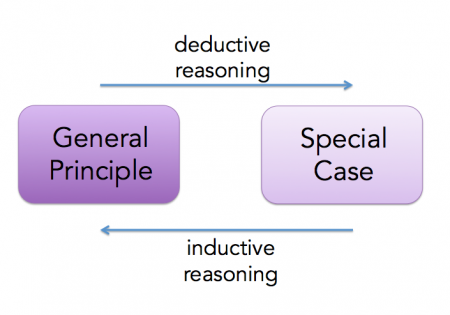
Inductive Reasoning : Generally human knowledge arises from observations and experiences. In the beginning mathematics also arises out of practical applications and it is mostly inductive and intuitive. When the statements or   propositions are based on general observations and experiences, the reasoning is called inductive. From our observation, we can get that some particular properties hold good in the sufficient number of cases and by this we may   conclude that these properties will also hold good in all other similar cases. This type of logical reasoning is called inductive reasoning. Here inductive means that particular theme, theory, rule, formulae is induced from general  experience or observation. Thus, in inductive reasoning we proceed from several particular examples or experiences to a general agreement. In mathematics this type of reasoning is very much used.

Deductive Reasoning : In deductive reasoning, We proceed from general to a specific. This type of reasoning is based on self-evident truth, established facts, postulates is proved with the help of already established general rules. Therefore in deductive  reasoning we proceed from a premise. We make several statements or propositions in our mind. This reasoning consists in comparing the statements and drawing a conclusion therefrom. Thus, here we deduce the solution or proof of a particular problem or statement on the basis of a general premise. In mathematics, the inductive reasoning is useful for beginners but, afterward mostly deductive reasoning is more fruitful. As far as the place of inductive and deductive is concerned, the following saying is good enough to clear it.

Mathematics as Science of Logical Reasoning – Inductive Reasoning and – Deductive Reasoning

“Mathematics in the making is not a deductive science, it is an inductive, experimental science and guessing is the tool of mathematics. Mathematician like all other scientists, formulate their theories from bunches, analogies and simple examples. They are pretty confident that what they are trying to prove is correct, and in writing these, they use only the bull- dozer of logical deduction”.


Whitehead has also emphasized the importance of deductive reasoning in mathematics by saying, “Mathematics  in its widest sense is the development of all types of deductive reasoning

, D’ Alembert  says, “Geometry is a practical logic, because in it the rules of reasoning are applied in the most simple and sensible manner.”

  Pascal says, “Logic has borrowed the rules of geometry. The method of avoiding error is sought by  everyone. The logicians profess to lead the way, the geometers alone reach it, and aside from their science there is no true demonstration.  Geometry is a true demonstration of logic. Mathematics is resources. As a conclusion the term science of teaching stands the only branch of knowledge, in which logical reasoning or for the ways and means provided to or utilized  by a teacher for logical laws are applied and the results can be verified by the managing his task of teaching as smoothly and effectively as method of logical reasoning. possible by involving his least efforts for drawing the  maximum.

Mathematics as Science of Logical Reasoning – Inductive Reasoning and – Deductive Reasoning

W.C.D. Whetham– “Mathematics is nothing but higher development of Symbolic Logic.

C.J. Keyser-  “Symbolic Logic is Mathematics, Mathematics is Symbolic Logic.”

The symbols and methods used in the  investigations of  the foundation of mathematics can be transferred to the study  of logic. They help in the  development and formulation  logical laws. In mathematics the symbol has got a meaning,

e.g., a < b means ‘a’ is less than ‘b’. In logic,  the meaning of this  symbol has been extended. Let ‘a’ denote the class denoted by  the cows and ‘b’ stand for  the class denoted by the animals, then a < b is easily interpreted to mean, “a is included in b”  that is, all cows  are animals.

For another example, take the symbol ‘x’. Let A denote the  class, ‘Teachers’ and B the class,  ‘Ladies.’ AXB may be interpreted to mean the class of persons who are both Teachers and Ladies.  Thus the meanings of mathematical symbols have been  extended to represent the relationship of propositions in logic.
The aims of the mathematician and those of the logician are practically the same.

.Mathematics as Science of Logical Reasoning – Inductive Reasoning and – Deductive Reasoning

Read More 

Practice Exams 


Nature of Mathematics – CTET Pedagogical Issues New and Best No-1

0
Mathematics as Science of Logical Reasoning - Inductive Reasoning and - Deductive Reasoning-

Nature of Mathematics – CTET Pedagogical Issues New and Best s -Logical Thinking – nature of mathematics, nature of mathematics pdf, what is nature of mathematics, nature of mathematics in Telugu, meaning and nature of mathematics, deductive nature of mathematics, 6 nature of mathematics.

Nature of Mathematics - CTET Pedagogical Issues New and Best s -Logical Thinking

Meaning of Mathematics
The term ‘Mathematics’ has been interpreted and explained ‘in various ways. This is due to our empirical knowledge and various types of experiences. But ultimately all types of explanations conclusively end at some kinds of relationship  with number and space. Thus, mathematics deals with quantitative facts and relationships as well as with problems involving space and form. It enables the man to study various phenomena in space and establish different types of relationships between them.

It also deals with relationship between magnitudes of quantitative and qualitative facts. Therefore it may be concluded that mathematics is the enumerative and calculative part of human life and knowledge the person to be given for an exact interpretation.

According to New English Dictionary, “Mathematics, in a strict sense, is the abstract science which investigates deductively the conclusions implicit in the elementary conceptions of spatial and numerical relations.”

According to Webster’s Dictionary, “Mathematics is the science of numbers and their operations, interrelations, combinations, generalizations and abstractions and of space configuration and their structure, measurement, transformations and generalizations.”

In the words of Locke, “Mathematics is a way to settle in the mind a habit of reasoning.”

According to Roger Bacon, “Mathematics is the gate and key of the sciences…


Neglection of mathematics work cause injury to all knowledge, science who is ignorant of it cannot know the other sciences or the things of the world. And what is worse, men who are thus ignorant are unable to perceive
their own ignorance and so do not seek a remedy.” On the basis of above definitions, we can say or conclude that-

(A) Mathematics is the science of magnitude and numbers.

(B) Mathematics is the science of quantity and space.

(C) Mathematics is the important means of generalisation.

(D) Mathematics is an applied science for the expression of other sciences.

(E) Mathematics is the method of progress of various subjects.

(F) Mathematics is the means to draw conclusion and judgement.

(G) Mathematics is the perfection of generalisation.

H. Mathematics is the science of logical reasoning.


Nature of Mathematics

What Mathematics is and how it grows are the basic  questions which all the students of Mathematics must understand. In school, those subjects which are included in the curriculum must have certain aims and objectives on the
basis of which its nature is decided. Mathematics holds a strong  and unbreakable position as compared to other school subjects. With this reason, mathematics is more stable and important than other school subjects. The way in which the structure of a subject because in the same manner. On the basis of this specific structure, the nature of each subject is determined and placed in the school curriculum.
It is not necessary that all subjects have same nature. Mathematics has its unique nature thus on the basis of which we can compare it with other subjects. The basis of comparison of two or more subjects is their nature. We can understand the nature of Mathematics on the basis of following features
1. Mathematics is a science of space, numbers, magnitude and measurement.
2. Mathematics has its own language. Language consists. of mathematical terms, mathematical concepts, formulae, theories, principles and signs, etc.
3. It gives accurate and reliable knowledge.
4. Mathematical knowledge is exact, systematic, logical, and clear so that once it is captured it can never be forgotten.
5. Mathematical rules, laws and formulae, are universal and that can be verified at any place and time.
6. It develops the ability of induction; deduction and generalisation.


7. Mathematics helps in developing scientific attitude among  children.
8. The study of Mathematics gives the training of scientific method to the children.
9. Mathematics is a systematised, organised and exact branch of science.
10. Mathematics is a systematised, organised and exact branch of science.
11. Mathematics involves conversion of abstract concepts into concrete form.
12. Mathematics is the science of logical reasoning.
13. Mathematics does not leave any doubt in the mind of learner about theories, principles, concepts, etc.

Nature of Mathematics -Logical Thinking – nature of mathematics, nature of mathematics pdf, what is nature of mathematics, nature of mathematics in hindi, meaning and nature of mathematics,
deductive nature of mathematics, 6 nature of mathematics.


14. Mathematics helps to develop the habit of self-confidence and self-reliance in children.
15. Mathematics helps in the development of sense of appreciation among children.
16. Mathematical language is well defined, useful and clear.
17. It draws numerical inferences on the basis of given information and data.
18. Mathematical knowledge is applied in the study of science and in its different branches; for example physics, chemistry, biology, and other sciences.
19. It is not only useful for different branches of science but also helps in its progress and organisation.
Thus on the basis of above points we can understand the nature of mathematics and draw conclusion that the structure of mathematics is indeed the basis of its nature and is more strong as compared to other school subjects. That is why its study is essential in school education.

For Practice Exam  ????????????????

For AP Academic Books


Errors and Types of Errors – Inter Physics

0

Errors and Types of Errors - Inter Physics

Errors and Types of Errors – Inter Physics – Error: The result of every measurement by any measuring instrument contains some uncertainty. This uncertainty in measurement is called error.
Mathematically  :
Error = True value – Measured value
Correction =-error

True value means, standard value free of errors. Errors are broadly classified into 3 types :
i) Systematic errors
ii) Random errors
iii) Gross errors

Systematic Errors
The errors due to a definite cause and which follow a particular rule are called systematic errors. They always occur in one direction (either +ve or -ve )
Systematic errors with a constant magnitude are called constant errors.
The constant arised due to imperfect design, zero error in the instrument or any other such defects. These are also called instrumental errors.

Errors and Types of Errors – Inter Physics, Inter 1st year physics Errors and Types of Errors , error correction, error correction, measurement errors

Example for the error due to improper designing and construction.
If a screw gauge has a zero error of -4 head scale divisions, then every reading will be 0.004cm less than the true value.

The error arised due to external conditions like changes in environment, changes in temperature, pressure, humidity etc.
Ex: Due to rise in temperature, a scale gets expanded and this results in error in measurement of length.

Imperfection in Experimental
technique or Procedure: The error due to experimental arrangement,  procedure followed and experimental technique is called imperfection error.
Ex: In calorimetric experiments, the loss of heat due to radiation, the effect on weighing due to buoyancy of air cannot be avoided.

Personal errors or observational errors:
These are entirely due to the personal peculiarities of the experimenter. Individual bias, lack of proper setting of the apparatus, carelessness in taking observations (without taking the required necessary precautions.) etc. are the causes for these type of errors. A person may be habituated to hold his eyes (head) always a bit too far to the right (or left) while taking the reading with a scale. This will give rise to parallax error.
 If a person keeps his eye-level below the level of  mercury in a barometer all the time, his readings will have systematic error.
These errors can be minimised by obtaining several readings carefully and then taking their arithmetic mean.. probable error
Ex: Parallax error

Errors and Types of Errors – Inter Physics,

Inter 1st year physics Errors and Types of Errors , error correction, error correction, measurement errors 

Random Errors:
 They are due to uncontrolled disturbances which influence the physical quantity and the instrument. these errors are estimated by statistical methods.
1.Random no. of observations error
Ex-:The errors due to line voltage changes and backlash error. Backlash errors are due to screw and nut.

Gross Errors
The cause for gross errors are improper recording, neglecting the sources of the error, reading the instrument incorrectly, sheer carelessness
Ex: In a tangent galvanometer experiment, the coil is to be placed exactly in the magnetic meridian and care should be taken to see that no any other magnetic material is present in the vicinity.
– No correction can be applied to these gross errors.
– When the errors are minimized, the accuracy increases. The systematic errors can be estimated and  observations can be corrected.
– Random errors are compensating type. A physical quantity is measured number of times and these values lie on either side of mean value. These errors are estimated by statistical methods and accuracy is achieved.
– Personal errors like parallax error can be avoided by taking proper care.
– The instrumental errors are avoided by calibrating the instrument with a standard reference and by applying proper corrections.

Errors and Types of Errors – Inter Physics, Inter 1st year physics Errors and Types of Errors , error correction, error correction, measurement errors