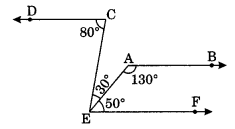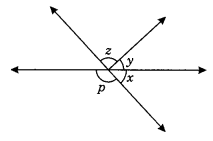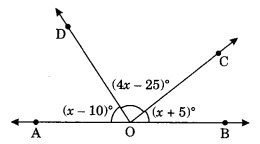
Home Blog Page 8

Class 7 Mathematics – CHAPTER 9 : PERIMETER AND AREA

0

Perimeter and Area

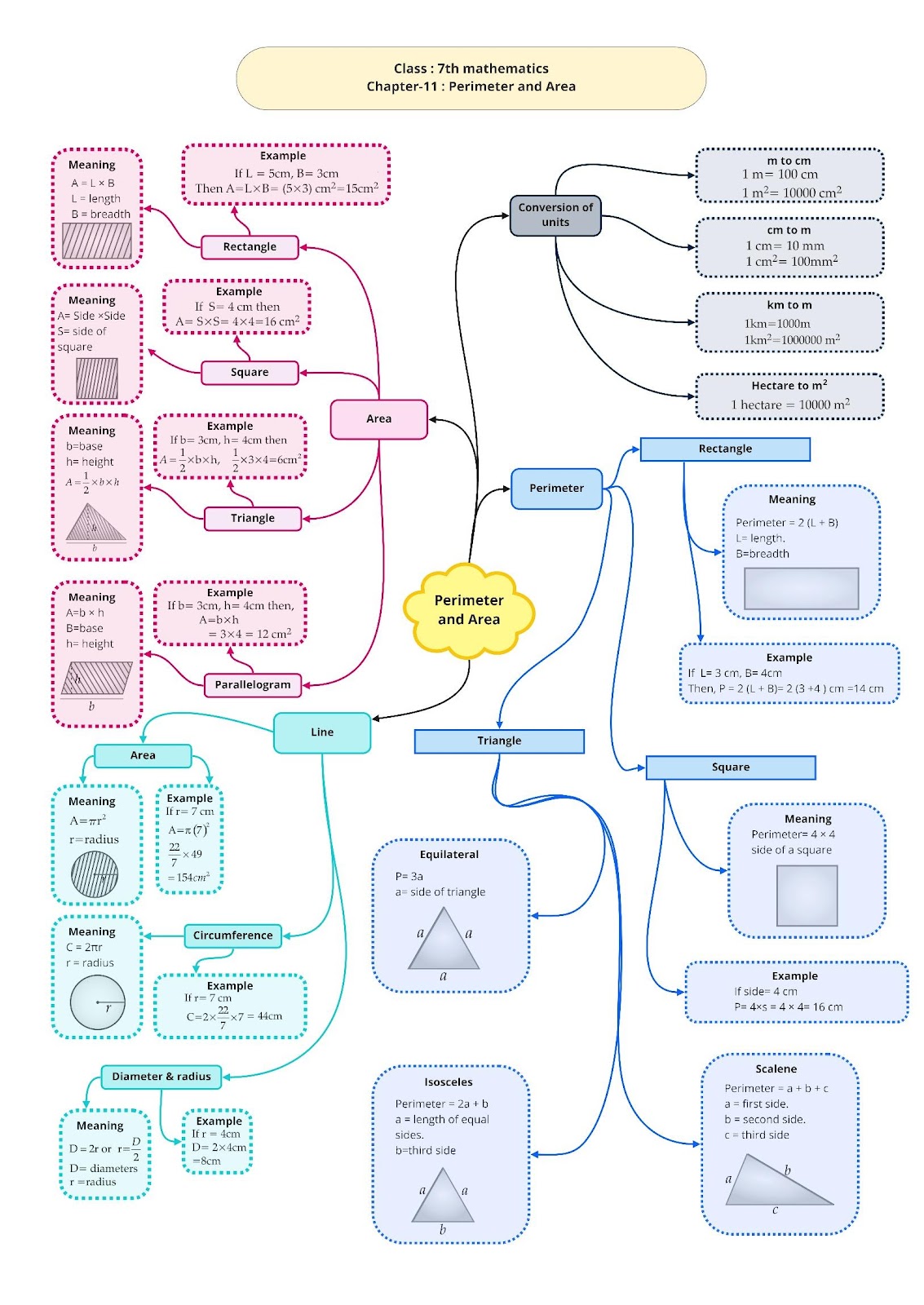
  1. Perimeter is the distance around a closed figure when we go around the figure once. So, perimeter = sum of lengths of all sides.
  2. The measurement of the region enclosed by a plane figure is called the area of the figure.
  3. Perimeter of a rectangle = 2 × (length + breadth)
  4. Perimeter of a square = 4 × (side)
  5. Area of rectangle = (length) × (breadth)
  6. Area of a square = (side)2
  7. Area of parallelogram = base × height
  8. Area of triangle  =12×base×height
  9. The perimeter of a circle is called its circumference. The length of the thread that winds tightly around the circle exactly once gives the circumference of the circle.
  10. Circumference =2πr=πd, where r = radius and d = diameter. Here, (pi) is a constant.
  11. The ratio of the circumference of a circle and its diameter is always constant.
  12. Area of a circle with radius r units is equal to r2 sq. units.
  13. The region enclosed between two concentric circles of different radii is called the area of ring.

Area of path formed =(πR2-πr2) sq units

=π(R2-r2) sq units

=π(R+r)(R-r) sq units

  1. Conversion of units:

1 cm2 = 100 mm2

1 m2 = 10000 cm2

1 dm2 = 100 cm2

1 km2 = 1000000 m2

1 hectare = 10000 m2

Perimeter

Perimeter is the total length or total distance covered along the boundary of a closed shape.

The perimeter of a Quadrilateral
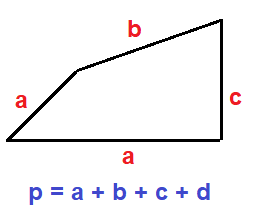
Chart

Description automatically generated

Area

Areas of a closed figure

The area is the total amount of surface enclosed by a closed figureS.

Areas of a closed figure

The perimeter of Square and Rectangle
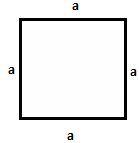
The perimeter of Square and Rectangle

Perimeter of a square = a + a + a + a = 4a, where a is the length of each side.

Square with side length ‘a’ units

Perimeter of a rectangle = l + l + b + b = 2(l + b), where l and b are length and breadth, respectively.
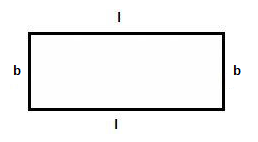
Rectangle with length 'l' units and breadth 'b' units

Rectangle with length ‘l’ units and breadth ‘b’ units

Area of Square & Rectangle

Area of square = 4a2

Here a is the length of each side
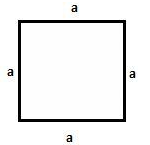
Square with the length of each side 'a' units

Square with the length of each side ‘a’ units

Area of rectangle = Length(l) × Breadth(b) = l × b
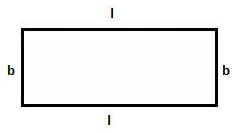
Area of rectangle = Length(l) × Breadth(b) = l×b

Rectangle with length ‘a’ units and breadth ‘b’ units

Area of a Parallelogram
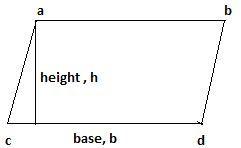
Area of a Parallelogram

Area of parallelogram ABCD = (base × height)

Area of parallelogram ABCD = (b × h)

Triangle as Part of Rectangle

The rectangle can be considered as a combination of two congruent triangles.

Consider a rectangle ABCD, it is divided into 2 triangles ACD and ABD.S
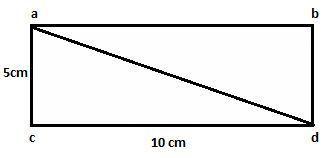
Triangle as Part of Rectangle

Triangles as parts of Rectangle

Area of each triangle = 12 (Area of the rectangle).

= 12(length × breadth)

= 12(10cm × 5cm)

= 25cm2

Area of a Triangle

Consider a parallelogram ABCD.

Draw a diagonal BD to divide the parallelogram into two congruent triangles.
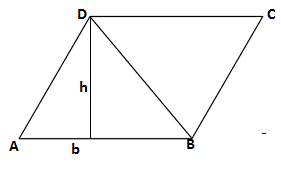
Area of a Triangle

Area of Triangle = 1/2 (base × height)

Area of triangle ABD = 1/2 (Area of parallelogram ABCD)

Area of triangle ABD = 1/2 (b × h)

Conversion of Units

Kilometres, metres, centimetres, millimetres are units of length.

10 millimetres = 1 centimetre

100 centimetres = 1 metre

1000 metres = 1 kilometre

Life of Pi

Terms Related to Circle

  • A circle is a simple closed curve which is not a polygon.
  • A circle is a collection of points which are equidistant from a fixed point.
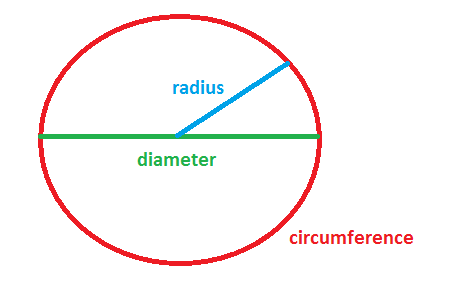
Circle
  • The fixed point in the middle is called the centre.
  • The fixed distance is known as radius.
  • The perimeter of a circle is also called as the circumference of the circle.

Circumference of a Circle

The circumference of a circle (C) is the total path or total distance covered by the circle. It is also called a perimeter of the circle.

Circumference of a circle = 2 × π × r,

where r is the radius of the circle.

Visualising Area of a Circle

Area of Circle

Area of a circle is the total region enclosed by the circle.

Area of a circle = π × r2, where r is the radius of the circle.

Circle Definition

A circle is a closed two-dimensional figure in which the set of all the points in the plane is equidistant from a given point called “centre”. Every line that passes through the circle forms the line of reflection symmetry. Also, it has rotational symmetry around the centre for every angle. The circle formula in the plane is given as:

(x-h)2 + (y-k)2 = r2

where (x, y) are the coordinate points

(h, k) is the coordinate of the centre of a circle

and r is the radius of a circle.

Circle Shaped Objects

There are many objects we have seen in the real world that are circular in shape. Some of the examples are:

  • Ring
  • CD/Disc
  • Bangles
  • Coins
  • Wheels
  • Button
  • Dartboard
  • Hula hoop

We can observe many such examples in our day to day life.

Parts of Circle

A circle has different parts based on the positions and their properties. The different parts of a circle are explained below in detail.

Annulus-The region bounded by two concentric circles. It is basically a ring-shaped object. See the figure below.
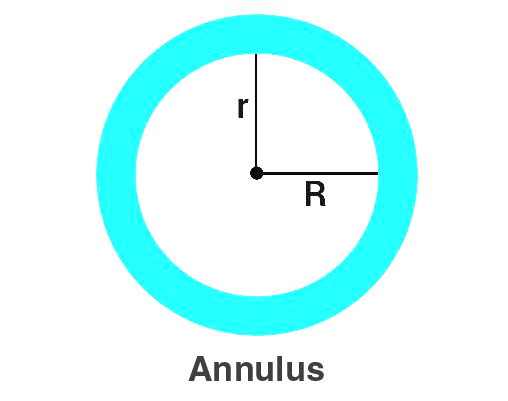
Annulus

Arc – It is basically the connected curve of a circle.

Sector – A region bounded by two radii and an arc.

Segment- A region bounded by a chord and an arc lying between the chord’s endpoints. It is to be noted that segments do not contain the centre.

See the figure below explaining the arc, sector and segment of a circle.
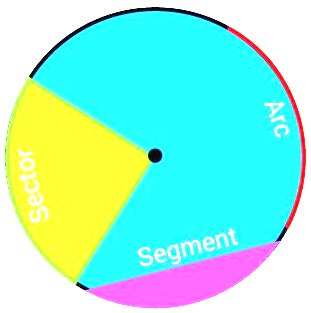
Centre – It is the midpoint of a circle.

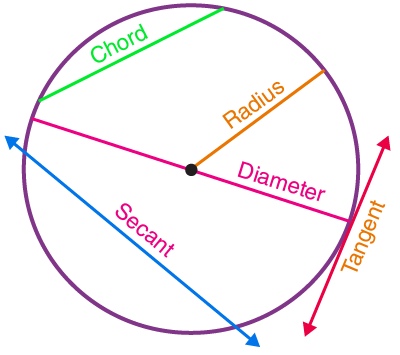
Chord- A line segment whose endpoints lie on the circle.

Diameter- A line segment having both the endpoints on the circle and is the largest chord of the circle.

Radius- A line segment connecting the centre of a circle to any point on the circle itself.

Secant- A straight line cutting the circle at two points. It is also called an extended chord.

Tangent- A coplanar straight line touching the circle at a single point.

See the figure below-representing the centre, chord, diameter, radius, secant and tangent of a circle.
Introduction and Value of Pi

Pi (π) is the constant which is defined as the ratio of a circle’s circumference (2πr) to its diameter(2r).

π= Circumference (2πr)/Diameter (2r)

The value of pi is approximately equal to 3.14159 or 22/7.

Problem Solving

Cost of Framing, Fencing

  • Cost of framing or fencing a land is calculated by finding its perimeter.
  • Example: A square-shaped land has length of its side 10m.

Perimeter of the land = 4 × 10 = 40m

Cost of fencing 1m = Rs 10

Cost of fencing the land = 40 m × Rs 10 = Rs 400

Cost of Painting, Laminating

  • Cost of painting a surface depends on the area of the surface.
  • Example: A wall has dimensions 5m×4m.

Area of the wall = 5m × 4m = 20m2

Cost of painting 1m2 of area is Rs 20.

Cost of painting the wall = 20m2 × Rs 20 = Rs 400

Area of Mixed Shapes

Find the area of the shaded portion using the given information.
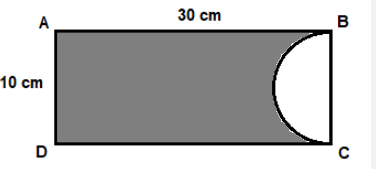
Area of Mixed Shapes

Area of the shaded portion

Solution: Diameter of the semicircle = 10cm

Radius of semicircle = 5cm

Area of the shaded portion = Area of rectangle ABCD – Area of semicircle

Area of the shaded portion = (l × b) − (πr2/2)

= 30×10 − (π × 52/2)

= 300 − (π × 25/2)

= (600 – 25π)/2

= (600 – 78.5)/2

= 260.7 cm2
Important Questions

Multiple Choice Questions-

Question 1. Perimeter of a square =

(a) side × side

(b) 3 × side

(c) 4 × side

(d) 2 × side

Question 2. Perimeter of a rectangle of length Z and breadth 6 is

(a) l + b

(b) 2 × (l + b)

(c) 3 × (l + b)

(d) l × b

Question 3. Area of a square =

(a) side × side

(b) 2 × side

(c) 3 × side

(d) 4 × side

Question 4. Area of a rectangle of length l and breadth b is

(a) l × b

(b) l + b

(c) 2 × (l + b)

(d) 6 × (l + b)

Question 5. Area of a parallelogram =

(а) base × height

(b) 12  × base × height

(c) 13 × base × height

(d) 14 × base × height

Question 6. Area of a triangle =

(а) base × height

(b) 12   × base × height

(c) 13 × base × height

(d) 14  × base × height

Question 7. The circumference of a circle of radius r is

(a) πr

(b) 2πr

(c) πr2

(d) 14  πr2

Question 8. The circumference of a circle of diameter d is

(a) πd

(b) 2πd

(c) 12 πd

(d) πd2

Question 9. If r and d are the radius and diameter of a circle respectively, then

(a) d = 2 r

(b) d = r

(C) d = 12  r

(d) d = r2

Question 10. The area of a circle of radius r is

(a) πr2

(b) 2πr2

(c) 2πr

(d) 4πr2

Question 11. The area of a circle of diameter d is

(a) πd2

(b) 2πd2

(c) 14 πd2

(d) 2πd

Question 12. 1 cm2 =

(a) 10 mm2

(b) 100 mm2

(c) 1000 mm2

(d) 10000 mm2

Question 13. 1 m2 =

(a) 10 cm2

(b) 100 cm2

(c) 1000 cm2

(d) 10000 cm2

Question 14. 1 hectare =

(a) 10 m2

(b) 100 m2

(c) 1000 m2

(d) 10000 m2

Question 15. 1 are =

(a) 10 m2

(b) 100 m2

(c) 1000 m2

(d) 10000 m2

Very Short Questions:

  1. The side of a square is 2.5 cm. Find its perimeter and area.
  2. If the perimeter of a square is 24 cm. Find its area.
  3. If the length and breadth of a rectangle are 36 cm and 24 cm respectively. Find

(i) Perimeter

(ii) Area of the rectangle.

  1. The perimeter of a rectangular field is 240 m. If its length is 90 m, find:

(i) it’s breadth

(ii) it’s are

  1. The length and breadth of a rectangular field are equal to 600 m and 400 m respectively. Find the cost of the grass to be planted in it at the rate of ₹ 2.50 per m2.
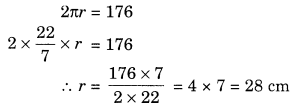
  2. The perimeter of a circle is 176 cm, find its radius.
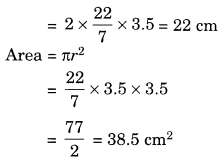
  3. The radius of a circle is 3.5 cm, find its circumference and area.
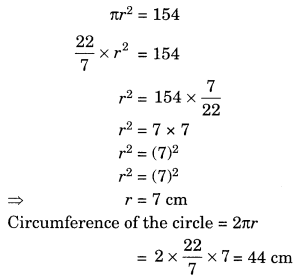
  4. Area of a circle is 154 cm2, find its circumference.
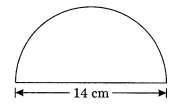
  5. Find the perimeter of the figure given below.
Perimeter and Area Class 7 Extra Questions Maths Chapter 11 Q9
  1. The length of the diagonal of a square is 50 cm, find the perimeter of the square.
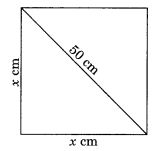
Perimeter and Area Class 7 Extra Questions Maths Chapter 11 Q10

Short Questions:

  1. A wire of length 176 cm is first bent into a square and then into a circle. Which one will have more area?
  2. In the given figure, find the area of the shaded portion.
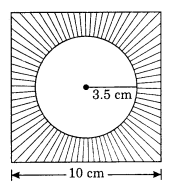
Perimeter and Area Class 7 Extra Questions Maths Chapter 11 Q12
  1. Find the area of the shaded portion in the figure given below.
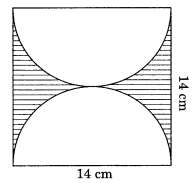
Perimeter and Area Class 7 Extra Questions Maths Chapter 11 Q13
  1. A rectangle park is 45 m long and 30 m wide. A path 2.5 m wide is constructed outside the park. Find the area of the path.
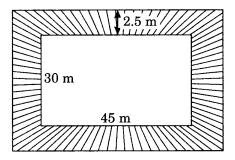
Perimeter and Area Class 7 Extra Questions Maths Chapter 11 Q14
  1. In the given figure, calculate:

(а) the area of the whole figure.

(b) the total length of the boundary of the field.
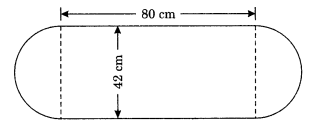
Perimeter and Area Class 7 Extra Questions Maths Chapter 11 Q15
  1. How many times a wheel of radius 28 cm must rotate to cover a distance of 352 m? (Take π =227)

Long Questions:

  1. A nursery school playground is 160 m long and 80 m wide. In it 80 m × 80 m is kept for swings and in the remaining portion, there are 1.5 m wide path parallel to its width and parallel to its remaining length as shown in Figure. The remaining area is covered by grass. Find the area covered by grass.
Perimeter and Area Class 7 Extra Questions Maths Chapter 11 Q17
  1. Rectangle ABCD is formed in a circle as shown in Figure. If AE = 8 cm and AD = 5 cm, find the perimeter of the rectangle.
  2. Find the area of a parallelogram-shaped shaded region. Also, find the area of each triangle. What is the ratio of the area of shaded portion to the remaining area of the rectangle?
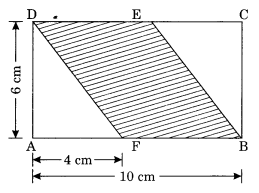
Perimeter and Area Class 7 Extra Questions Maths Chapter 11 Q19
  1. A rectangular piece of dimension 3 cm × 2 cm was cut from a rectangular sheet of paper of dimensions 6 cm × 5 cm. Find the ratio of the areas of the two rectangles.
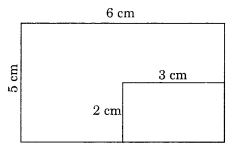
Perimeter and Area Class 7 Extra Questions Maths Chapter 11 Q20
  1. In the given figure, ABCD is a square of side 14 cm. Find the area of the shaded region. (Take π=227)
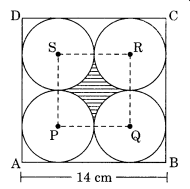
Perimeter and Area Class 7 Extra Questions Maths Chapter 11 Q21
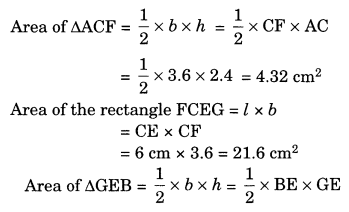
  1. Find the area of the following polygon if AB = 12 cm, AC = 2.4 cm, CE = 6 cm, AD = 4.8 cm, CF = GE = 3.6 cm, DH = 2.4 cm.
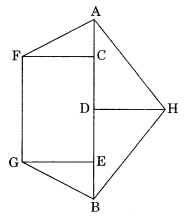
Perimeter and Area Class 7 Extra Questions Maths Chapter 11 Q22

Answer Key-

Multiple Choice questions-

  1. (c) 4 × side
  2. (b) 2 × (l + b)
  3. (a) side × side
  4. (a) l × b
  5. (а) base × height
  6. (b) 12    × base × height
  7. (b) 2πr
  8. (a) πd
  9. (a) d = 2 r
  10. (a) πr2
  11. (c) 14 πd2
  12. (b) 100 mm2
  13. (d) 10000 cm2
  14. (d) 10000 m2
  15. (b) 100 m2

Very Short Answer:

  1. Side of the square = 2.5 cm

Perimeter = 4 × Side = 4 × 2.5 = 10 cm

Area = (side)2 = (4)2 = 16 cm2

  1. Perimeter of the square = 24 cm

Side of the square =244cm = 6 cm

Area of the square = (Side)2 = (6)2 cm2 = 36 cm2

  1. Length = 36 cm, Breadth = 24 cm

(i) Perimeter = 2(l + b) = 2(36 + 24) = 2 × 60 = 120 cm

(ii) Area of the rectangle = l × b = 36 cm × 24 cm = 864 cm2

  1. (i) Perimeter of the rectangular field = 240 m

2(l + b) = 240 m

l + b = 120 m

90 m + b = 120 m

b = 120 m – 90 m = 30 m

So, the breadth = 30 m.

(ii) Area of the rectangular field = l × b = 90 m × 30 m = 2700 m2

So, the required area = 2700 m2

  1. Length = 600 m, Breadth = 400 m

Area of the field = l × b = 600 m × 400 m = 240000 m2

Cost of planting the grass = ₹ 2.50 × 240000 = ₹ 6,00,000

Hence, the required cost = ₹ 6,00,000.

  1. The perimeter of the circle = 176 cm
Perimeter and Area Class 7 Extra Questions Maths Chapter 11 Q6
  1. Radius = 3.5 cm

Circumference = 2πr

Perimeter and Area Class 7 Extra Questions Maths Chapter 11 Q7
  1. Area of the circle = 154 cm2
Perimeter and Area Class 7 Extra Questions Maths Chapter 11 Q8
  1. Perimeter of the given figure = Circumference of the semicircle + diameter

= πr + 2r

=227× 7 + 2 × 7

= 22 + 14

= 36 cm

Hence, the required perimeter = 36 cm.

  1. Let each side of the square be x cm.

x2 + x2 = (50)2 [Using Pythagoras Theorem]

2x2 = 2500

x2 = 1250
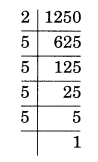
Perimeter and Area Class 7 Extra Questions Maths Chapter 11 Q10.1

x = 5 × 5 × √2 = 25√2

The side of the square = 25√2 cm

Perimeter of the square = 4 × side = 4 × 25√2 = 100√2 cm

Short Answer:

  1. Length of the wire = 176 cm

Side of the square = 176 ÷ 4 cm = 44 cm

Area of the square = (Side)2 = (44)2 cm2 = 1936 cm2

Circumference of the circle = 176 cm
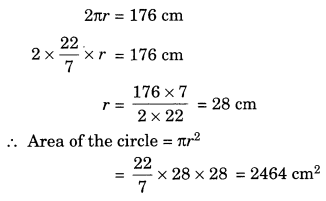
Perimeter and Area Class 7 Extra Questions Maths Chapter 11 Q11

Since 2464 cm2 > 1936 cm2

Hence, the circle will have more area.

  1. Area of the square = (Side)2 = 10 cm × 10 cm = 100 cm2

Area of the circle = πr2

= 227 × 3.5 × 3.5

= 772 cm2

= 38.5 cm2

Area of the shaded portion = 100 cm2 – 38.5 cm2 = 61.5 cm2

  1. Area of the rectangle = l × b = 14 cm × 14 cm = 196 cm2

Radius of the semicircle =142= 7 cm

Area of two equal semicircle = 2 ×12r2

= πr2

= 227  × 7 × 7

= 154 cm2

Area of the shaded portion = 196 cm2 – 154 cm2 = 42 cm2

  1. Length of the rectangular park = 45 m

Breadth of the park = 30 m

Area of the park = l × 6 = 45m × 30m = 1350 m2

Length of the park including the path = 45 m + 2 × 2.5 m = 50 m

Breadth of the park including the path = 30 m + 2 × 2.5 m = 30m + 5m = 35m

Area of the park including the path = 50 m × 35 m = 1750 m2

Area of the path = 1750 m2 – 1350 m2 = 400 m2

Hence, the required area = 400 m2.

  1. Area of the rectangular portions = l × b = 80 cm × 42 cm = 3360 cm2

Area of two semicircles = 2 ×12r2= πr2

=227× 21 × 21

= 22 × 3 × 21

= 1386 cm2

Total area = 3360 cm2 + 1386 cm2 = 4746 cm2

Total length of the boundary of field = (2 × 80 + πr + πr) cm

= (160 +227 × 21 +227 × 21)

= (160 + 132) cm

= 292 cm

Hence, the required (i) area = 4746 cm2 and (ii) length of boundary = 292 cm.

  1. Radius of the wheel = 28 cm

Circumference = 2πr = 2 ×227× 28 = 176 cm

Distance to be covered = 352 m or 352 × 100 = 35200 m

Number of rotation made by the wheel to cover the given distance =35200176= 200

Hence, the required number of rotations = 200.

Long Answer:

  1. Area of the playground = l × b = 160 m × 80 m = 12800 m2

Area left for swings = l × b = 80m × 80m = 6400 m2

Area of the remaining portion = 12800 m2 – 6400 m2 = 6400 m2

Area of the vertical road = 80 m × 1.5 m = 120 m2

Area of the horizontal road = 80 m × 1.5 m = 120 m2

Area of the common portion = 1.5 × 1.5 = 2.25 m2

Area of the two roads = 120 m2 + 120 m2 – 2.25 m2 = (240 – 2.25) m2 = 237.75 m2

Area of the portion to be planted by grass = 6400 m2 – 237.75 m2 = 6162.25 m2

Hence, the required area = 6162.25 m2.

  1. DE (Radius) = AE + AD = 8 cm + 5 cm = 13 cm

DB = AC = 13 cm (Diagonal of a rectangle are equal)

In right ∆ADC,

AD2 + DC2 = AC2 (By Pythagoras Theorem)

⇒ (5)2 + DC2 = (13)2

⇒ 25 + DC2 = 169

⇒ DC2 = 169 – 25 = 144

⇒ DC = √144 = 12 cm

Perimeter of rectangle ABCD = 2(AD + DC)

= 2(5 cm + 12 cm)

= 2 × 17 cm

= 34 cm

  1. Here, AB = 10 cm

AF = 4 cm

FB = 10 cm – 4 cm = 6 cm

Area of the parallelogram = Base × Height = FB × AD = 6 cm × 6 cm = 36 cm2

Hence, the required area of shaded region = 36 cm2.

Area ∆DEF = 12  × b × h

= 12  × AF × AD

= 12 × 4 × 6

= 12 cm2

Area ∆BEC = 12 × b × h

= 12 × GC × BC

= 12 × 4 × 6

= 12 cm2

Area of Rectangle ABCD = l × b = 10 cm × 6 cm = 60 cm2

Remaining area of Rectangle = 60 cm2 – 36 cm2 = 24 cm2

Required Ratio = 36 : 24 = 3 : 2

  1. Length of the rectangular piece = 6 cm

Breadth = 5 cm

Area of the sheet = l × b = 6 cm × 5 cm = 30 cm2

Area of the smaller rectangular piece = 3 cm × 2 cm = 6 cm2

Ratio of areas of two rectangles = 30 cm2 : 6 cm2 = 5 : 1

  1. PQ = 12 AB = 12 × 14 = 7 cm

PQRS is a square with each side 7 cm

Radius of each circle =72 cm

Area of the quadrants of each circle =14× πr2

Area of the four quadrants of all circles
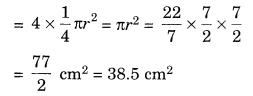
Perimeter and Area Class 7 Extra Questions Maths Chapter 11 Q21.1

Area of the square PQRS = Side × Side = 7 cm × 7 cm = 49 cm2

Area of the shaded portion = 49 cm2 – 38.5 cm2 = 10.5 cm2

Hence, the required area = 10.5 cm2.

  1. BE = AB – AE

= 12 cm – (AC + CE)

= 12 cm – (2.4 cm + 6 cm)

= 12 cm – 8.4 cm

= 3.6 cm
Perimeter and Area Class 7 Extra Questions Maths Chapter 11 Q22.2
Perimeter and Area Class 7 Extra Questions Maths Chapter 11 Q22.1
Perimeter and Area Class 7 Extra Questions Maths Chapter 11 Q22.2

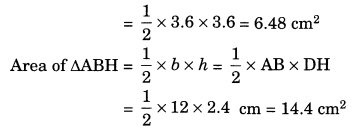
Area of the polygon AFGBH = Area of ∆ACF + Area of rectangle FCEG + Area of ∆GEB + Area of ∆ABH

= 3.6 cm2 + 4.32 cm2 + 21.6 cm2 + 6.48 cm2 + 14.4 cm2

= 50.40 cm2

Hence, the required area = 50.40 cm2.

Class 7 Mathematics – CHAPTER 8 : RATIONAL NUMBERS

0

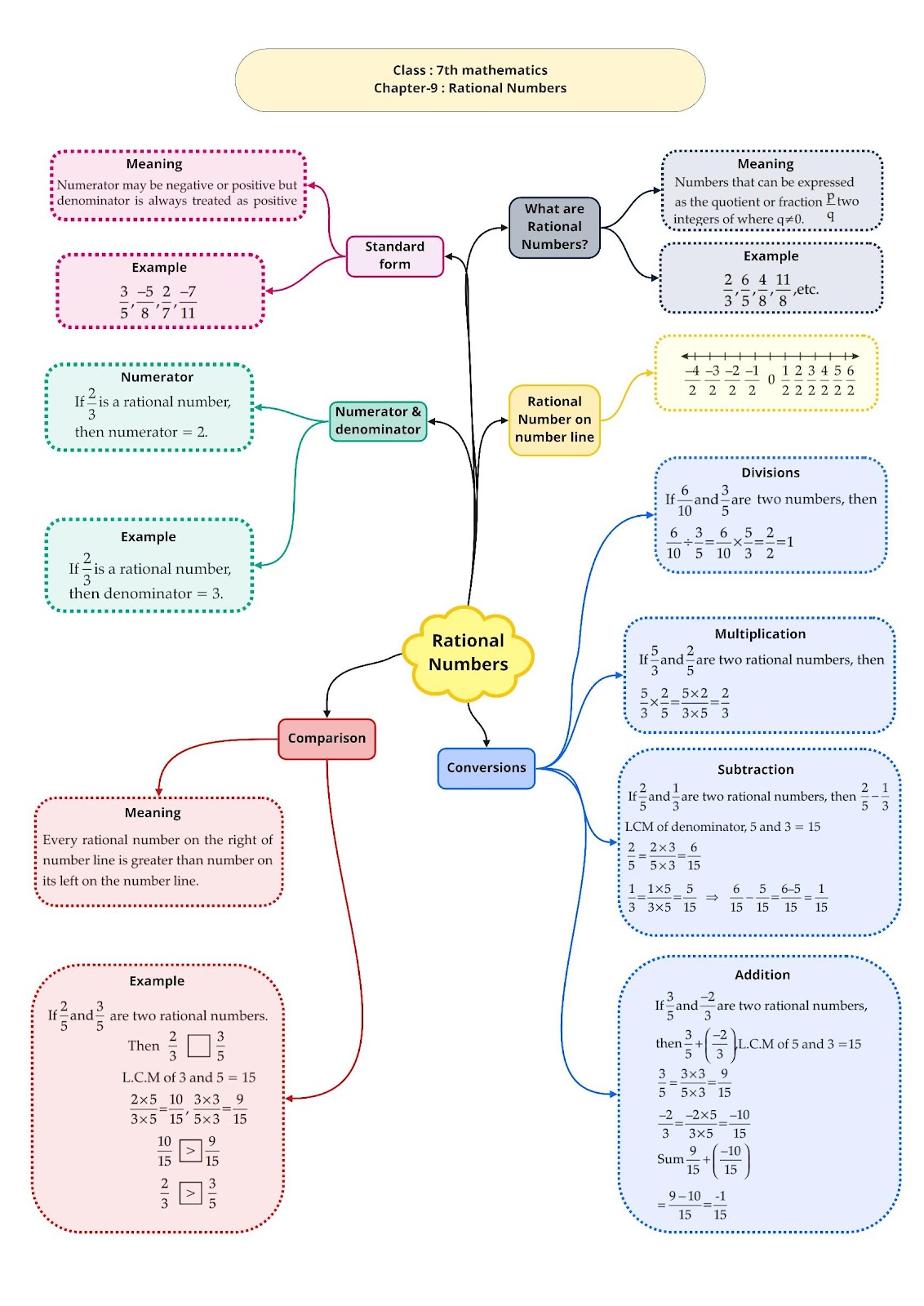
Rational Numbers

  1. The numbers of the form xv, where x and y are natural numbers, are known as fractions.
  2. A number of the form pq[q 0], where p and q are integers, is called a rational number.
  3. Every integer is a rational number and every fraction is a rational number.
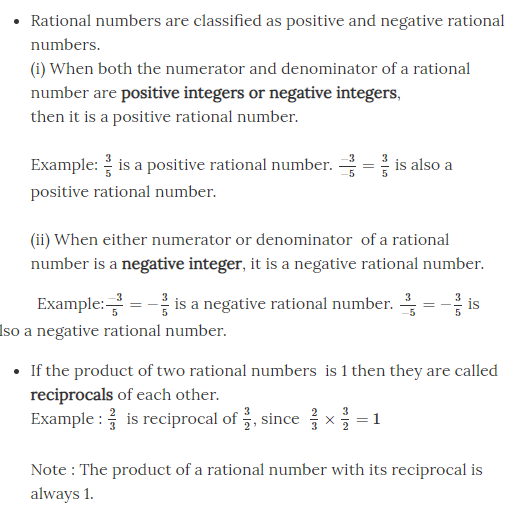
  4. A rational number pq is positive if p and q are either both positive or both negative.
  5. A rational number pq is negative if one of p and q is positive and the other one is negative.
  6. Every positive rational number is greater than 0. 
  7. Every negative rational number is less than 0.
  8. If pq is a rational number and ‘m’ is a non-zero integer, then pqpmqm. Here, pqand pmqm are known as equivalent rational numbers.
  9. If pq is a rational number and ‘m’ is a common divisor of p and q, then pqpmqm. Here, pqand pmqm are known as equivalent rational numbers.
  10. Two rational numbers are equivalent only when the product of numerator of the first and the denominator of the second is equal to the product of the denominator of the first and the numerator of the second.
  11. A rational number pq is said to be in standard form if q is positive and the integers p and q have no common divisors other than 1.
  12. If there are two rational numbers with a common denominator then the one with the larger numerator is greater than the other.
  13. Rational numbers with different denominators can be compared by first making their denominators same and then comparing their numerators.
  14. There are infinite rational numbers between two rational numbers.
  15. Two rational numbers with the same denominator can be added by adding their numerators, keeping the denominator same.

pqrq [pr]q

  1. Two rational numbers with different denominators are added by first taking the LCM of the two denominators and converting both the rational numbers to their equivalent forms having the LCM as the denominator.
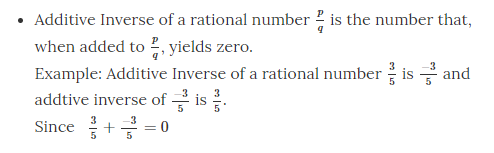
  2. While subtracting two rational numbers, we add the additive inverse of the rational number to be subtracted to the other rational number.

pq rs pq (additive inverse of rs)

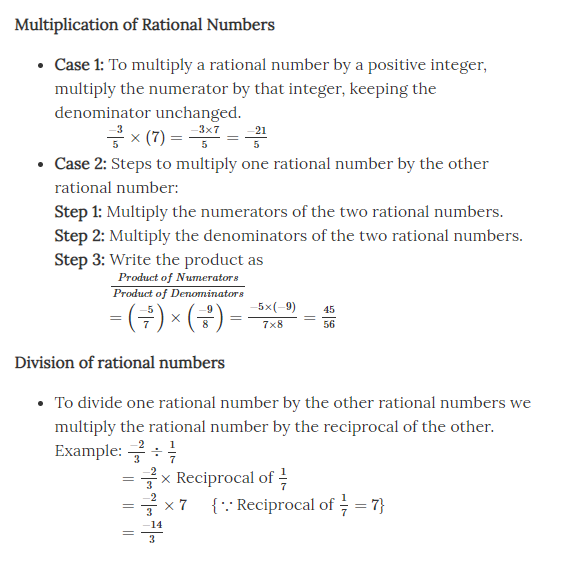
  1. To multiply two rational numbers, we multiply their numerators and denominators separately, and write the product as product of numeratorsproduct of denominators
  2. Reciprocal of pq is qp.
  3. To divide one rational number by the other non-zero rational number, we multiply the first rational number by the reciprocal of the other.

Rational Numbers

A rational number is defined as a number that can be expressed in the form

pq

 , where p and q are integers and q≠0.

In our daily lives, we use some quantities which are not whole numbers but can be expressed in the form of

pq

Hence, we need rational numbers.

Equivalent Rational Numbers

By multiplying or dividing the numerator and denominator of a rational number by a same non zero integer, we obtain another rational number equivalent to the given rational number. These are called equivalent fractions.

Rational Numbers in Standard Form

A rational number is said to be in the standard form if its denominator is a positive integer and the numerator and denominator have no common factor other than 1.

Example: Reduce

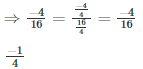
Here, the H.C.F. of 4 and 16 is 4.

Graphical user interface

Description automatically generated with medium confidence

is the standard form of

LCM

The least common multiple (LCM) of two numbers is the smallest number (≠0) that is a multiple of both.

Example: LCM of 3 and 4 can be calculated as shown below:

Multiples of 3: 0, 3, 6, 9, 12, 15

Multiples of 4: 0, 4, 8, 12, 16

LCM of 3 and 4 is 12.

Rational Numbers between Two Rational Numbers

There are unlimited number (infinite number) of rational numbers between any two rational numbers.

Example: List some of the rational numbers between −35 and −13.

Solution: L.C.M. of 5 and 3 is 15.

⇒ The given equations can be written as

⇒ −615, −715, −815 are the rational numbers between −35 and −13.

Note: These are only few of the rational numbers between −35 and −13. There are infinte number of rational numbers between them. Following the same procedure, many more rational numbers can be inserted between them.

Properties of Rational Numbers

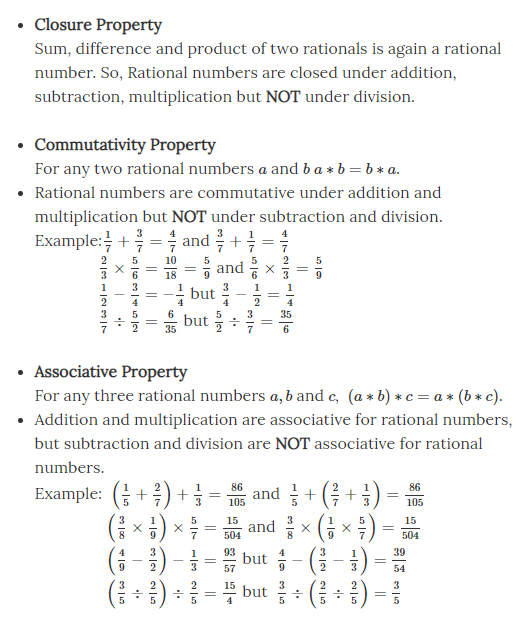
Properties of Rational Number

Addition of Rational Numbers

Addition of Rational Numbers

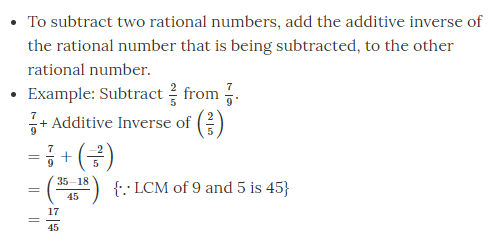
Subtraction of Rational Numbers

Subtraction of Rational Numbers

Multiplication and Division of Rational Numbers

Multiplication and Divison of Rational Numbers

Negatives and Reciprocals

Negatives and Reciprocals

Additive Inverse of a Rational Number

Additive Inverse

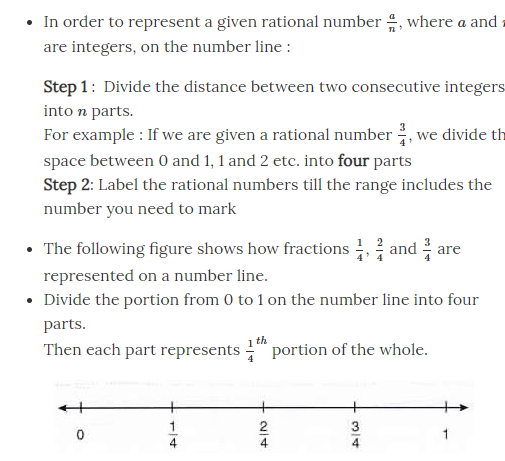
Rational Numbers on a Number Line

Rational Numbers on a Number Line

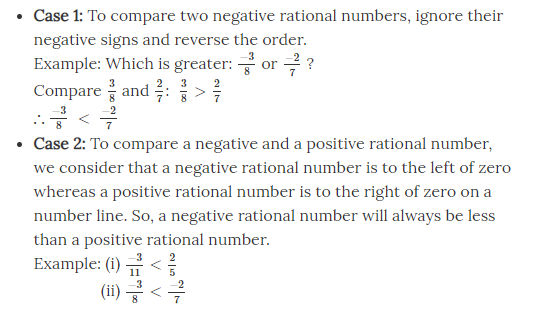
Comparison of Rational Numbers

Comparison of Rational Numbers

Important Questions

Multiple Choice Questions:

Question 1. The numerator of the rational number 1100 is

(a) 100

(b) 1

(c) 10

(d) 99

Question 2. The denominator of the rational number 47 is

(a) 7

(b) 4

(c) 3

(d) 11

Question 3. The denominator of the rational number 713 is

(a) 13

(b) 7

(c) 6

(d) 91

Question 4. The numerator of the rational number -34 is

(a) -3

(b) 3

(c) 4

(d) -4

Question 5. The numerator of the rational number −29 is

(a) -2

(b) 2

(c) -9

(d) 9

Question 6. The denominator of the rational number 5-3 is

(a) 5

(b) -3

(c) 3

(d) 8

Question 7. The denominator of the rational number 3-7 is

(a) 7

(b) -7

(c) 3

(d) -3

Question 8. The numerator of the rational number -2-5  is

(a) 2

(b) -2

(c) 5

(d) -5

Question 9. the numerator of the rational number -5-3 is

(a) -5

(b) 5

(c) -3

(d) 3

Question 10. The denominator of the rational number -2-9 is

(a) -2

(b) 2

(c) 9

(d) -9

Question 11. The denominator of the rational number -6-5 is

(a) 6

(b) -6

(c) 5

(d) -5

Question 12. The denominator of the rational number -13-11 is

(a) -13

(b) 13

(c) 11

(d) -11

Question 13. The numerator of the rational number 0 is

(a) 0

(b) 1

(c) 2

(d) 3

Question 14. The denominator of the rational number 0 is

(a) 0

(b) 1

(c) -1

(d) any non-zero integer

Question 15. The numerator of a rational number 8 is

(a) 2

(b) 4

(c) 6

(d) 8

Very Short Questions:

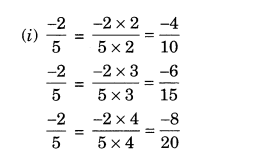
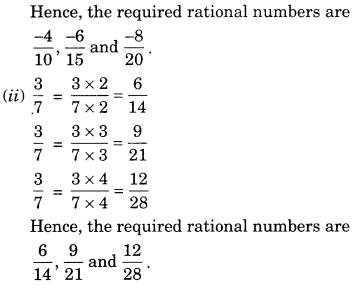
  1. Find three rational numbers equivalent to each of the following rational numbers.

(i) -25

(ii) 37

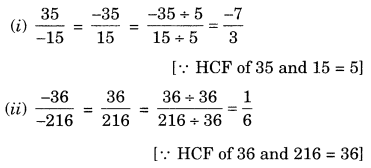
  1. Reduce the following rational numbers in standard form.

(i) 35-15

(ii) -36-216

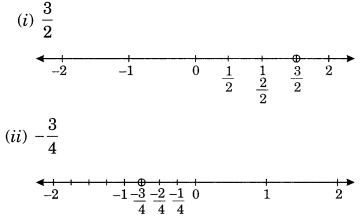
  1. Represent 32 and -34 on number lines.
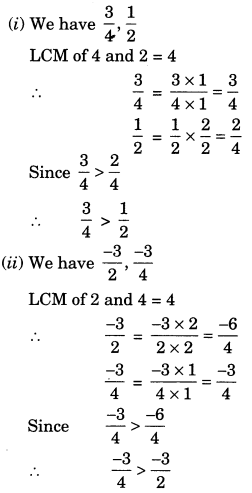
  2. Which of the following rational numbers is greater?

(i) 34,12

(ii) -32, -34

  1. Find the sum of
Rational Numbers Class 7 Extra Questions Maths Chapter 9 Q5
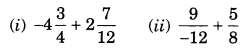
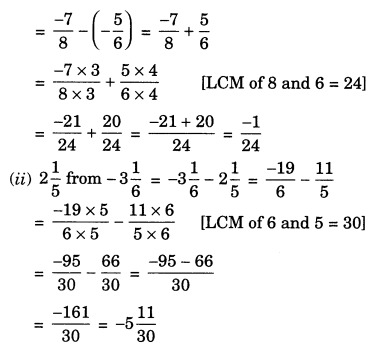
  1. Subtract:
Rational Numbers Class 7 Extra Questions Maths Chapter 9 Q6

Short Questions:

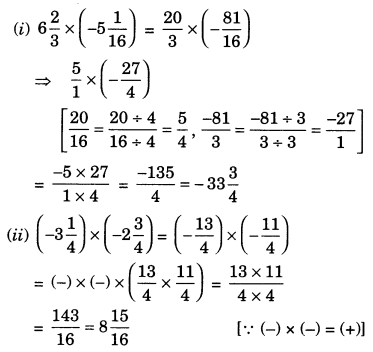
  1. Find the product:
Rational Numbers Class 7 Extra Questions Maths Chapter 9 Q7
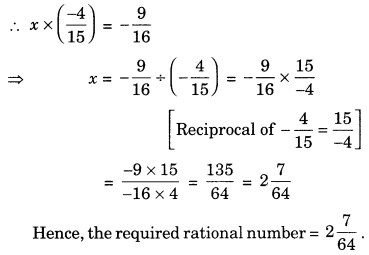
  1. If the product of two rational numbers is -916 and one of them is -415, find the other number.
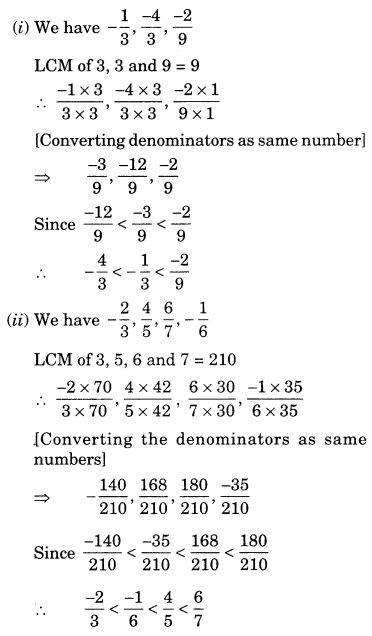
  2. Arrange the following rational numbers in ascending order.
Rational Numbers Class 7 Extra Questions Maths Chapter 9 Q9
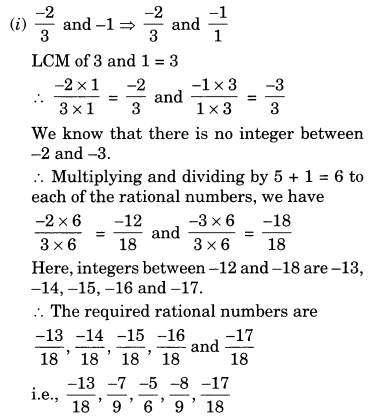
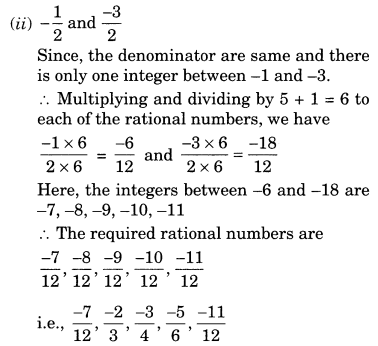
  1. Insert five rational numbers between:
Rational Numbers Class 7 Extra Questions Maths Chapter 9 Q10
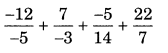
  1. Evaluate the following:
Rational Numbers Class 7 Extra Questions Maths Chapter 9 Q11
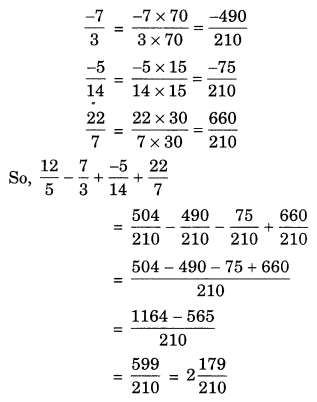
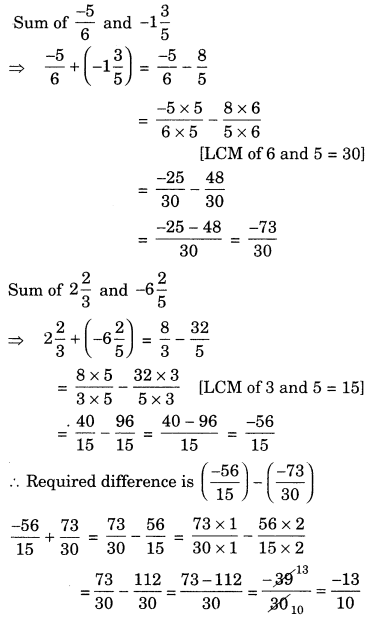
  1. Subtract the sum of -56 and -135 from the sum 223 and -625.

Long Questions:

Rational Numbers Class 7 Extra Questions Maths Chapter 9 Q13
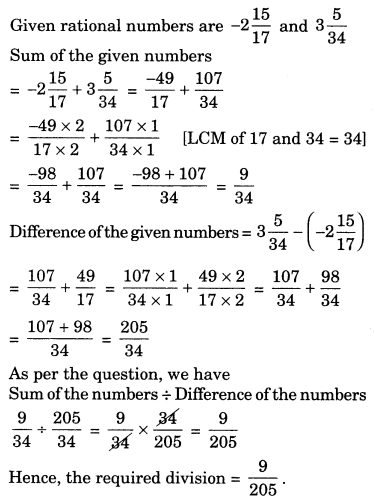
  1. Divide the sum of -21517 and 3534 by their difference.
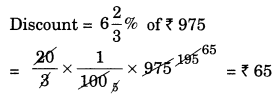
  2. During a festival sale, the cost of an object is ₹ 870 on which 20% is off. The same object is available at other shops for ₹ 975 with a discount of 623 %. Which is a better deal and by how much?
  3. Simplify:

21.5 ÷ 5 –15of 20.5 – 5.5+ 0.5 × 8.5

  1. Simplify:
Rational Numbers Class 7 Extra Questions Maths Chapter 9 Q17
Rational Numbers Class 7 Extra Questions Maths Chapter 9 Q18

ANSWER KEY –

Multiple Choice Questions:

  1. (b) 1
  2. (a) 7
  3. (a) 13
  4. (a) -3
  5. (a) -2
  6. (b) -3
  7. (b) -7
  8. (b) -2
  9. (a) -5
  10. (d) -9
  11. (d) -5
  12. (d) -11
  13. (a) 0
  14. (d) -1
  15. (d) 8

Very Short Answer:

Calendar

Description automatically generated
Table

Description automatically generated
Rational Numbers Class 7 Extra Questions Maths Chapter 9 Q2
A picture containing text, antenna

Description automatically generated
Rational Numbers Class 7 Extra Questions Maths Chapter 9 Q4
  1. Find the sum of
Rational Numbers Class 7 Extra Questions Maths Chapter 9 Q5
Rational Numbers Class 7 Extra Questions Maths Chapter 9 Q6.2

Short Answer:

Rational Numbers Class 7 Extra Questions Maths Chapter 9 Q7.1
  1. Let the required rational number be x.
Rational Numbers Class 7 Extra Questions Maths Chapter 9 Q8
Rational Numbers Class 7 Extra Questions Maths Chapter 9 Q9.1
Rational Numbers Class 7 Extra Questions Maths Chapter 9 Q10.1
Rational Numbers Class 7 Extra Questions Maths Chapter 9 Q10.2
Rational Numbers Class 7 Extra Questions Maths Chapter 9 Q11.1
Rational Numbers Class 7 Extra Questions Maths Chapter 9 Q11.2
Rational Numbers Class 7 Extra Questions Maths Chapter 9 Q12

Long Answer:

  1. We have
Rational Numbers Class 7 Extra Questions Maths Chapter 9 Q13.1
Rational Numbers Class 7 Extra Questions Maths Chapter 9 Q14
  1. The cost of the object = ₹ 870

Discount = 20% of ₹ 870 =20100 × 870 = ₹ 174

Selling price = ₹ 870 – ₹ 174 = ₹ 696

The same object is available at other shop = ₹ 975

Rational Numbers Class 7 Extra Questions Maths Chapter 9 Q15

Selling price = ₹ 975 – ₹ 65 = ₹ 910

Since ₹ 910 > ₹ 696

Hence, deal at first shop is better and by ₹ 910 – ₹ 696 = ₹ 214

  1. Using BODMAS rule, we have

21.5 ÷ 5 – 15 of (20.5 – 5.5) + 0.5 × 8.5

= 21.5 ÷ 5 – 15 of 15 + 0.5 × 8.5

= 21.5 × 15 – 15 × 15 + 0.5 × 8.5

= 4.3 – 3 + 4.25

= 4.3 + 4.25 – 3

= 8.55 – 3

= 5.55

  1. Using BODMAS rule, we have

2.3 – [1.89 – {3.6 – (2.7 – 0.77)}]

= 2.3 – [1.89 – {3.6 – 1.93}]

= 2.3 – [1.89 – 1.67]

= 2.3 – 0.22

= 2.08

  1. Using BODMAS rule, we have
Rational Numbers Class 7 Extra Questions Maths Chapter 9 Q18.1

Class 7 Mathematics – CHAPTER 7 : COMPARING QUANTITIES

0

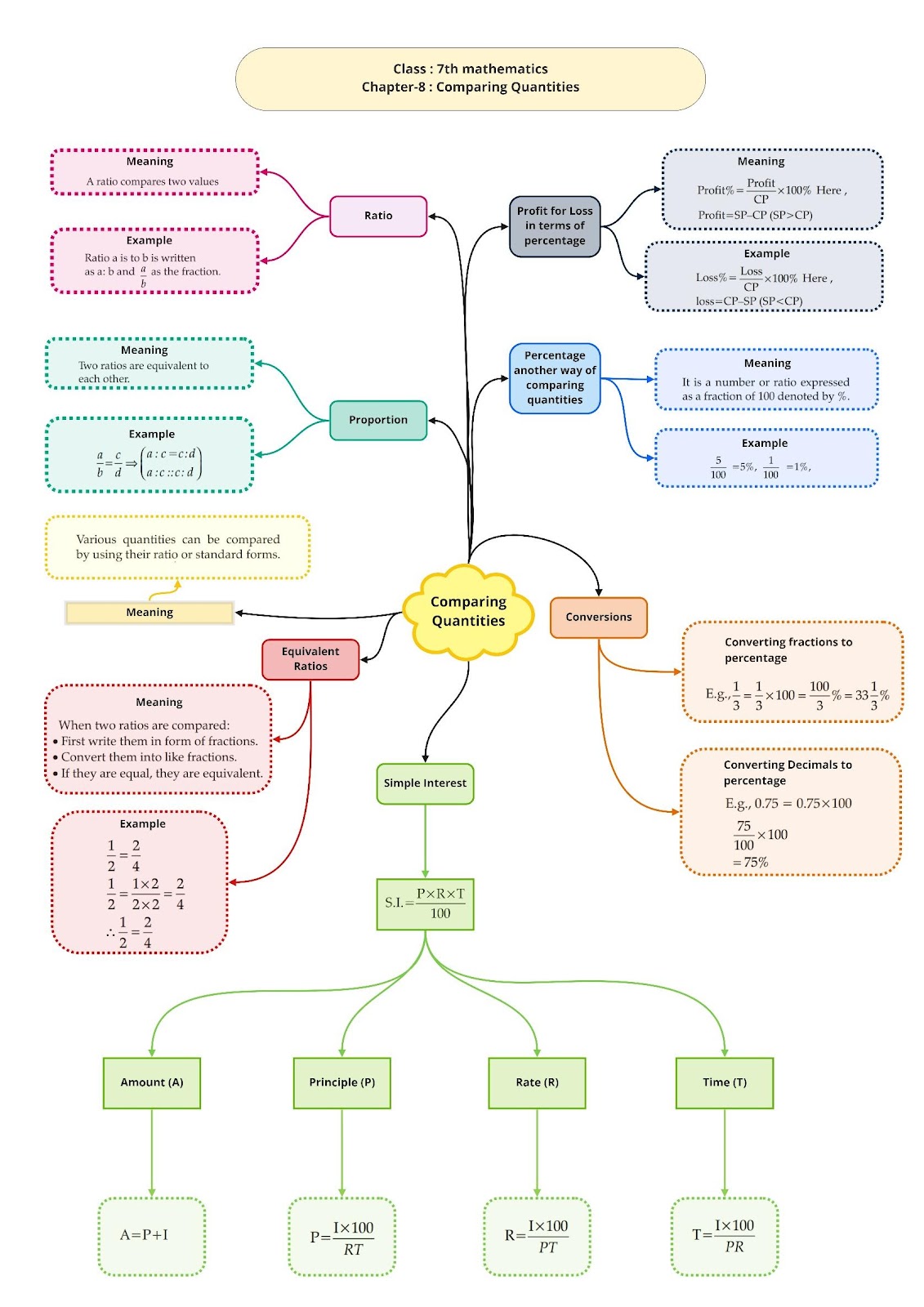
Comparing Quantities

Ratio and Proportion

  1. Ratio is a method of comparing two quantities of same kind by division. Symbol used to write ratio is ‘:’ and is read asSS ‘is to’. Ratio is always expressed in its simplest form.
  2. Two or more ratios are equivalent if their corresponding fractions are equivalent.
  3. When two ratios are equal they are said to be in proportion. Symbol for proportion is :: and is read as ‘as to’.
  4. If two ratios are equal or to be in proportion, their product of means should be equal to the product of extremes.
  5. That is, if a : b : : c : d then ad = bc.
  6. The method to find out the value of one unit/item which in turn is used to find the value of required number of units/items is called unitary method.

Percentages

  1. Percentages are numerators of fractions with denominator 100. The symbol ‘%’ is used for percent and it indicates multiplication with 1100.

For example: 16%=16100

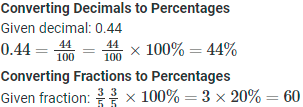
  1. To convert a fraction into a percentage, we multiply the fraction by 100.
  2. To convert a decimal into a percentage, write the decimal as fraction and then multiply the fraction by 100.
  3. To convert a percentage into a fraction (decimal), drop the percent sign and divide by 100 and then reduce it into simplest form of fraction (decimal).
  4. Percentage increase/ decrease =Amount of changeOriginal amount×100% 

Profit and Loss

  1. The price at which an article is purchased is called the cost price (CP).
  2. The price at which an article is sold is called the selling price (SP).
  3. If SP > CP, then a profit is made.

Gain = (SP) – (CP)

  1. If SP < CP, then a loss is incurred.

Loss = (CP) – (SP)

  1. Gain%=gain×100CP

Loss%=loss×100CP

Simple Interest

  1. Whenever we borrow money from some lending sources such as banks or financial institutions etc., we have to pay some extra money for the service of lending. This extra money depends on the sum we borrow and the period of time for which we borrow. This extra money is called the interest.
  2. The money borrowed is called the principal or sum.
  3. Amount = (principal + interest).
  4. Interest on C:\Documents and Settings\Jeevan\Desktop\Rs.New.JPG100 for 1 year is called the rate per cent per annum.


  5. If the interest is calculated uniformly on the original principal, it is called the simple interest.
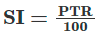
  6. If stand for principal, rate and time respectively, and SI stands for simple interest, then:

SI=P×R×T100

Prices related to an item

  • Prices related to an item are: (i) Selling price

(ii) Cost price

  • Selling price (SP) is the price at which a product is sold out.
  • Cost price (CP) is the buying price of an item.
  • Profit = Selling price – Cost price
  • Loss = Cost price – Selling price
  • If SP > CP, then it is profit.
  • If SP = CP, then it is neither profit nor loss.
  • If CP > SP, then it is loss.

Finding the profit or loss percentage

Text, letter

Description automatically generated

Percentages

Percentages are ratios expressed as a fraction of 100.

Percentages are represented by the symbol ‘%’.

Comparing percentages when denominator is not 100

When a ratio is not expressed in fraction of 100, then convert the fraction to an equivalent fraction with denominator 100.

Converting fractions/decimals to percentages

Text

Description automatically generated

Converting percentages to fractions/decimals

Graphical user interface

Description automatically generated with medium confidence

Estimation using percentages

Estimation can be done using percentages.

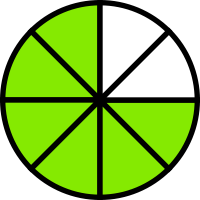
Example: What percentage of the given circle is shaded?

Estimation using percentages

Solution: The given triangle consists of 8 regions, out of which 6 regions are shaded.

So, the percentage of shaded regions will be

Interpreting percentage into usable data

  • Percentages can be interpreted into useful data.
  • Examples:

(i) 40% of Raghav’s clothes are not washed.

⇒ Raghav’s 40 clothes out of 100 clothes are not washed.

(ii) 30 % of students in class are infected by fever.

⇒ Out of 100 students in a class, 30 students are infected by fever.

Converting percentage to the form “how many”

Example: 200 chocolates were distributed among two children: Joe and Tom. Joe got 60% and Tom got 40% of the chocolates. How many chocolates will each get?

Solution: Total number of chocolates = 200

Joe got 60% of the chocolates = 60100×200=120 Tom got 40% of the chocolates =  40100×200=80

 ∴ Joe and Tom will get 120 and 80 chocolates, respectively.

Converting Ratios to percentages

Ratios can be expressed as percentages to understand certain situations much better.

Example: 200 chocolates were distributed among two children: James and Jacob. James got 35 and Jacob got 25 of the chocolates. What is the percentage of chocolate that each got?

Solution: Total number of chocolates = 200

Chart

Description automatically generated with medium confidence

Introduction to Fractions and Ratios

Comparing Quantities: Introduction

To compare two quantities, the units must be the same.

Examples:

(i) Joe’s height is 150 cm and Tom’s is 100 cm.

Ratio of Joe’s height to Tom’s height would be Joe’s height: Tom’s height.

= 150 : 100 = 3 : 2

(ii) Ratio of 3 km to 30 m is 3 km : 30 m.

= 3000 m : 30 m

= 300 : 1

Ratios

Ratio is a relation between two quantities showing the number of times one value contains or is contained within the other.

Example: If there are four girls and seven boys in a class, then the ratio of number of girls to number of boys is 4 : 7.

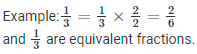
Equivalent Ratios

By multiplying numerator and denominator of a rational number by a non zero integer, we obtain another rational number equivalent to the given rational number. These are called equivalent fractions.

Chart, box and whisker chart

Description automatically generated

Proportions

If two ratios are equal, then they are said to be in proportion.

Symbol “::” or “=” is used to equate the two ratios.

Example: (i) Ratios 2:3 and 6:9 are equal. They can be represented as 2 : 3 :: 6:9 or 2 : 3 = 6 : 9.

(ii) Ratios 1 : 2 and x : 4 are in proportion.

⇒12 = x4

⇒1 × 4 = x × 2

⇒2x = 4

⇒x = 2

Finding the percentage increase or decrease

Example: Price of a book was changed from ₹20 to ₹25 in a week. Calculate the percentage increased.

Solution: Change in price = ₹25 – ₹20 = ₹5

Text

Description automatically generated

Simple and Compound Interest

Sum / principal

The money which has been borrowed is called sum or principal.

This money can be used by the borrower for a particular time period before returning to the lender.

Example: Loan that you take from a bank is the principal.

Interest

Interest is the extra payment that a borrower should pay to the lender along with the principal.

Amount

A borrower should return the principal amount (he/she has borrowed) and the interest to the lender. This money is called amount.

⇒ Amount = Principal + Interest.

Simple Interest

Simple Interest (S.I) is the method of calculating the interest amount for some principal amount of money. Have you ever borrowed money from your siblings when your pocket money is exhausted? Or lent him maybe? What happens when you borrow money? You use that money for the purpose you had borrowed it in the first place. After that, you return the money whenever you get the next month’s pocket money from your parents. This is how borrowing and lending work at home.

But in the real world, money is not free to borrow. You often have to borrow money from banks in the form of a loan. During payback, apart from the loan amount, you pay some more money that depends on the loan amount as well as the time for which you borrow. This is called simple interest. This term finds extensive usage in banking.

Simple interest (SI) is the interest charged on a borrowed money where the principal amount will be fixed for a particular time period.

Simple Interest Formula

The formula for simple interest helps you find the interest amount if the principal amount, rate of interest and time periods are given.

Simple interest formula is given as:

Where SI = simple interest

P = principal

R = interest rate (in percentage)

T = time duration (in years)

In order to calculate the total amount, the following formula is used:

Amount (A) = Principal (P) + Interest (I)

Where,

Amount (A) is the total money paid back at the end of the time period for which it was borrowed.

The total amount formula in case of simple interest can also be written as:

A = P (1 + RT)

Here,

A = Total amount after the given time period

P = Principal amount or the initial loan amount

R = Rate of interest (per annum)

T = Time (in years)

Simple Interest Formula For Months

The formula to calculate the simple interest on a yearly basis has been given above. Now, let us see the formula to calculate the interest for months. Suppose P be the principal amount, R be the rate of interest per annum and n be the time (in months), then the formula can be written as:

Simple Interest for n months = (P × n × R)/ (12 ×100)

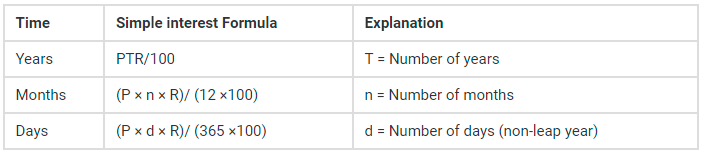
The list of formulas of simple interest for when the time period is given in years, months and days are tabulated below:

Table

Description automatically generated

Example: Calculate the simple interest for 3 years when the principal amount is 200 and interest rate is 10% for 1 year.

Solution: Given: P = 200; R = 10%; T = 3 yrs

Difference Between Simple Interest and Compound Interest

There is another type of interest called compound interest. The major difference between simple and compound interest is that simple interest is based on the principal amount of a deposit or a loan whereas compound interest is based on the principal amount and interest that accumulates in every period of time. Let’s see one simple example to understand the concept of simple interest.

Compound interest

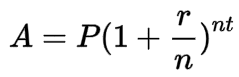
Compound interest is the addition of interest to the principal sum of a loan or deposit, or in other words, interest on interest. It is the result of reinvesting interest, rather than paying it out, so that interest in the next period is then earned on the principal sum plus previously accumulated interest.

Formula

A picture containing text, clock

Description automatically generated

A = final amount

P = initial principal balance

r = interest rate

n = number of times interest applied per time period

t = number of time periods elapsed

Important Questions

Multiple Choice Questions:

Question 1. Convert 0.09 into per cent.

(a) 9%

(b) 8%

(c) 10%

(d) None of these

Question 2. Convert 0.2 into per cent.

(a) 200%

(b) 2%

(c) 20%

(d) None of these

Question 3. If 65% of students in a class have bicycle, what per cent of the students do not have bicycles?

(a) 35%

(b) 25%

(c) 45%

(d) None of these

Question 4. What per cent of the adjoining figure is shaded?

MCQ Questions for Class 7 Maths Chapter 8 Comparing Quantities with Answers 1

(a) 50%

(b) 40%

(c) 100%

(d) None of these

Question 5. What per cent of the given figure is shaded?

MCQ Questions for Class 7 Maths Chapter 8 Comparing Quantities with Answers 2

(a) 75%

(b) 50%

(c) 25%

(d) None of these

Question 6. A survey of 40 children showed that 25% liked playing football. How many children liked playing football?

(a) 10

(b) 20

(c) 30

(d) None of these

Question 7. Find 50% of 164.

(a) 72

(b) 62

(c) 82

(d) None of these

Question 8. Rahul has saved Rs. 20 when a discount of 25% was given. What was the price of the sweater before the discount?

(a) 70

(b) 60

(c) 80

(d) None of these

Question 9. Convert the given fractional numbers 18 into percentage.

(a) 12.5%

(b) 13.5%

(c) 14.5%

(d) None of these

Question 10. Convert the given decimal fractions to per cent

(a) 6.5%

(b) 0.065%

(c) 65%

(d) None of these

Question 11. Find 75% of 1 kg.

(a) 750 g

(b) 75 g

(c) .750 g

(d) None of these

Question 12. Find the whole quantity if 5% of it is 600.

(a) 1200

(b) 120

(c) 12000

(d) None of these

Question 13. Gardening shares are bought for Rs. 250 and sold for Rs. 325. What is the profit?

(a) Rs. 75

(b) Rs. 50

(c) Rs. 25

(d) None of these

Question 14. Find loss if CP is 250 and SP is Rs. 150.

(a) Rs. 50

(b) Rs. 100

(c) Rs. 15

(d) None of these

Question 15. Find interest if Principal = Rs. 1200, rate of interest = 12% p.a. and Time 1 year.

(a) Rs. 144

(b) Rs. 244

(c) Rs. 344

(d) None of these

Very Short Questions:

  1. Find the ratio of:

(a) 5 km to 400 m

(b) 2 hours to 160 minutes

  1. State whether the following ratios are equivalent or not?

(a) 2 : 3 and 4 : 5

(b) 1 : 3 and 2 : 6

  1. Express the following ratios in simplest form:

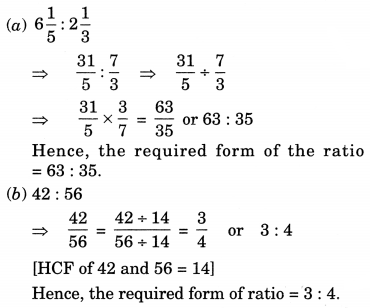
(a) 615: 213

(b) 42 : 56

  1. Compare the following ratios:

3 : 4, 5 : 6 and 3 : 8

  1. State whether the following ratios are proportional or not:

(i) 20 : 45 and 4 : 9

(ii) 9 : 27 and 33 : 11

  1. 24, 36, x are in continued proportion, find the value of x.
  2. Find the mean proportional between 9 and 16.
  3. Find:

(i) 36% of 400

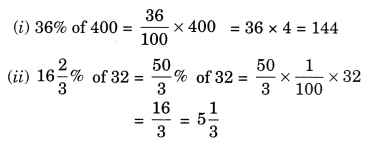
(ii) 1623% of 32

Short Questions:

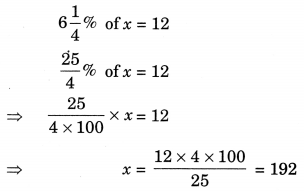
  1. Find a number whose 614% is 12.
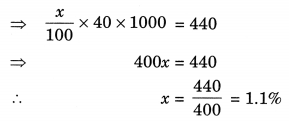
  2. What per cent of 40 kg is 440 g?
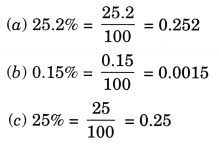
  3. Convert each of the following into the decimal form:

(а) 25.2%

(b) 0.15%

(c) 25%

  1. What per cent of

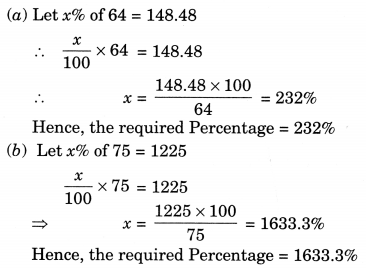
(a) 64 is 148.48?

(b) 75 is 1225?

  1. A machine costs ₹ 7500. Its value decreases by 5% every year due to usage. What will be its price after one year?
  2. What sum of money lent out at 12 per cent p.a. simple interest would produce ₹ 9000 as interest in 2 years?

Long Questions:

  1. Rashmi obtains 480 marks out of 600. Rajan obtains 560 marks out of 700. Whose performance is better?
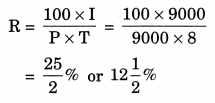
  2. ₹ 9000 becomes ₹ 18000 at simple interest in 8 years. Find the rate per cent per annum.
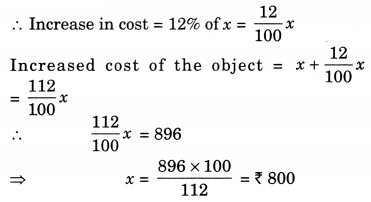
  3. The cost of an object is increased by 12%. If the current cost is ₹ 896, what was its original cost?
  4. Radhika borrowed ₹ 12000 from her friends. Out of which ₹ 4000 were borrowed at 18% and the remaining at 15% rate of interest per annum. What is the total interest after 3 years?
  5. Bhavya earns ₹ 50,000 per month and spends 80% of it. Due to pay revision, her monthly income increases by 20% but due to price rise, she has to spend 20% more. Find her new savings.
  6. The simple interest on a certain sum at 5% per annum for 3 years and 4 years differ by ₹ 82. Find the sum.
  7. Rajan’s monthly income is 20% more than the monthly income of Sarita. What per cent of Sarita’s income is less than Rajan’s monthly income?
  8. If 10 apples are bought for ₹ 11 and sold at the rate of 11 apples for ₹ 10. Find the overall gain or loss per cent in these transactions.
  9. If 25 men can do a work in 36 hours, find the number of men required to do the same work in 108 hours.
  10. A machine is sold by A to B at a profit of 10% and then B sold it to C at a profit of 20%. If C paid ₹ 1200 for the machine, what amount was paid by A to purchase the machine?

Assertion Reason Questions:

1) Assertion (A) –The ratio of 50 paise to Rs. 1 is 1 : 2.

Reasons (R) –A ratio can be defined as the relationship or comparison between two numbers of the same unit to check how bigger is one number than the other one

a) Both A and R are true and R is the correct explanation of A

b) Both A and R are true but R is not the correct explanation of A

c) A is true but R is false

d) A is false but R is true

2) Assertion (A) –A shopkeeper purchased 2 refrigerators for Rs 9800 and Rs 8200 respectively. He sold them for Rs 16920. Loss% = 6%

Reasons (R) –Loss percentage refers to the amount of loss incurred which is expressed or calculated in percentage

a) Both A and R are true and R is the correct explanation of A

b) Both A and R are true but R is not the correct explanation of A

c) A is true but R is false

d) A is false but R is true

ANSWER KEY –

Multiple Choice Questions:

  1. (a) 9%
  2. (c) 20%
  3. (a) 35%
  4. (a) 50%
  5. (a) 75%
  6. (a) 10
  7. (c) 82
  8. (c) 80
  9. (a) 12.5%
  10. (c) 65%
  11. (a) 750 g
  12. (c) 12000
  13. (a) Rs. 75
  14. (b) Rs. 100
  15. (a) Rs. 144

Very Short Answer:

  1. (a) 5 km = 5 × 1000 = 5000 m

Ratio of 5 km to 400 m

= 5000 m : 400 m

= 25 : 2

Required ratio = 25 : 2

(b) 2 hours = 2 × 60 = 120 minutes

Ratio of 2 hours to 160 minutes

= 120 : 160

= 3 : 4

Required ratio = 3 : 4

  1. (a) Given ratios = 2 : 3 and 4 : 5
Comparing Quantities Class 7 Extra Questions Maths Chapter 8 Q2

Hence 2 : 3 and 4 : 5 are not equivalent ratios.

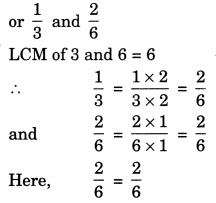
(b) Given ratios = 1 : 3 and 2 : 6

LCM of 3 and 6 = 6

Comparing Quantities Class 7 Extra Questions Maths Chapter 8 Q2.1

Hence, 1 : 3 and 2 : 6 are equivalent ratios.

Comparing Quantities Class 7 Extra Questions Maths Chapter 8 Q3
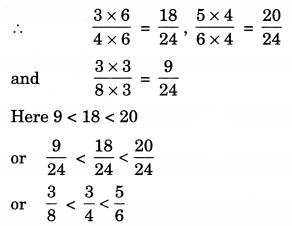
  1. Given: 3 : 4, 5 : 6 and 3 : 8

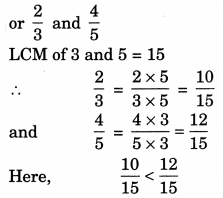
or 34,56and38

LCM of 4, 6 and 8 = 24

Comparing Quantities Class 7 Extra Questions Maths Chapter 8 Q4

Hence, 3 : 8 < 3 : 4 < 5 : 6

  1. (i) 20 : 45 and 4 : 9

Product of extremes = 20 × 9 = 180

Product of means = 45 × 4 = 180

Here, the product of extremes = Product of means

Hence, the given ratios are in proportion.

(ii) 9 : 27 and 33 : 11

Product of extremes = 9 × 11 = 99

Product of means = 27 × 33 = 891

Here, the product of extremes ≠ Product of means

Hence, the given ratios are not in proportion.

  1. Since, 24, 36, x are in continued proportion.

24 : 36 :: 36 : x

⇒ 24 × x = 36 × 36

⇒ x = 54

Hence, the value of x = 54.

  1. Let x be the mean proportional between 9 and 16.

9 : x :: x : 16

⇒ x × x = 9 × 16

⇒ x2 = 144

⇒ x = √144 = 12

Hence, the required mean proportional = 12.

Comparing Quantities Class 7 Extra Questions Maths Chapter 8 Q8

Short Answer:

  1. Let the required number be x.
Comparing Quantities Class 7 Extra Questions Maths Chapter 8 Q9

Hence, the required number = 192.

  1. Let x% of 40 kg = 440 g
Comparing Quantities Class 7 Extra Questions Maths Chapter 8 Q10

Hence, the required Percentage = 1.1%

Comparing Quantities Class 7 Extra Questions Maths Chapter 8 Q11
Comparing Quantities Class 7 Extra Questions Maths Chapter 8 Q12
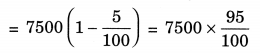
  1. The cost price of the machine = ₹ 7500

Decrease in price = 5%

Decreased price after one year

Comparing Quantities Class 7 Extra Questions Maths Chapter 8 Q13

= 75 × 95

= ₹ 7125

Hence, the required price = ₹ 7125.

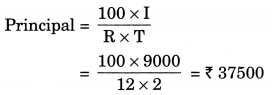
  1. Here, Interest = ₹ 9000

Rate = 12% p.a.

Time = 2 years

Principal = ?

Comparing Quantities Class 7 Extra Questions Maths Chapter 8 Q14

Hence, the required principal amount = ₹ 37500.

Long Answer:

  1. Rashmi obtains 480 marks out of 600

Marks Percentage =480600× 100 = 80%

Rajan obtains 560 marks out of 700

Marks Percentage =560700× 100 = 80%

Since, both of them obtained the same per cent of marks i.e. 80%.

So, their performance cannot be compared.

  1. Here, Principal = ₹ 9000

Amount = ₹ 18000

Interest = Amount – Principal = ₹ 18000 – ₹ 9000 = ₹ 9000

Comparing Quantities Class 7 Extra Questions Maths Chapter 8 Q16

Hence, the required rate of interest = 1212%.

  1. Here, rate of increase in cost = 12%

Increased Cost = ₹ 896

Original Cost = ?

Let the Original Cost be ₹ x

Comparing Quantities Class 7 Extra Questions Maths Chapter 8 Q17

Hence, the required cost = ₹ 800.

  1. Total amount borrowed by Radhika = ₹ 12,000

The amount borrowed by her at 18% p.a. = ₹ 4000

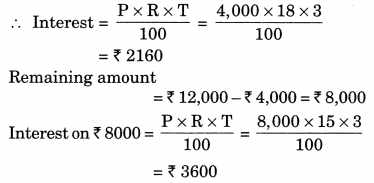
Comparing Quantities Class 7 Extra Questions Maths Chapter 8 Q18

Total interest = ₹ 2160 + ₹ 3600 = ₹ 5760

Hence, the total interest = ₹ 5760.

  1. Monthly income of Bhavya = ₹ 50,000

Money spent by her = 80% of ₹ 50,000

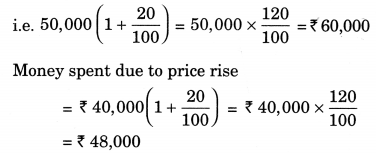
=80100× 50,000 = ₹ 40,000

Due to pay revision, income is increased by 20%

Comparing Quantities Class 7 Extra Questions Maths Chapter 8 Q19

So, the new savings = ₹ 60,000 – ₹ 48,000 = ₹ 12,000

  1. Let the required sum be ₹ P.

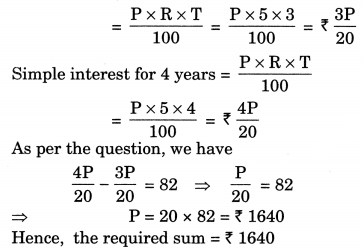
Simple interest for 3 years

Comparing Quantities Class 7 Extra Questions Maths Chapter 8 Q20

Alternate Method

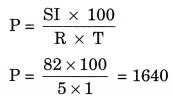
Simple Interest gained from 3rd to 4th year = ₹ 82

Time (4th year – 3rd year) = 1 year

Comparing Quantities Class 7 Extra Questions Maths Chapter 8 Q20.1

Required sum = ₹ 1640

  1. Let the monthly income of Sarita be ₹ 100.

Rajan’s monthly income

Comparing Quantities Class 7 Extra Questions Maths Chapter 8 Q21

Now, Sarita’s monthly income is less than the monthly income of Raj an by = ₹ 120 – ₹ 100 = ₹ 20

Per cent of less in Rajan’s monthly income

= 20×100120=503% = 1623%

Hence, the required per cent = 16 23%

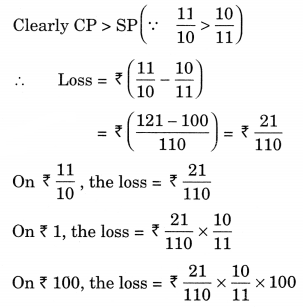
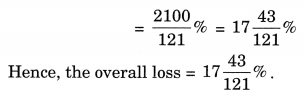
  1. CP of 10 apples = ₹ 11

CP of 1 apple = ₹1110

SP of 11 apples = ₹ 10

SP of 1 apple = ₹1011 

Comparing Quantities Class 7 Extra Questions Maths Chapter 8 Q22
Comparing Quantities Class 7 Extra Questions Maths Chapter 8 Q22.1
  1. Let the number of men required to be x.

Men : Hours :: Men : Hours

25 : 36 :: x : 108

Product of extremes = 25 × 108

Product of means = 36 × x

Product of means = Product of extremes

36 × x = 25 × 108

⇒ x = 25 × 3 = 75

Hence, the required number of men = 75.

  1. Cost price of machine for C = Selling price of the machine for B = ₹ 1200

Hence, the required cost price = ₹ 9091011or ₹ 909.09 approx

Assertion Reason Answers:

  1. a) Both A and R are true and R is the correct explanation of A
  2. a) Both A and R are true and R is the correct explanation of A

Class 7 Mathematics – CHAPTER 6 : THE TRIANGLE AND ITS PROPERTIES

0

THE TRIANGLE AND ITS PROPERTIES

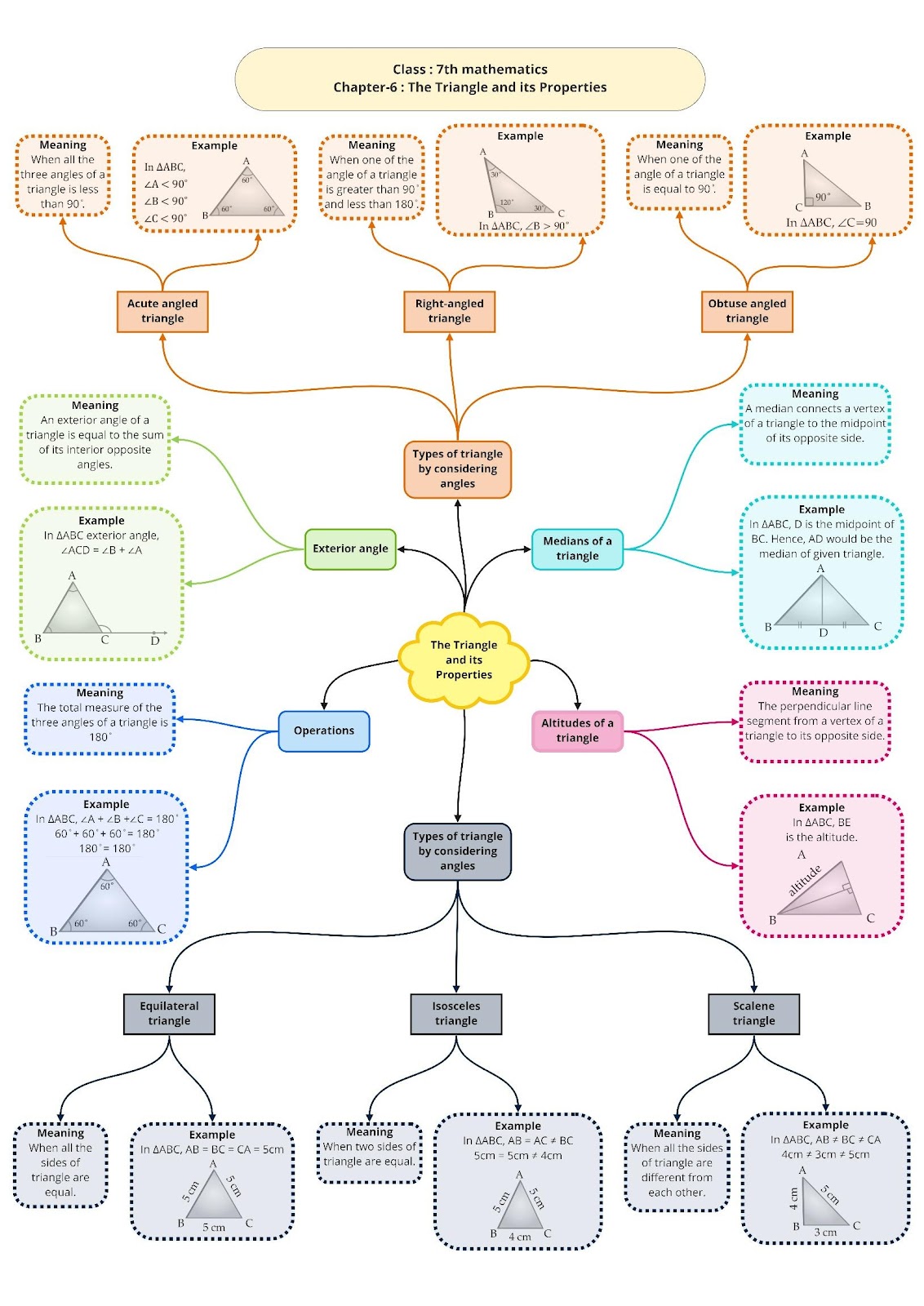
A triangle is a simple closed curve made up of three line segments.

Classification of triangles:

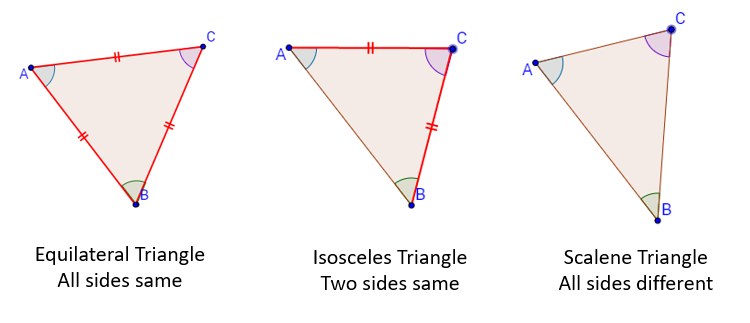
On the basis of sides: A triangle is said to be

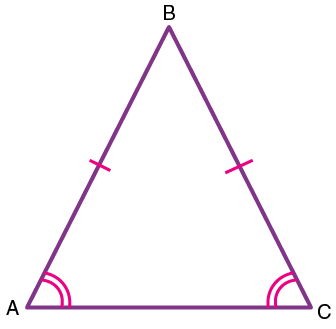
  • an isosceles triangle if two of its sides are equal;
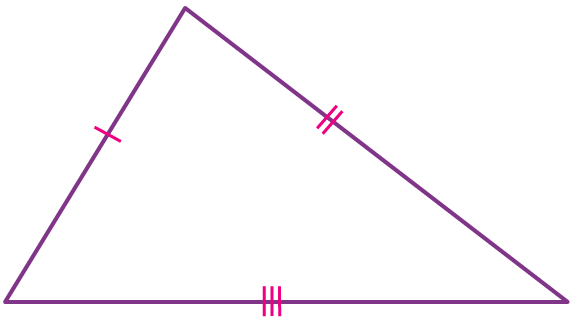
  • a scalene triangle if all of its three sides are of different lengths;
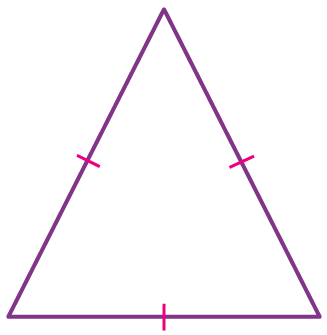
  • an equilateral triangle if all of its sides are of equal lengths.

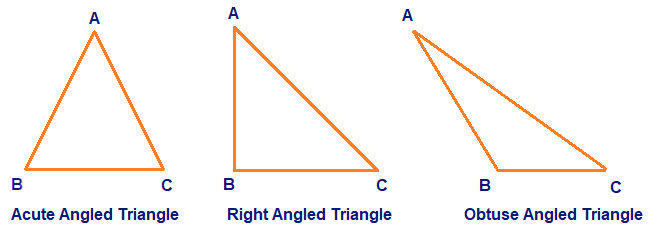
On the basis of angles: A triangle is said to be

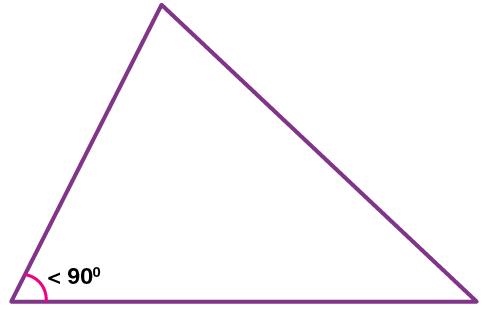
  • an acute triangle if each one of its angles measure less than 90o;
  • an obtuse triangle if one of its angles measure more than 90o;
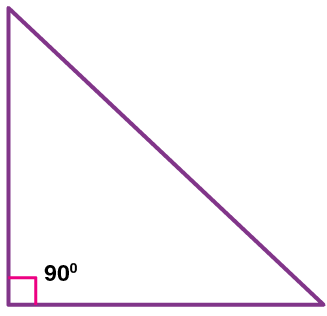
  • a right triangle if one of its angles measure 90o.

Angle sum property of a triangle: The sum of all three interior angles of a triangle is 180o.

In an equilateral triangle:

  • All sides have same length.
  • each angle has measure 60o.

In an isosceles triangle:

  • two sides have the same length.
  • base angles opposite to equal sides are equal.
  1. The sum of any two sides of a triangle is always greater than the third side.
  2. The difference of any two sides of a triangle is always less than the third side.
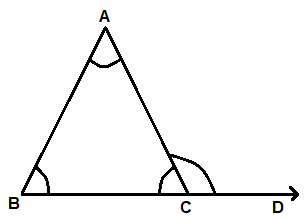
  3. An exterior angle of a triangle is formed when a side of a triangle is produced. There are two ways of forming an exterior angle at each vertex of a triangle.
  4. Exterior angle property of a triangle: The measure of any exterior angle of a triangle is equal to the sum of the measures of its interior opposite angles.
  5. In a right angled triangle, the side opposite to the right angle is called the hypotenuse and the other two sides are called its legs.
  6. Pythagoras property: In a right angled triangle, the square of the hypotenuse is equal to the sum of the squares of the remaining two sides.
  7. A median of a triangle is the line segment joining a vertex of the triangle to the mid-point of its opposite side. A triangle has three medians.
  8. An altitude of triangle is the perpendicular drawn from a vertex of a triangle to its opposite sides. A triangle has three altitudes.

Triangle

A triangle is a closed curve made of three line segments.

In Geometry, a triangle is a three-sided polygon that consists of three edges and three vertices. The most important property of a triangle is that the sum of the internal angles of a triangle is equal to 180 degrees. This property is called angle sum property of triangle. 

If ABC is a triangle, then it is denoted as ∆ABC, where A, B and C are the vertices of the triangle. A triangle is a two-dimensional shape, in Euclidean geometry, which is seen as three non-collinear points in a unique plane.

Shape of Triangle

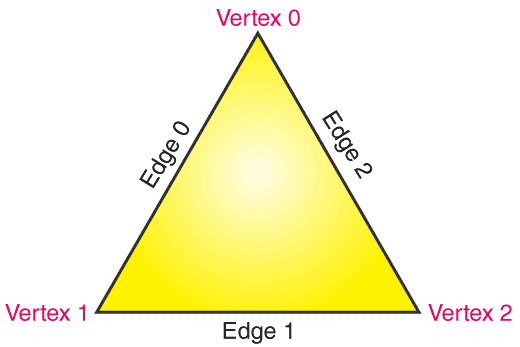
Triangle is a closed two-dimensional shape. It is a three-sided polygon. All sides are made of straight lines. The point where two straight lines join is the vertex. Hence, the triangle has three vertices. Each vertex forms an angle.

Angles of Triangle

There are three angles in a triangle. These angles are formed by two sides of the triangle, which meets at a common point, known as the vertex. The sum of all three interior angles is equal to 180 degrees.

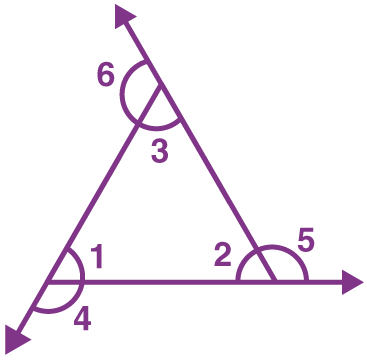
If we extend the side length outwards, then it forms an exterior angle. The sum of consecutive interior and exterior angles of a triangle is supplementary.

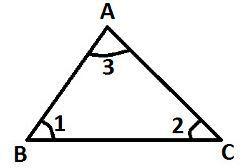
Let us say, ∠1, ∠2 and ∠3 are the interior angles of a triangle. When we extend the sides of the triangle in the outward direction, then the three exterior angles formed are ∠4, ∠5 and ∠6, which are consecutive to ∠1, ∠2 and ∠3, respectively.

Hence, 

∠1 + ∠4 = 180°   ……(i)

∠2 + ∠5 = 180°  …..(ii)

∠3 + ∠6 = 180°  …..(iii)

If we add the above three equations, we get;

∠1 + ∠2 + ∠3 + ∠4 + ∠5 + ∠6 = 180° + 180° + 180°

Now, by angle sum property we know, 

∠1 + ∠2 + ∠3 = 180°

Therefore, 

180 + ∠4 + ∠5 + ∠6 = 180° + 180° + 180°

∠4 + ∠5 + ∠6 = 360°

This proves that the sum of the exterior angles of a triangle is equal to 360 degrees.

Properties

Each and every shape in Maths has some properties which distinguish them from each other. Let us discuss here some of the properties of triangles.

  • A triangle has three sides and three angles.
  • The sum of the angles of a triangle is always 180 degrees.
  • The exterior angles of a triangle always add up to 360 degrees.
  • The sum of consecutive interior and exterior angle is supplementary.
  • The sum of the lengths of any two sides of a triangle is greater than the length of the third side. Similarly, the difference between the lengths of any two sides of a triangle is less than the length of the third side.
  • The shortest side is always opposite the smallest interior angle. Similarly, the longest side is always opposite the largest interior angle.

Triangle

It has three: Sides:

(i) Sides: AB, BC and CA

(ii) Angles: ∠BAC, ∠ACB and ∠CBA

(iii) Vertices: A, B and C

Types of Triangles

On the basis of length of the sides, triangles are classified into three categories:

  • Scalene Triangle
  • Isosceles Triangle
  • Equilateral Triangle

On the basis of measurement of the angles, triangles are classified into three categories:

  • Acute Angle Triangle
  • Right Angle Triangle
  • Obtuse Angle Triangle

Scalene Triangle

A scalene triangle is a type of triangle, in which all the three sides have different side measures. Due to this, the three angles are also different from each other.

Isosceles Triangle

In an isosceles triangle, two sides have equal length. The two angles opposite to the two equal sides are also equal to each other.

Equilateral Triangle

An equilateral triangle has all three sides equal to each other. Due to this all the internal angles are of equal degrees, i.e. each of the angles is 60°

Acute Angled Triangle

An acute triangle has all of its angles less than 90°.

Right Angled Triangle

In a right triangle, one of the angles is equal to 90° or right angle.

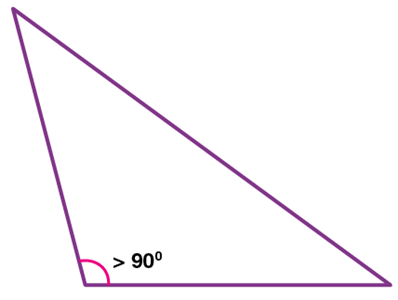
Obtuse Angled Triangle

An obtuse triangle has any of its one angles more than 90°.

Important Lines in a Triangle

Median

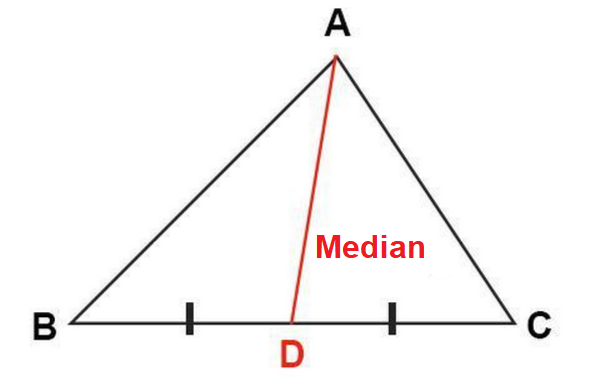
Median is the line that connects a vertex of a triangle to the mid-point of the opposite side.

In the given figure, AD is the median, joining the vertex A to the midpoint of BC.

Median

Altitude

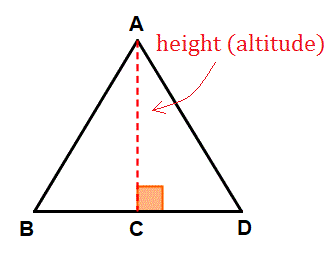
An altitude is a line segment through a vertex of the triangle and perpendicular to a line containing the opposite side.

Altitude

Sides Also Have Constraints

Sum of the lengths of two sides of a triangle

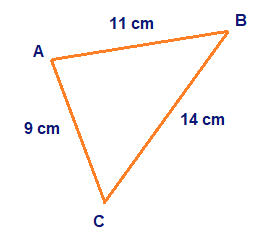
The sum of the lengths of any two sides of a triangle is greater than the third side.

Sum of the lengths of two sides of a triangle

In the above triangle,

9 + 11 = 20 > 14

11 + 14 = 25 > 9

9 + 14 = 23 > 11

Difference between lengths of two sides of a triangle

The difference between lengths of any two sides is smaller than the length of the third side.

Difference between lengths of two sides of a triangle

In the above triangle,

11 – 9 = 2 < 14

14 – 11 = 3 < 9

14 – 9 = 5 < 11

Using the concept of sum of two sides and difference of two sides, it is possible to determine the range of lengths that the third side can take.

Pythagoras Theorem

  • The side opposite to the right angle in a right-angled triangle is called the hypotenuse.
  • The other two sides are known as legs of the right-angled triangle.
  • In a right-angled triangle, square of hypotenuse is equal to the sum of squares of legs.
Pythagoras Theorem

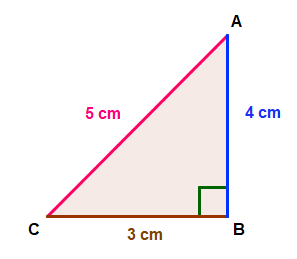
AC2 = AB2 + BC2

⇒ 52 = 42 + 32

If a triangle holds Pythagoras property, then it is a right-angled triangle.

Properties of isosceles and equilateral triangles

Properties of Isosceles Triangle 

Two sides are equal in length.

Base angles opposite to the equal sides are equal.

Properties of Equilateral Triangle

All three sides are equal in length.

Each angle equals to 600.

Classification of Triangles

Classification of triangles based on sides

Equilateral triangle: A triangle in which all the three sides are of equal lengths.

Isosceles triangle: A triangle in which two sides are of equal lengths.

Scalene Triangle: A triangle in which all three sides are of different length.

Classification of triangles based on sides

Classification of triangles based on angles

Acute-angled: A triangle with three acute angles.

Right-angled: A triangle with one right angle.

Obtuse-angled: A triangle with one obtuse angle.

Classification of triangles based on angles

Important Questions

Multiple Choice Questions:

Question 1. A triangle has how many sides:

(a) three

(b) five

(c) four

(d) None of these

Question 2. A triangle has medians:

(a) 2

(b) 1

(c) 3

(d) None of these

Question 3. A triangle has altitudes:

(a) 2

(b) 3

(c) 1

(d) None of these

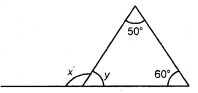
Question 4. Find the value of x:

MCQ Questions for Class 7 Maths Chapter 6 The Triangles and its Properties with Answers 1

(a) 120°

(b) 110°

(c) 100°

(d) None of these

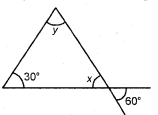
Question 5. Find the value of y:

MCQ Questions for Class 7 Maths Chapter 6 The Triangles and its Properties with Answers 2

(a) 50°

(b) 70°

(c) 40°

(d) None of these

Question 6. Sum of three angles of a triangle is:

(a) 170°

(b) 90°

(c) 180°

(d) None of these

Question 7. Find the third angle of the given triangle

MCQ Questions for Class 7 Maths Chapter 6 The Triangles and its Properties with Answers 3

(a) 71°

(b) 61°

(c) 81°

(d) None of these

Question 8. Find the unknown x in the following diagram

MCQ Questions for Class 7 Maths Chapter 6 The Triangles and its Properties with Answers 4

(a) 60°

(b) 30°

(c) 90°

(d) None of these

Question 9. Find the value of x in the given diagram:

MCQ Questions for Class 7 Maths Chapter 6 The Triangles and its Properties with Answers 5

(a) 65°

(b) 50°

(c) 70°

(d) None of these

Question 10. Find the value of x in the given diagram:

MCQ Questions for Class 7 Maths Chapter 6 The Triangles and its Properties with Answers 6

(a) 4°

(b) 60°

(c) 80°

(d) None of these

Question 11. Find the value of x in the given diagram:

MCQ Questions for Class 7 Maths Chapter 6 The Triangles and its Properties with Answers 6

(a) 30°

(b) 45°

(c) 60°

(d) None of these

Question 12. Find the value of x and y in the following diagram

MCQ Questions for Class 7 Maths Chapter 6 The Triangles and its Properties with Answers 6

(a) (60, 70)

(b) (50, 70)

(c) (70, 60)

(d) None of these

Question 13. Find the value of x and y in the following diagram

MCQ Questions for Class 7 Maths Chapter 6 The Triangles and its Properties with Answers 6

(a) (110, 70)

(b) 70, 110)

(c) (60, 120)

(d) none of these

Question 14. Find the value of x and y in the following diagram:

MCQ Questions for Class 7 Maths Chapter 6 The Triangles and its Properties with Answers 6

(a) (60,90)

(b) (90,60)

(c) (60,60)

(d) none of these

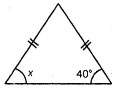
Question 15. Find the angle x in given diagram:

MCQ Questions for Class 7 Maths Chapter 6 The Triangles and its Properties with Answers 6

(a) 30°

(b) 60°

(c) 40°

(d) none of these

Very Short Questions:

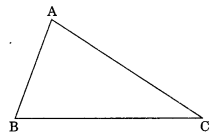
  1. In ∆ABC, write the following:

(a) Angle opposite to side BC.

(b) The side opposite to ∠ABC.

(c) Vertex opposite to side AC.

The Triangles and its Properties Class 7 Extra Questions Maths Chapter 6
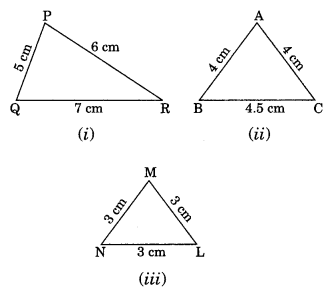
  1. Classify the following triangle on the bases of sides
The Triangles and its Properties Class 7 Extra Questions Maths Chapter 6
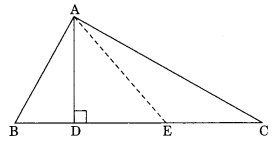
  1. In the given figure, name the median and the altitude. Here E is the midpoint of BC.
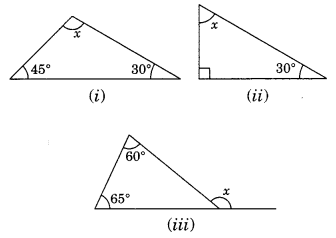
  2. In the given diagrams, find the value of x in each case.
The Triangles and its Properties Class 7 Extra Questions Maths Chapter 6
  1. Which of the following cannot be the sides of a triangle?

(i) 4.5 cm, 3.5 cm, 6.4 cm

(ii) 2.5 cm, 3.5 cm, 6.0 cm

(iii) 2.5 cm, 4.2 cm, 8 cm

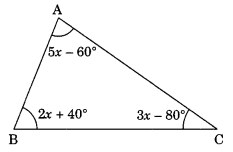
  1. In the given figure, find x.
The Triangles and its Properties Class 7 Extra Questions Maths Chapter 6
  1. One of the equal angles of an isosceles triangle is 50°. Find all the angles of this triangle.
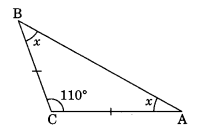
  2. In ΔABC, AC = BC and ∠C = 110°. Find ∠A and ∠B.
The Triangles and its Properties Class 7 Extra Questions Maths Chapter 6

Short Questions:

  1. Two sides of a triangle are 4 cm and 7 cm. What can be the length of its third side to make the triangle possible?
  2. Find whether the following triplets are Pythagorean or not?

(a) (5, 8, 17)

(b) (8, 15, 17)

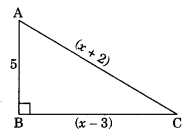
  1. In the given right-angled triangle ABC, ∠B = 90°. Find the value of x.
The Triangles and its Properties Class 7 Extra Questions Maths Chapter 6
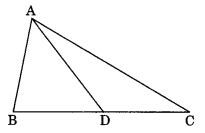
  1. AD is the median of a ΔABC, prove that AB + BC + CA > 2AD (HOTS)
The Triangles and its Properties Class 7 Extra Questions Maths Chapter 6
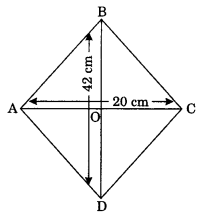
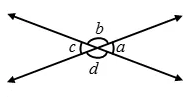
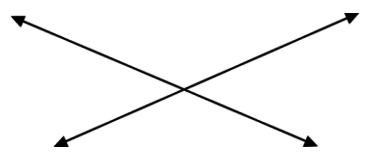
  1. The length of the diagonals of a rhombus is 42 cm and 40 cm. Find the perimeter of the rhombus.
The Triangles and its Properties Class 7 Extra Questions Maths Chapter 6
  1. The sides of a triangle are in the ratio 3 : 4 : 5. State whether the triangle is right-angled or not.
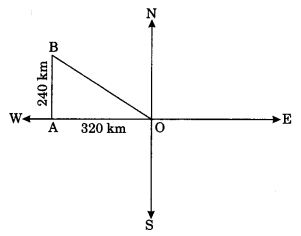
  2. A plane flies 320 km due west and then 240 km due north. Find the shortest distance covered by the plane to reach its original position.

Long Questions:

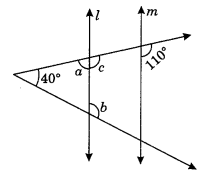
  1. In the following figure, find the unknown angles a and b, if l || m.
The Triangles and its Properties Class 7 Extra Questions Maths Chapter 6
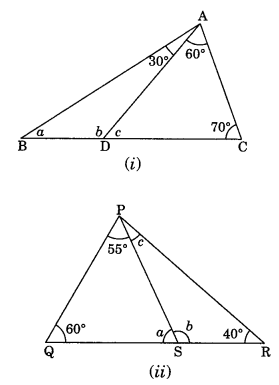
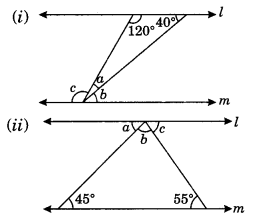
  1. In figure (i) and (ii), Find the values of a, b and c.
Diagram, shape

Description automatically generated
  1. I have three sides. One of my angle measure 15°. Another has a measure of 60°. What kind of a polygon am I? If I am a triangle, then what kind of triangle am I?
  2. A 15 m long ladder reached a window 12 m high from the ground on placing it against a wall at a distance a. Find the distance of the foot of the ladder from the wall
  3. A tree is broken at a height of 5 m from the ground and its top touches the ground at a distance of 12 m from the base of the tree. Find the original height of the tree.

Assertion and Reason Questions:

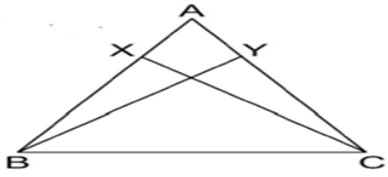
1) Assertion: In the adjoining figure, X and Y are respectively two points on equal sides AB and AC of ΔABC such that AX = AY then CX = BY

Diagram, line chart

Description automatically generated

Reason: If two sides and the included angle of one triangle are equal to two sides and the included angle of the other triangle, then the two triangles are congruent

a) both Assertion and reason are correct and reason is correct explanation for Assertion.

b) both Assertion and reason are correct but reason is not correct explanation for Assertion.

c) Assertion is true but reason is false.

d) both Assertion and reason are false

2) Assertion: Two angles measures a – 60° and 123º – 2a. If each one is opposite to equal sides of an isosceles triangle, then the value of a is 61°.
Reason: Sides opposite to equal angles of a triangle are equal.

a) both Assertion and reason are correct and reason is correct explanation for Assertion.

b) both Assertion and reason are correct but reason is not correct explanation for Assertion

c) Assertion is true but reason is false.

d) both Assertion and reason are false

ANSWER KEY –

Multiple Choice Questions:

  1. (a) three
  2. (c) 3
  3. (b) 3
  4. (a) 120°
  5. (b) 70°
  6. (c) 180°
  7. (c) 81°
  8. (a) 60°
  9. (a) 65°
  10. (b) 60°
  11. (a) 30°
  12. (c) (70, 60)
  13. (a) (110, 70)
  14. (a) (60,90)
  15. (c) 40°

Very Short Answer:

  1. (a) In ∆ABC, Angle opposite to BC is ∠BAC

(b) Side opposite to ∠ABC is AC

(c) Vertex opposite to side AC is B

  1. (i) PQ = 5 cm, PR = 6 cm and QR = 7 cm

PQ ≠ PR ≠ QR

Thus, ∆PQR is a scalene triangle.

(ii) AB = 4 cm, AC = 4 cm

AB = AC

Thus, ∆ABC is an isosceles triangle.

(iii) MN = 3 cm, ML = 3 cm and NL = 3 cm

MN = ML = NL

Thus, ∆MNL is an equilateral triangle.

  1. In ∆ABC, we have
The Triangles and its Properties Class 7 Extra Questions Maths Chapter 6

AD is the altitude.

AE is the median.

  1. (i) x + 45° + 30° = 180° (Angle sum property of a triangle)

⇒ x + 75° – 180°

⇒ x = 180° – 75°

x = 105°

(ii) Here, the given triangle is right angled triangle.

x + 30° = 90°

⇒ x = 90° – 30° = 60°

(iii) x = 60° + 65° (Exterior angle of a triangle is equal to the sum of interior opposite angles)

⇒ x = 125°

  1. (i) Given sides are, 4.5 cm, 3.5 cm, 6.4 cm

Sum of any two sides = 4.5 cm + 3.5 cm = 8 cm

Since 8 cm > 6.4 cm (Triangle inequality)

The given sides form a triangle.

(ii) Given sides are 2.5 cm, 3.5 cm, 6.0 cm

Sum of any two sides = 2.5 cm + 3.5 cm = 6.0 cm

Since 6.0 cm = 6.0 cm

The given sides do not form a triangle.

(iii) 2.5 cm, 4.2 cm, 8 cm

Sum of any two sides = 2.5 cm + 4.2 cm = 6.7 cm

Since 6.7 cm < 8 cm

The given sides do not form a triangle.

  1. In ∆ABC, we have

5x – 60° + 2x + 40° + 3x – 80° = 180° (Angle sum property of a triangle)

⇒ 5x + 2x + 3x – 60° + 40° – 80° = 180°

⇒ 10x – 100° = 180°

⇒ 10x = 180° + 100°

⇒ 10x = 280°

⇒ x = 28°

Thus, x = 28°

  1. Let the third angle be x°.

x + 50° + 50° = 180°

⇒ x° + 100° = 180°

⇒ x° = 180° – 100° = 80°

Thus ∠x = 80°

In given ΔABC, ∠C = 110°

  1. Let ∠A = ∠B = x° (Angle opposite to equal sides of a triangle are equal)

x + x + 110° = 180°

⇒ 2x + 110° = 180°

⇒ 2x = 180° – 110°

⇒ 2x = 70°

⇒ x = 35°

Thus, ∠A = ∠B = 35°

Short Answer:

  1. Let the length of the third side be x cm.

Condition I: Sum of two sides > the third side

i.e. 4 + 7 > x ⇒ 11 > x ⇒ x < 11

Condition II: The difference of two sides less than the third side.

i.e. 7 – 4 < x ⇒ 3 < x ⇒ x > 3

Hence the possible value of x are 3 < x < 11

i.e. x < 3 < 11

  1. (a) Given triplet: (5, 8, 17)

172 = 289

82 = 64

52 = 25

82 + 52 = 64 + 25 = 89

Since 89 ≠ 289

52 + 82 ≠ 172

Hence (5, 8, 17) is not Pythagorean triplet.

(b) Given triplet: (8, 15, 17)

172 = 289

152 = 225

82 = 64

152 + 82 = 225 + 64 = 289

172 = 152 + 82

Hence (8, 15, 17) is a Pythagorean triplet.

  1. In ΔABC, ∠B = 90°

AB2 + BC2 = AC2 (By Pythagoras property)

(5)2 + (x – 3)2 = (x + 2)2

⇒ 25 + x2 + 9 – 6x = x2 + 4 + 4x

⇒ -6x – 4x = 4 – 9 – 25

⇒ -10x = -30

⇒ x = 3

Hence, the required value of x = 3

  1. In ΔABD,

AB + BD > AD …(i)

(Sum of two sides of a triangle is greater than the third side)

Similarly, In ΔADC, we have

AC + DC > AD …(ii)

Adding (i) and (ii), we have

AB + BD + AC + DC > 2AD

⇒ AB + (BD + DC) + AC > 2AD

⇒ AB + BC + AC > 2AD

Hence, proved.

  1. AC and BD are the diagonals of a rhombus ABCD.

Since the diagonals of a rhombus bisect at the right angle.

AC = 40 cm

AO = 402  = 20 cm

BD = 42 cm

OB = 422 = 21 cm

In right angled triangle AOB, we have

AO2 + OB2 = AB2

⇒ 202 + 212 = AB2

⇒ 400 + 441 = AB2

⇒ 841 = AB2

⇒ AB = √841 = 29 cm.

Perimeter of the rhombus = 4 × side = 4 × 29 = 116 cm

Hence, the required perimeter = 116 cm

  1. Let the sides of the given triangle are 3x, 4x and 5x units.

For right angled triangle, we have

Square of the longer side = Sum of the square of the other two sides

(5x)2 = (3x)2 + (4x)2

⇒ 25x2 = 9x2 + 16x2

⇒ 25x2 = 25x2

Hence, the given triangle is a right-angled.

Here, OA = 320 km

AB = 240 km

OB = ?

The Triangles and its Properties Class 7 Extra Questions Maths Chapter 6

Clearly, ∆OBA is right angled triangle

OB2 = OA2 + AB2 (By Pythagoras property)

⇒ OB2 = 3202 + 2402

⇒ OB2 = 102400 + 57600

⇒ OB2 = 160000

⇒ OB = √160000 = 400 km.

Hence the required shortest distance = 400 km.

Long Answer:

  1. Here, l || m

∠c = 110° (Corresponding angles)

∠c + ∠a = 180° (Linear pair)

⇒ 110° + ∠a = 180°

⇒ ∠a = 180° – 110° = 70°

Now ∠b = 40° + ∠a (Exterior angle of a triangle)

⇒ ∠b = 40° + 70° = 110°

Hence, the values of unknown angles are a = 70° and b = 110°

  1. (i) In ∆ADC, we have

∠c + 60° + 70° = 180° (Angle sum property)

⇒ ∠c + 130° = 180°

⇒ ∠c = 180° – 130° = 50°

∠c + ∠b = 180° (Linear pair)

⇒ 50° + ∠b = 180°

⇒ ∠ b = 180° – 50° = 130°

In ∆ABD, we have

∠a + ∠b + 30° = 180° (Angle sum property)

⇒ ∠a + ∠130° + 30° = 180°

⇒ ∠a + 160° = 180°

⇒ ∠a = 180° – 160° = 20°

Hence, the required values are a = 20°, b = 130° and c = 50°

(ii) In ∆PQS, we have

∠a + 60° + 55° = 180° (Angle sum property)

⇒ ∠a + 115° = 180°

⇒ ∠a = 180° – 115°

⇒ ∠a = 65°

∠a + ∠b = 180° (Linear pair)

⇒ 65° + ∠b = 180°

⇒ ∠b = 180° – 65° = 115°

In ∆PSR, we have

∠b + ∠c + 40° = 180° (Angle sum property)

⇒ 115° + ∠c + 40° = 180°

⇒ ∠c + 155° = 180°

⇒ ∠c = 180° – 155° = 25°

Hence, the required angles are a = 65°, b = 115° and c = 25°

  1. Since I have three sides.

It is a triangle i.e. three-sided polygon.

Two angles are 15° and 60°.

Third angle = 180° – (15° + 60°)

= 180° – 75° (Angle sum property)

= 105°

which is greater than 90°.

Hence, it is an obtuse triangle.

  1. By the rule of Pythagoras Theorem,

Pythagoras theorem states that for any right angled triangle, the area of the square on the hypotenuse is equal to the sum of the areas of square on the legs.

In the above figure RQ is the hypotenuse,

152 = 122 + a2

225 = 144 + a2

By transposing 144 from RHS to LHS it becomes – 144

a2 = 225 – 144

a2 = 81

a = √81

a = 9 m

Hence, the length of a = 9 m.

  1. Let ABC is the triangle and B is the point where tree is broken at the height 5 m from the ground.

Tree top touches the ground at a distance of AC = 12 m from the base of the tree,

NCERT Solutions for Class 7 Maths Chapter 6 The Triangles and Its Properties Image 40

By observing the figure we came to conclude that right angle triangle is formed at A.

From the rule of Pythagoras theorem,

BC2 = AB2 + AC2

BC2 = 52 + 122

BC2 = 25 + 144

BC2 = 169

BC = √169

BC = 13 m

Then, the original height of the tree = AB + BC

= 5 + 13

= 18 m

Assertion and Reason Answers:

  1. a) both Assertion and reason are correct and reason is correct explanation for Assertion
  2. b) both Assertion and reason are correct but reason is not correct explanation for Assertion.

Class 7 Mathematics – CHAPTER 5 : LINES AND ANGLES

0

Lines and Angles

  1. Two angles are said to be complementary if the sum of their measures is 90o.
  2. Two angles are said to be supplementary if the sum of their measures is 180o.
  3. Two angles with the same vertex, one arm common and the other arms lying on opposite sides of the common arm are called adjacent angles.
  4. Two adjacent angles are said to form a linear pair of angles if their non-common arms are two opposite rays.
  5. The sum of the measures of a linear pair angles is always 180o.
  6. The sum of all angles formed on the same side of a line at a given point on the line is 180o.
  7. The sum of all angles around a point is 360o.
  8. Two angles are called a pair of vertically opposite angles if their arms from two pairs of opposite rays.
  9. If two lines intersect each other then the vertically opposite angles are equal.
  10. Two lines ‘l’ and ‘m’ are said to be parallel, if they lie in the same plane and do not intersect when produced however far on either side and is written as l||m.
  11. A line which intersects two or more lines at distinct points is called a transversal.
  1. [∠1, ∠5], [∠2, ∠6], [∠3, ∠7] and [∠4, ∠8] are called pair of corresponding angles.  Check for angle sign
  2. [∠3, ∠5] and [∠4, ∠6] are called pair of alternate interior angles or simply alternate angles.
  3. [∠4, ∠5] and [∠3, ∠6] are called pairs of interior angles on the same side of the transversal.
  4. If two parallel lines are cut by a transversal, then
    1. The alternate angles are equal
    2. The corresponding angles are equal and
    3. The interior angles on the same side of the transversal are supplementary.
  5. Two lines are parallel if, when they are cut by a transversal, they make a pair of
    1. Corresponding angles equal or
    2. Alternate angles equal or
    3. Interior angles on the same side of the transversal supplementary.
  6. Two lines which are parallel to the same line are parallel to each other.
  7. If three parallel lines are intersected by two transversals, the ratio of the intercepts made on one transversal is the same as the ratio of the intercepts made on the other transversal.

Line, line segment and ray

  • If we take a point and draw a straight path that extends endlessly on both the sides, then the straight path is called as a line.
  • A ray is a part of a line with one endpoint.
  • A line segment is a part of a line with two endpoints.
Line, line segment and ray

We come across many shapes in daily life. Consider a triangle, a square or any other shape. To draw any of these figures, one begins with a line or a line segment or a curve. Depending upon the number and arrangement of these lines we get distinct types of shapes and figures. For example, a triangle is a figure enclosed by 3 line segments, Pentagon is a polygon bounded by 5 line segments and so on. We have already discussed line now let us see what is line segment and ray.

Line Segment

A line segment is a part of a line having two endpoints. Figures such as a triangle, polygon, hexagon, square are made of different numbers of line segments. The measure of a line segment is called its length.  In contrast to the infinitely extending line, a line segment has a fixed length and can be measured easily. A line segment with A and B as two endpoints is represented as AB

Line segment example

Ray

Ray is another part of a line. It is a combination of a line and a line segment that has an infinitely extending end and one terminating end. As its one end is non-terminating, its length cannot be measured. A ray is represented by

AB

where one end is symbolized by an endpoint and the infinitely extending part by an arrow.

Ray example

Angles

What is an angle? In Plane Geometry, a figure which is formed by two rays or lines that shares a common endpoint is called an angle. The word “angle” is derived from the Latin word “angulus”, which means “corner”. The two rays are called the sides of an angle, and the common endpoint is called the vertex. The angle that lies in the plane does not have to be in the Euclidean space. In case if the angles are formed by the intersection of two planes in the Euclidean or the other space, the angles are considered dihedral angles. The angle is represented using the symbol “∠”. The angle measurement between the two rays can be denoted using the Greek letter θ, α, β etc. If the angles are measured from a line, we can find two different types of angles, such as a positive angle and a negative angle.

Positive Angle: If the angle goes in counterclockwise, then it is called a positive angle.

Negative Angle: If the angle goes clockwise direction, then it is called a negative angle.

Label the Angles

There are two different ways to label the angles. They are:

Method 1: Give a name to the angle. Generally, the angle is named using the lower case letter like “a”, “x”, etc or by using the Greek Letters alpha (α), beta (β), theta (θ), etc.

Method 2: By using the three letters on the shapes, we can define the angle. The middle letter should be the vertex (actual angle). 

For example, ABC is a triangle. To represent the angle A is equal to 60 degrees, we can define it as ∠BAC = 60°

Measure the Angle

The angles are generally measured in degrees (°). An important geometrical tool that helps to measure the angles in degree is a “protractor”. A protractor has two sets of numbers going in opposite directions.  One set goes from 0 to 180 degree on the outer rim and the other set goes from 180 to 0 degree on the inner rim.

Types of Angles

The angles are classified under the following types:

Acute Angle – an angle measure less than 90 degrees

Right Angle – an angle is exactly at 90 degrees

Obtuse Angle – an angle whose measure is greater than 90 degrees and less than 180 degrees

Straight Angle – an angle which is exactly at 180 degrees

Reflex Angle – an angle whose measure is greater than 180 degrees and less than 360 degrees

Full Angle – an angle whose measure is exactly at 360 degrees

Based on these angles and the lines, it is further classified into different types such as complementary angles, supplementary angles, adjacent angles, vertical angles, alternate interior angles, alternate exterior angles, and so on.

  • Corresponding Angles
  • Alternate Interior Angles
  • Alternate Exterior Angles
  • Interior Angles on the Same Side of Transversal
  • Supplementary Angles
  • Adjacent Angles
  • Vertical Angles

Now let us discuss some of the important theorems based on the lines and angles:

  • If two parallel lines are cut by a transversal, then the alternate interior angles are of the same measure.
  • If two parallel lines are cut by a transversal, then the alternate exterior angles are of the same measure.
  • If two parallel lines are cut by a transversal, then the corresponding angles are of the same measure.
  • If two parallel lines are cut by a transversal, then the interior angles on the same side of the transversal are supplementary.
  • Vertical angles are congruent when the straight line intersects the lines. The lines may be either parallel or non-parallel

Properties of Angles

The following are the important properties of angles:

The sum of all the angles on one side of a straight line is always equal to 180 degrees,

The sum of all the angles around the point is always equal to 360 degrees.

  • An angle is formed when two rays originate from the same end point.
  • The rays making an angle are called the arms of the angle.
  • The end point is called the vertex of the angle.
Angles

Complementary Angles

Two angles whose sum is 900 are called complementary angles.

Example: 500 + 400 = 900

∴ 500 and 400 angles are complementary angles.

Complementary Angles

Parallel Lines and a Transversal

Transversal intersecting two lines

Transversal is a line that intersects two or more lines at different points.

Transversal intersecting two lines

Corresponding Angles:

(i) ∠1 and ∠5 (ii) ∠2 and ∠6

(iii) ∠3 and ∠7 (iv) ∠4 and ∠8

Alternate Interior Angles:

(i) ∠3 and ∠6 (ii) ∠4 and ∠5

Alternate Exterior Angles:

(i) ∠1 and ∠8 (ii) ∠2 and ∠7

Interior angles on the same side of the transversal:

(i) ∠3 and ∠5 (ii) ∠4 and ∠6

Transversal of Parallel Lines

Transversal of Parallel Lines

If a transversal intersects two parallel lines, then each pair of corresponding angles is equal.

(i) ∠1=∠5 (ii) ∠2=∠6

(iii) ∠3=∠7 (iv) ∠4=∠8

If a transversal intersects two parallel lines, then each pair of alternate interior angles is equal.

(i) ∠3=∠6 (ii) ∠4=∠5

If a transversal intersects two parallel lines, then each pair of interior angles on the same side of the transversal is supplementary.

(i) ∠3+∠5=1800 (ii) ∠4+∠6=1800

Checking if two or more lines are parallel

There are three conditions to check whether the two lines are parallel. They are:

(i) If a transversal intersects two lines such that a pair of corresponding angles is equal, then the two lines are parallel to each other.

(ii) If a transversal intersects two lines such that a pair of alternate interior angles is equal, then the two lines are parallel.

(iii) If a transversal intersects two lines such that a pair of interior angles on the same side of the transversal is supplementary, then the two lines are parallel.

Intersecting Lines and Pairs of Angles

Supplementary angles

Two angles whose sum is 1800 are called supplementary angles.

Example: 1100 + 700 = 900

∴ 1100 and 700 angles are supplementary angles.

Supplementary angles

Adjacent Angles

Two angles are adjacent, if they have

(i) A common vertex

(ii) A common arm

(iii) Their non-common arms on different sides of the common arm.

Adjacent Angles

Here ∠ABD and ∠DBC are adjacent angles.

Linear Pair

Linear pair of angles are adjacent angles whose sum is equal to 180∘.

Linear Pair

Here, 1 and 2 are linear pair of angles.

Vertically Opposite Angles

Vertically opposite angles are formed when two straight lines intersect each other at a common point.

Vertically opposite angles are equal.

Vertically Opposite Angles

Here, the following pairs of angles are vertically opposite angles.

(i) a and c

(ii) b and d

Intersecting and Non-Intersecting lines

Intersecting lines are lines which intersect at a common point called the point of intersection.

Intersecting lines

Parallel lines are lines which do not intersect at any point. Parallel lines are also known as non- intersecting lines.

 Non-Intersecting lines

Basic Properties of a Triangle

All the properties of a triangle are based on its sides and angles. By the definition of triangle, we know that, it is a closed polygon that consists of three sides and three vertices. Also, the sum of all three internal angles of a triangle equal to 180°.

In the beginning, we start from understanding the shape of triangles, its types and properties, theorems based on it such as Pythagoras theorem, etc. In higher classes, we deal with trigonometry, where the right-angled triangle is the base of the concept. Let us learn here some of the fundamentals of the triangle by knowing its properties.

Sum of Interior Angles in a Triangle

Angle sum property of a triangle: Sum of all interior angles of a triangle is 1800.

Sum of Interior Angles in a Triangle

In △ABC, ∠1 + ∠2 + ∠3 = 1800

The exterior angle of a triangle = Sum of opposite internal angles

If a side of a triangle is produced, then the exterior angle so formed is equal to the sum of the two interior opposite angles.

The exterior angle of a triangle = Sum of opposite internal angles

In △ABC, ∠CAB + ∠ABC = ∠ACD.

Important Questions

Multiple Choice Questions:

Question 1. (180°, 5°) pair of angle is given:

(a) complementary

(b) supplementary

(c) None of these

Question 2. What is the measure of the complement of 65°?

(a) 25°

(b) 55°

(c) 65°

(d) 45°

Question 3. Complementary to 0° angle is:

(a) 90°

(b) 95°

(c) 75°

(d) None of these

Question 4. Identify which of the following pairs of angles are complementary.

(a) 65°, 115°

(b) 130°, 50°

(c) 63°, 27°

(d) 112°, 68°

Question 5. Complementary to 70° angle is :

(a) 20°

(b) 30°

(c) 40°

(d) None of these

Question 6. What happens to the measurement of an angle after the extension of its arms?

(a) Doubles

(b) Triples

(c) Remains the same

(d) Cannot be said

Question 7. Complementary to 95° angle is:

(a) 5°

(b) 0°

(c) 10°

(d) None of these

Question 8. What is the supplement of 105°?

(a) 65°

(b) 75°

(c) 85°

(d) 95°

Question 9. Find the value of x in the given figure if lines p ∥ q:

MCQ Questions for Class 7 Maths Chapter 5 Lines and Angles with Answers 1

(a) x = 60°

(b) 50°

(c) 75°

(d) none of these

Question 10. Identify which of the following pairs of angles are supplementary.

(a) 45°, 45°

(b) 63°, 27°

(c) 112°, 68°

(d) 80°, 10°

Question 11. Measure of the supplement of 0°:

(a) 180°

(b) 90°

(c) 175°

(d) None of these

Question 12. What do we call an angle whose measurement is exactly equal to 0°?

(a) An obtuse angle

(b) A straight angle

(c) A zero angle

(d) A right angle

Question 13. If in the given figure l ∥ m then:

MCQ Questions for Class 7 Maths Chapter 5 Lines and Angles with Answers 2

(a) x = 50°

(b) x = 60°

(c) No relation

Question 14. What are the lines which lie on the same plane and do not intersect at any point called?

(a) Perpendicular lines

(b) Intersecting lines

(c) Parallel lines

(d) Collinear lines

Question 15. In the given figure value of x is :

MCQ Questions for Class 7 Maths Chapter 5 Lines and Angles with Answers 3

(a) 55°

(b) 45°

(c) 65°

(d) None of these

Very Short Questions:

  1. Find the angles which is 15 of its complement.
  2. Find the angles which is 23 of its supplement.
  3. Find the value of x in the given figure.
Lines and Angles Class 7 Extra Questions Maths Chapter 5 Q3
  1. In the given figure, find the value of y.
Lines and Angles Class 7 Extra Questions Maths Chapter 5 Q4
  1. Find the supplements of each of the following:

(i) 30°

(ii) 79°

(iii) 179°

(iv) x°

(v) 25 of right angle

  1. If the angles (4x + 4)° and (6x – 4)° are the supplementary angles, find the value of x.
  2. Find the value of x.
Lines and Angles Class 7 Extra Questions Maths Chapter 5 Q7
  1. Find the value of y.
Lines and Angles Class 7 Extra Questions Maths Chapter 5 Q8

Short Questions:

  1. Find the value of y in the following figures:
Diagram

Description automatically generated
  1. In the following figures, find the lettered angles.
Lines and Angles Class 7 Extra Questions Maths Chapter 5 Q10
  1. In the given figure, prove that AB || CD.
Lines and Angles Class 7 Extra Questions Maths Chapter 5 Q11
  1. In the given figure l || m. Find the values of a, b and c.
Lines and Angles Class 7 Extra Questions Maths Chapter 5 Q12
  1. In the adjoining figure if x : y : z = 2 : 3 : 4, then find the value of z.
Lines and Angles Class 7 Extra Questions Maths Chapter 5 Q13

Long Questions:

  1. In the following figure, find the value of ∠BOC, if points A, O and B are collinear. 
Lines and Angles Class 7 Extra Questions Maths Chapter 5 Q14
  1. In given figure, PQ, RS and UT are parallel lines.

(i) If c = 57° and a = c3, find the value of d.

(ii) If c = 75° and a = 25 c, find

Lines and Angles Class 7 Extra Questions Maths Chapter 5 Q15
  1. An angle is greater than 45˚. Is its complementary angle greater than 45˚ or equal to 45˚ or less than 45˚?
  2. In the adjoining figure, p ∥ q. Find the unknown angles.

Assertion and Reason Questions:

1.) Assertion: When the sum of the measures of two angles is 90°, the angles are called complementary angles.

Reason: Two acute angles can be complementary to each other.

a.) Both Assertion and Reason are correct and Reason is the correct explanation for Assertion

b.) Both Assertion and Reason are correct and Reason is not the correct explanation for Assertion.

c.) assertion is true but the reason is false.

d.) both assertion and reason are false.

2.) Assertion: The sum of the measures of two complementary angles is 90°.

Reason: When the sum of the measures of two angles is 90°, the angles are called complementary angles.

a.) Both Assertion and Reason are correct and Reason is the correct explanation for Assertion

b.) Both Assertion and Reason are correct and Reason is not the correct explanation for Assertion.

c.) assertion is true but the reason is false.

d.) both assertion and reason are false.

ANSWER KEY –

Multiple Choice Questions:

  1. (c) None of these
  2. (a) 25°
  3. (a) 90°
  4. (c) 63°, 27°
  5. (a) 20°
  6. (c) Remains the same
  7. (d) None of these
  8. (b) 75°
  9. (a) x = 60°
  10. (c) 112°, 68°
  11. (a) 180°
  12. (c) A zero angle
  13. (a) x = 50°
  14. (c) Parallel lines
  15. (a) 55°

Very Short Answer:

  1. Let the required angle be x°

its complement = (90 – x)°

As per condition, we get

Lines and Angles Class 7 Extra Questions Maths Chapter 5 Q1
Lines and Angles Class 7 Extra Questions Maths Chapter 5 Q1.1
  1. Let the required angle be x°.

its supplement = (180 – x)°

As per the condition, we get

23 of (180 – x)° = x°

Lines and Angles Class 7 Extra Questions Maths Chapter 5 Q2
  1. ∠POR + ∠QOR = 180° (Angles of linear pair)

⇒ (2x + 60°) + (3x – 40)° = 180°

⇒ 2x + 60 + 3x – 40 = 180°

⇒ 5x + 20 = 180°

⇒ 5x = 180 – 20 = 160

⇒ x = 32

Thus, the value of x = 32.

  1. Let the angle opposite to 90° be z.

z = 90° (Vertically opposite angle)

3y + z + 30° = 180° (Sum of adjacent angles on a straight line)

⇒ 3y + 90° + 30° = 180°

⇒ 3y + 120° = 180°

⇒ 3y = 180° – 120° = 60°

⇒ y = 20°

  1. Thus the value of y = 20°.

(i) Supplement of 30° = 180° – 30° = 150°

(ii) Supplement of 79° = 180° – 79° = 101°

(iii) Supplement of 179° = 180° – 179° = 1°

(iv) Supplement of x° = (180 – x)°

(v) Supplement of 25 of right angle

= 180° – 25 × 90° = 180° – 36° = 144°

  1. (4x + 4)° + (6x – 4)° = 180° (∵ Sum of the supplementary angle is 180°)

⇒ 4x + 4 + 6x – 4 = 180°

⇒ 10x = 180°

⇒ x = 18°

Thus, x = 18°

  1. (6x – 40)° + (5x + 9)° + (3x + 15) ° = 180° (∵ Sum of adjacent angles on straight line)

⇒ 6x – 40 + 5x + 9 + 3x + 15 = 180°

⇒ 14x – 16 = 180°

⇒ 14x = 180 + 16 = 196

⇒ x = 14

Thus, x = 14

  1. l || m, and t is a transversal.

y + 135° = 180° (Sum of interior angles on the same side of transversal is 180°)

⇒ y = 180° – 135° = 45°

Thus, y = 45°

Short Answer:

  1. (i) y + 15° = 360° (Sum of complete angles round at a point)

⇒ y = 360° – 15° = 345°

Thus, y = 345°

(ii) (2y + 10)° + 50° + 40° + 130° = 360° (Sum of angles round at a point)

⇒ 2y + 10 + 220 = 360

⇒ 2y + 230 = 360

⇒ 2y = 360 – 230

⇒ 2y = 130

⇒ y = 65

Thus, y = 65°

(iii) y + 90° = 180° (Angles of linear pair)

⇒ y = 180° – 90° = 90°

[40° + 140° = 180°, which shows that l is a straight line]

  1. (i) Let a be represented by ∠1 and ∠2

∠a = ∠1 + ∠2

∠1 = 35° (Alternate interior angles)

∠2 = 55° (Alternate interior angles)

∠1 + ∠2 = 35° + 55°

∠a = 90°

Thus, ∠a = 90°

  1. ∠CEF = 30° + 50° = 80°

∠DCE = 80° (Given)

∠CEF = ∠DCE

But these are alternate interior angle.

CD || EF ……(i)

Now ∠EAB = 130° (Given)

∠AEF = 50° (Given)

∠EAB + ∠AEF = 130° + 50° = 180°

But these are co-interior angles.

AB || EF …(ii)

From eq. (i) and (ii), we get

AB || CD || EF

Hence, AB || CD

Co-interior angles/Allied angles: Sum of interior angles on the same side of transversal is 180°.

  1. (i) We have l || m

∠b = 40° (Alternate interior angles)

∠c = 120° (Alternate interior angles)

∠a + ∠b + ∠c = 180° (Sum of adjacent angles on straight angle)

⇒ ∠a + 40° + 120° = 180°

⇒ ∠a + 160° = 180°

⇒ ∠a = 180° – 160° = 20°

Thus, ∠a = 20°, ∠b = 40° and ∠c = 120°.

(ii) We have l || m

∠a = 45° (Alternate interior angles)

∠c = 55° (Alternate interior angles)

∠a + ∠b + ∠c = 180° (Sum of adjacent angles on straight line)

⇒ 45 + ∠b + 55 = 180°

⇒ ∠b + 100 = 180°

⇒ ∠b = 180° – 100°

⇒ ∠b = 80°

  1. Let x = 2s°

y = 3s°

and z = 4s°

∠x + ∠y + ∠z = 180° (Sum of adjacent angles on straight line)

2s° + 3s° + 4s° = 180°

⇒ 9s° = 180°

⇒ s° = 20°

Thus x = 2 × 20° = 40°, y = 3 × 20° = 60° and z = 4 × 20° = 80°

Long Answer:

  1. We have A, O and B are collinear.

∠AOD + ∠DOC + ∠COB = 180° (Sum of adjacent angles on straight line)

(x – 10)° + (4x – 25)° + (x + 5)° = 180°

⇒ x – 10 + 4x – 25 + x + 5 = 180°

⇒ 6x – 10 – 25 + 5 = 180°

⇒ 6x – 30 = 180°

⇒ 6x = 180 + 30 = 210

⇒ x = 35

So, ∠BOC = (x + 5)° = (35 + 5)° = 40°

  1. (i) We have ∠c = 57° and ∠a = c3

∠a = 573 = 19°

PQ || UT (given)

∠a + ∠b = ∠c (Alternate interior angles)

19° + ∠b = 57°

∠b = 57° – 19° = 38°

PQ || RS (given)

∠b + ∠d = 180° (Co-interior angles)

38° + ∠d = 180°

∠d = 180° – 38° = 142°

Thus, ∠d = 142°

(ii) We have ∠c = 75° and a =25c

a =25 75° = 30°

PQ || UT (given)

∠a + ∠b = ∠c

30° + ∠b = 75°

∠b = 75° – 30° = 45°

Thus, ∠b = 45°

  1. Let us assume the complementary angles be p and q,

We know that, sum of measures of complementary angle pair is 90o.

Then,

= p + q = 90o

It is given in the question that p > 45o

Adding q on both the sides,

= p + q > 45o + q

= 90o > 45o + q

= 90o – 45o > q

= q < 45o

Hence, its complementary angle is less than 45o.

  1. By observing the figure,

∠d = ∠125o … [∵ corresponding angles]

We know that, Linear pair is the sum of adjacent angles is 180o

Then,

= ∠e + 125o = 180o … [Linear pair]

= ∠e = 180o – 125o

= ∠e = 55o

From the rule of vertically opposite angles,

∠f = ∠e = 55o

∠b = ∠d = 125o

By the property of corresponding angles,

∠c = ∠f = 55o

∠a = ∠e = 55o 

Assertion and Reason Answers:

  1. b.) Both Assertion and Reason are correct and Reason is not the correct explanation for Assertion.
  2. a.) Both Assertion and Reason are correct and Reason is the correct explanation for Assertion.

Class 7 Mathematics – CHAPTER 4 : SIMPLE EQUATIONS

0

Simple Equations

Introduction to Simple Equations

Variables and Expressions

Variable is a quantity that can take any value, its value is not fixed. It is a symbol for a number whose value is unknown yet.

Expressions are formed by performing operations like addition, subtraction, multiplication and division on the variables.

Example: 6x – 3 is an expression in variable x.

Algebraic expressions are the idea of expressing numbers using letters or alphabets without specifying their actual values. The basics of algebra taught us how to express an unknown value using letters such as x, y, z, etc. These letters are called here as variables. An algebraic expression can be a combination of both variables and constants. Any value that is placed before and multiplied by a variable is a coefficient.

Variables, Coefficient & Constant in Algebraic Expressions

In Algebra we work with Variable, Symbols or Letters whose value is unknown to us.

In the above expression (i.e. 5x – 3),

  • x is a variable, whose value is unknown to us which can take any value.
  • 5 is known as the coefficient of x, as it is a constant value used with the variable term and is well defined.
  • 3 is the constant value term that has a definite value.

The whole expression is known to be the Binomial term, as it has two unlikely terms.

Types of Algebraic expression

There are 3 main types of algebraic expressions which include:

Monomial Expression

Binomial Expression

Polynomial Expression

Monomial Expression

An algebraic expression which is having only one term is known as a monomial.

Examples of monomial expressions include 3x4, 3xy, 3x, 8y, etc.

Binomial Expression

A binomial expression is an algebraic expression which is having two terms, which are unlike.

Examples of binomial include 5xy + 8, xyz + x3, etc.

Polynomial Expression

In general, an expression with more than one term with non-negative integral exponents of a variable is known as a polynomial.

Examples of polynomial expression include ax + by + ca, x3 + 2x + 3, etc.

Other Types of Expression

Apart from monomial, binomial and polynomial types of expressions, an algebraic expression can also be classified into two additional types which are:

Numeric Expression

Variable Expression

Numeric Expression

A numeric expression consists of numbers and operations, but never include any variable. Some of the examples of numeric expressions are 10 + 5, 15 ÷ 2, etc.

Variable Expression

A variable expression is an expression that contains variables along with numbers and operation to define an expression. A few examples of a variable expression include 4x + y, 5ab + 33, etc.

Formulas

The general algebraic formulas we use to solve the expressions or equations are:

(a + b)2 = a2 + 2ab + b2

(a – b)2 = a2 – 2ab + b2

a2 – b2 = (a – b) (a + b)

(a + b) 3 = a3 + b3 + 3ab (a + b)

(a – b) 3 = a3 – b3 – 3ab (a – b) 

a3 – b3 = (a – b) (a2 + ab + b2)

a3 + b3 = (a + b) (a2 – ab + b2)

Algebraic Equation

In simple words, equations mean equality i.e. the equal sign. That’s what equations are all about- “equating one quantity with another”.

Ax2 + bx + c = 0

Example:

5x2 + 7x – 9 = 4x2 + x – 18

5x2 + 7x – 9 – 4x2 – x + 18 = 0

X2 + 6x + 9 = 0

Equations are like a balance scale. If you’ve seen a balance scale, you would know that an equal amount of weight has to be placed on either side for the scale to be considered “balanced”. If we add some weight to just one side, the scale will tip on one side and the two sides are no longer in balance. Equations follow the same logic. Whatever is on one side of the equal sign must have exactly the same value on the other side else it becomes an inequality.

An equation is a condition on a variable such that two expressions in the variable should have equal value.

Example: 8x – 8 = 16 is an equation.

Algebraic Equations

An algebraic equation is an equation in the form:

P = 0

Where P is a polynomial.

For example, x + 8 = 0 is an algebraic equation, where x + 8 is a polynomial. Hence, it is also called a polynomial equation.

An algebraic equation is always a balanced equation that includes variables, coefficients, and constants.

Consider an equation 1+1 = 2.

It is balanced as both sides have the same value. To avoid committing an error that tips the equation out of balance, make sure that any change on one side of the equation is reciprocated on the other side. For example, if you want to add a number 5 to one side of the equation you will have to add the same 5 to the other side of the equation i.e.

1 + 1 = 2

1 + 1 + 5 = 2 + 5

The same goes for subtraction, multiplication, and division. As long as you do the same thing to both sides of the equation it will remain balanced.

Equation

An equation is simply defined as mathematical statements that express the relationship between two values. Usually, the two values are equated by an equal sign in an equation.

For example, 2x + 3 = 7 is an equation, where 2x + 3 and 7 are equated by equal to “=” sign. 

2x + 3 is at the Left-hand side of the equation and 7 is at the right-hand side. In this example, 

  • 2x, 3 and 7 are terms
  • x is the variable
  • 3 and 7 are the constants
  • ‘+’ is the operator

If we write x = 3, then it is also an equation, where we are denoting the value of variable x equal to 3.

Types of Algebraic Equations

Algebraic equations are of various types. A few of the equations in algebra are:

  • Polynomial Equations
  • Quadratic Equations
  • Cubic Equations
  • Rational polynomial Equations
  • Trigonometric Equations

Polynomial Equations

All the polynomial equations are a part of algebraic equations like the linear equations. To recall, a polynomial equation is an equation consisting of variables, exponents and coefficients.

Linear equations: ax + b = c (a not equal to 0)

Quadratic Equations

A quadratic equation is a polynomial equation of degree 2 in one variable of type f(x) = ax2 + bx + c.

Quadratic Equations: ax2 + bx + c = 0 (a not equal to 0)

Cubic Equations

The cubic polynomials are polynomials with degree 3. All the cubic polynomials are also algebraic equations.

Cubic Polynomials: ax3 + bx2 + cx + d = 0

Rational Polynomial Equations

P (x)Q (x)=0

Trigonometric Equations

All the trigonometric equations are all considered as algebraic functions. For a trigonometry equation, the expression includes the trigonometric functions of a variable.

Trigonometric Equations: cos2x = 1 + 4sinx

Difference Between Expression and Equations

Many times, students are confused between expressions and equation. Here is the difference between them

The value of the variable in an equation for which the equation is satisfied is called the solution of the equation.​

​​​​​​Example: The solution for the equation 2x − 3 = 5 is x = 4.

How to Solve Algebraic Equations

Consider the following situation. I am going on a trip. In one bag I carry some t-shirts, shorts, and towels. A total of 8 items can fit in the bag. So I pack 4 shirts and 2 shorts. How many towels can I now carry?

Consider the number of towels to be ‘x’. Let’s form the equation now.

4 shirts + 2 shorts + ‘x’ towels = 8 clothes

The left-hand side (LHS) of our equation is being compared to the right-hand side (RHS) of the equation.

Now, let’s solve this equation:

4 + 2 + x = 8

6 + x = 8

6 + x – 6 = 8 − 6

X = 2

I can carry 2 towels for my trip.

In the same way, what would depict an inequality? Obviously, when the left-hand side is not equal to the right-hand side. How would this happen?

Let’s take the same 6 + x = 8 and change that equal to into a greater than or a lesser than sign. These aren’t equations! Consider some examples to clarify this concept.

x + 2 = 21, xy + 9 = z are equations but 6p > 77 is not.

How to Solve Linear Equations?

There are six main methods to solve linear equations. These methods for finding the solution of linear equations are:

Graphical Method

Elimination Method

Substitution Method

Cross Multiplication Method

Matrix Method

Determinants Method

Graphical Method of Solving Linear Equations

To solve linear equations graphically, first graph both equations in the same coordinate system and check for the intersection point in the graph. For example, take two equations as 2x + 3y = 9 and x – y = 3.

Now, to plot the graph, consider x = {0. 1, 2, 3, 4} and solve for y. Once (x, y) is obtained, plot the points on the graph. It should be noted that by having more values of x and y will make the graph more accurate.

The graph of 2x + 3y = 9 and x – y = 3 will be as follows:

Graphical Method of Solving Linear Equations

In the graph, check for the intersection point of both the lines. Here, it is mentioned as (x, y). Check the value of that point and that will be the solution of both the given equations. Here, the value of (x, y) = (3.6, 0.6).

Elimination Method of Solving Linear Equations

In the elimination method, any of the coefficients is first equated and eliminated. After elimination, the equations are solved to obtain the other equation. Below is an example of solving linear equations using the elimination method for better understanding.

Consider the same equations as

2x + 3y = 9 ———–(i)

And,

x – y = 3 ———–(ii)

Here, if equation (ii) is multiplied by 2, the coefficient of “x” will become the same and can be subtracted.

So, multiply equation (ii) × 2 and then subtract equation (i)

        2x +3y=9      (-)2x  – 2y=6               – 5y =-3

Or, y = ⅗ = 0.6

Now, put the value of y = 0.6 in equation (ii).

So, x – 0.6 = 3

Thus, x = 3.6

In this way, the value of x, y is found to be 3.6 and 0.6.

Substitution Method of Solving Linear Equations

To solve a linear equation using the substitution method, first, isolate the value of one variable from any of the equations. Then, substitute the value of the isolated variable in the second equation and solve it. Take the same equations again for example.

Consider,

2x + 3y = 9 ———–(i)

And,

x – y = 3 ———–(ii)

Now, consider equation (ii) and isolate the variable “x”.

So, equation (ii) becomes,

x = 3 + y.

Now, substitute the value of x in equation (i). So, equation (i) will be-

2x + 3y = 9

⇒ 2(3 + y) + 3y = 9

⇒ 6 + 2y + 3y = 9

Or, y = ⅗ = 0.6

Now, substitute “y” value in equation (ii).

x – y =3

⇒ x = 3 + 0.6

Or, x = 3.6

Thus, (x, y) = (3.6, 0.6).

Cross Multiplication Method of Solving Linear Equations

Linear equations can be easily solved using the cross multiplication method. In this method, the cross-multiplication technique is used to simplify the solution. For the cross-multiplication method for solving 2 variable equation, the formula used is:

xb1c2-b2c1=yc1a2-c2a1=1b2a1-b1a2

For example, consider the equations

2x + 3y = 9 ———–(i)

And,

x – y = 3 ———–(ii)

Here,

a1 = 2, b1 = 3, c1 = -9

a2 = 1, b2 = -1, c2 = -3

Now, solve using the aforementioned formula.

x=b1c2-b2c1b2a1-b1a2

Putting the respective value we get,

x=185=3.6

Similarly, solve for y.

y=c1a2-c2a1b2a1-b1a2

So, y = ⅗ = 0.6

Matrix Method of Solving Linear Equations

Linear equations can also be solved using matrix method. This method is extremely helpful for solving linear equations in two or three variables. Consider three equations as:

a1x + a2y + a3z = d1

b1x + b2y + b3z = d2

c1x + c2y + c3z = d3

These equations can be written as:

Matrix Method of Solving Linear Equations

⇒ AX = B ————-(i)

Here, the A matrix, B matrix and X matrix are:

Solving Linear Equations Using Matrix Method

Now, multiply (i) by A-1 to get:

A−1AX = A−1B ⇒ I.X = A−1B

⇒ X = A−1B

Mathematical Operations on Expressions

Addition of variables: (3x + 4z) + (5y + 6)

Subtraction of variables: (4x − 7y) − (6y + 5)

Multiplication of variables: (5xy + 6) × 7x

Division of variables: 8xz + 5z5x - 6y

Solving an Equation

Solving an equation involves performing the same operations on the expressions on either side of the “=” sign so that the value of the variable is found without disturbing the balance.

Example: Solve 2x + 4 = 10

Consider 2x + 4 = 10

⇒ 2x + 4 – 4 = 10 − 4 [Subtracting 4 from both LHS and RHS] ⇒ 2x = 6

⇒2x/2 = 6/2 [Dividing both LHS and RHS by 2] ⇒ x = 3

Methods of Solving an Equation

Method 1: performing the same operations on the expressions on either side of the “=” sign so that the value of the variable is found without disturbing the balance.

Opertions involve Adding, subtracting, multipling or dividing on both sides.

Example: x + 2 = 6

Subtract 2 from LHS and RHS

⇒ LHS: x + 2 – 2 = x

⇒ RHS: 6 – 2 = 4

But LHS = RHS

⇒ x = 4

Method 2: Transposing

It involves moving the terms to one side of the equation to find out the value of the variable.

​​​​​​​When terms move from one side to another they change their sign.

Example: x + 2 = 6

Transpose (+2) from LHS to RHS

⇒ x = 6 – 2

⇒ x = 4

Applying Equations

Forming Equation from Solution

Given a solution, many equations can be constructed.

Example:  Given solution: x = 3

Multiply both sides by 4,

⇒ 4x = 4 × 3

Add -5 to both sides,

⇒ 4x – 5 = 12 − 5

⇒ 4x – 5 = 7

Similarly, more equations can be constructed.

Applications (Word problem)

Example: Ram’s father is 3 times as old as his son Ram. After 15 years, he will be twice the age of his son. Form an equation and solve it.

Solution: Let Ram’s age be x.

⇒ His father’s age is 3x.

After 15 years:

3x + 15 = 2(x + 15)

On solving,

3x + 15 = 2x + 30

3x − 2x = 30 − 15

X = 15

∴ Ram’s age is 15 and his dad’s age is 45.

Important Questions

Multiple Choice Questions:

Question 1. Write the statements “Seven times a number plus 7 gets you 77”in the form of equations:

(a) 7x + 7 = 77

(b) 7x – 7 = 77

(c) 7x + 6 = 66

(d) None of these

Question 2. Solve the given equation: 3n – 2 = 46.

(a) 16

(b) 12

(c) 14

(d) None of these

Question 3. Which is a solution of the equation 4x – 3 = 13?

(a) x = 5

(b) x = 3

(c) x = 4

(d) None of these

Question 4. Write an equation for If you take away 6 from 6 times y you get 60.

(a) 6y – 6 = 60

(b) 6y + 6 = 60

(c) 6y ÷ 6 = 60

(d) None of these

Question 5. The solution of the equation m – 7 = 3 is m =

(a) 15

(b) 12

(c) 10

(d) None of these

Question 6. Solve the given equation: x + 6 = 2.

(a) 4

(b) 6

(c) -4

(d) None of these

Question 7. By solving the equation 2a – 2 = 20, the value of ‘a’ will be

(a) 12

(b) 14

(c) 11

(d) 13

Question 8. Write an equation for three fourth of t is 15.

(a) 34t = 15

(b) 34+ t = 15

(c) 34– t = 15

(d) None of these

Question 9. The solution of the equation 4m – 2 = 18 is m =

(a) 4

(b) 6

(c) 5

(d) none of these

Question 10. Write an equation in statement form: 2m = 7.

(a) Two times of a number m is 7.

(b) Two added to m becomes 7.

(c) Two subtracted from m becomes 7.

(d) None of these.

Question 11. Which is a solution of the equation 2x = 12?

(a) x = 4

(b) x = 6

(c) x = 5

(d) x = 7

Question 12. Write an equation for 2 subtracted from y is 8.

(a) y – 2 = 8

(b) 2y = 8

(c) y + 2 = 8

(d) None of these

Question 13. Write the statements “If you take away 6 from 6 time a number, you get 60”in the form of equations:

(a) 6x + 6 = 60

(b) 6x – 5 = 60

(c) 6x – 6 = 60

(d) None of these

Question 14. Solve the given equation: b2= 6.

(a) 6

(b) 3

(c) 12

(d) None of these

Question 15. The solution of the equation 20m3 = 40 is m =

(a) 5

(b) 6

(c) 7

(d) none of these

Very Short Questions:

  1. Write the following statements in the form of equations.

(a) The sum of four times a number and 5 gives a number five times of it.

(b) One-fourth of a number is 2 more than 5.

  1. Convert the following equations in statement form:

(a) 5x = 20

(b) 3y + 7 = 1

  1. If k + 7 = 10, find the value of 9k – 50.
  2. Solve the following equations and check the answers.
Simple Equations Class 7 Extra Questions Maths Chapter 4 Q4
  1. Solve the following equations:

3(y – 2) = 2(y – 1) – 3

Short Questions:

  1. If 5 is added to twice a number, the result is 29. Find the number.
  2. If one-third of a number exceeds its one-fourth by 1, find the number.
  3. The length of a rectangle is twice its breadth. If its perimeter is 60 cm, find the length and the breadth of the rectangle.
  4. Seven times a number is 12 less than thirteen times the same number. Find the number.
  5. The present age of a son is half the present age of his father. Ten years ago, the father was thrice as old as his son. What are their present age?

Long Questions:

  1. The sum of three consecutive multiples of 2 is 18. Find the numbers.
  2. Each of the 2 equal sides of an isosceles triangle is twice as large as the third side. If the perimeter of the triangle is 30 cm, find the length of each side of the triangle.
  3. A man travelled two-fifth of his journey by train, one-third by bus, one-fourth by car and the remaining 3 km on foot. What is the length of his total journey?

Assertion and Reason Questions:

1.) Assertion: if x = 2, y = 1 is a solution of the equation 2x + 3y = k, then the value of k is 7.

Reason: the solution of the line will satisfy the equation of the line.

a.) Both Assertion and Reason are correct and Reason is the correct explanation for Assertion

b.) Both Assertion and Reason are correct and Reason is not the correct explanation for Assertion.

c.) assertion is true but the reason is false.

d.) both assertion and reason are false.

2.) Assertion: Expressions are formed by performing operations like addition, subtraction, multiplication and division on the variables.

Reason: 6x – 3 is an expression in variable x.

a.) Both Assertion and Reason are correct and Reason is the correct explanation for Assertion

b.) Both Assertion and Reason are correct and Reason is not the correct explanation for Assertion.

c.) assertion is true but the reason is false.

d.) both assertion and reason are false.

ANSWER KEY –

Multiple Choice Questions:

  1. (a) 7x + 7 = 77
  2. (a) 16
  3. (c) x = 4
  4. (a) 6y – 6 = 60
  5. (c) 10
  6. (c) – 4
  7. (c) 11
  8. (a)  34t = 15
  9. (c) 5
  10. (a) Two times of a number m is 7.
  11. (b) x = 6
  12. (d) None of these
  13. (c) 6x – 6 = 60
  14. (c) 12
  15. (b) 6

Very Short Answer:

  1. (a) Let the number be x.

Sum of 4x and 5 = 4x + 5

The sum is 5x.

The equation is 4x + 5 = 5x as required.

(b) Let the number be x.

14x = 5 + 2

14x  = 7 as required.

  1. (a) Five times a number x gives 20.

(b) Add 7 to three times a number y gives 1.

  1. k + 7 = 10

⇒ k = 10 – 7 = 3

Put k = 3 in 9k – 50, we get

9 × 3 – 50 = 27 – 50 = -23

Thus the value of k = -23

A picture containing text, receipt

Description automatically generated
A picture containing text, receipt

Description automatically generated
  1. 3(y – 2) = 2(y – 1) – 3

⇒ 3y – 6 = 2y – 2 – 3 (Removing the brackets)

⇒ 3y – 6 = 2y – 5

⇒ 3y – 2y = 6 – 5 (Transposing 6 to RHS and 2y to LHS)

⇒ y = 1

Thus y = 1

Short Answer:

  1. Let the required number be x.

Step I: 2x + 5

Step II: 2x + 5 = 29

Solving the equation, we get

2x + 5 = 29

⇒ 2x = 29 – 5 (Transposing 5 to RHS)

⇒ 2x = 24

⇒ x = 12 (Dividing both sides by 2)

⇒ x = 12

Thus the required number is 12.

  1. Let the required number be x.
Simple Equations Class 7 Extra Questions Maths Chapter 4 Q7
  1. Let the breadth of the rectangle be x cm.

its length = 2x

Perimeter = 2 (length + breadth) = 2(2x + x) = 2 × 3x = 6x

As per the condition of the question, we have

6x = 60 ⇒ x = 10

Thus the required breadth = 10 cm

and the length = 10 × 2 = 20 cm.

  1. Let the required number be x.

7x = 13x – 12

⇒ 7x – 13x = -12 (Transposing 13x to LHS)

⇒ -6x = -12

⇒ x = 2

Thus, the required number is 2.

  1. Let the present age of a father be x years.

Son’s age = 12x years

10 years ago, father’s age was (x – 10) years

10 years ago, son’s age was x2– 10 years

As per the question, we have

Simple Equations Class 7 Extra Questions Maths Chapter 4 Q10

Long Answer:

  1. Let the three consecutive multiples of 2 be 2x, 2x + 2 and 2x + 4.

As per the conditions of the question, we have

2x + (2x + 2) + (2x + 4) = 18

⇒ 2x + 2x + 2 + 2x + 4 = 18

⇒ 6x + 6 = 18

⇒ 6x = 18 – 6 (Transposing 6 to RHS)

⇒ 6x = 12

⇒ x = 2

Thus, the required multiples are

2 × 2 = 4, 4 + 2 = 6, 6 + 2 = 8 i.e., 4, 6 and 8.

  1. Let the length of the third side be x cm.

Each equal side = 2x cm.

As per the condition of the question, we have

Perimeter = x + 2x + 2x = 30

⇒ 5x = 30

⇒ x = 6

Thus, the third side of the triangle = 6 cm

and other two equal sides are 2 × 6 = 12 cm each

  1. Let the total length of total journey be x km.

Distance travelled by train =25x km

Distance travelled by bus =13x  km

Distance travelled by car =14x km

Remaining distance = 3 km

As per the question, we have

Simple Equations Class 7 Extra Questions Maths Chapter 4 Q13

Thus, the required journey = 180 km.

Assertion and Reason Answers:

1) a) Both Assertion and Reason are correct and Reason is the correct explanation for Assertion

2) a.) Both Assertion and Reason are correct and Reason is the correct explanation for Assertion

Class 7 Mathematics – CHAPTER 3 : DATA HANDLING

0

Data Handling

Double Bar Graphs

Double bar graphs are an effective tool to compare the values of two quantities for the same observation. For example, consider the marks obtained by five students of a class in two tests. Using a double bar graph, we can analyses which week students had better marks. Double Bar Graphs

Double Bar Graphs

Double Bar Graph

You have seen what the bar graph of your expenses for the first week looks like. Say you continue this habit of tracking where you spent the money for some more time. You find that your week two expenses are slightly different from your first week. The details of the second-week expenses are;

Table

Description automatically generated

Since they all belong to the same group, they can be charted on the same bar graph. Remember that the same scale applies to all the data in the graph. Instead of charting them individually, you can place similar groups next to each other to compare the changes over a larger time span or over a larger range of data. Now plotting this together, we are better poised to see the differences between the weekly expenditure.

This process can also help you control your expenditure because you now know what you are spending the most on. Through this, you can judge whether your expenses are necessary.

Averages

The average is defined as the mean value which is equal to the ratio of the sum of the number of a given set of values to the total number of values present in the set.

Check: Mean Definition

The average formula has many applications in real life. Suppose if we have to find the average age of men or women in a group or average male height in India, then we calculate it by adding all the values and dividing it by the number of values.

Symbol

The average is basically the mean of the values which are represented by x̄. It is also denoted by the symbol ‘μ’.

Average Formula in Maths

The formula to find the average of given numbers or values is very easy. We just have to add all the numbers and then divide the result by the number of values given. Hence, the average formula in Maths is given as follows:

Average = Sum of Values/ Number of values

Suppose, we have given with n number of values such as x1, x2, x3 ,….., xn. The average or the mean of the given data will be equal to:

Average = x1+x2+x3+…+ xnn

Calculate Average

We can easily calculate the average for a given set of values. We just have to add all the values and divide the outcome by the number of given values.

Average can be calculated using three simple steps. They are:

Step 1: Sum of Numbers: 

The first step in finding the average of numbers is to find the sum of all the given numbers.

Step 2: Number of Observations:

Next, we have to count how many numbers are in the given dataset.

Step 3: Average Calculation:

The final step in calculating the average is to divide the sum by the number of observations.

Now, let us consider an example to calculate the average.

If there are a group of numbers say, 20, 21, 23, 22, 21, 20, 23. Then find the average of these values.

By average formula, we know,

Average = Sum of valuesNo. of values

=20+21+23+22+21+20+237 / 7

=1507/7

= 21.42

Arithmetic Mean and Range

The average or arithmetic mean or mean of a given data is defined as :

Mean = Sum of all observations/Number of observations

The difference between the highest and the lowest observations in a given data is called its Range.

Example: Ages of all 10 teachers in grade 7 are: 25, 43, 34, 55, 44, 60, 32, 29, 35, 40.

Mean = 43 + 34 + 55 + 44 + 60, + 32 + 29 + 35 + 40 = 39.7 years

Range = Highest Observation – Lowest Observation = 60 – 25 = 35

Median

When a given data is arranged in ascending (or descending) order, then the middlemost observation is called the median of the data.

Example: Marks scored by seven students in a class are: 21, 32, 18 ,93, 21, 36, 50.

Observations in ascending order: 18, 21, 21, 32, 36, 50, 93.

Middle most value = 32

∴ Median is 32.

Mode

The mode of a set of observations is the observation that occurs most often.

Example: Given set of numbers: 1, 1, 2, 4, 3, 2, 1, 2, 2, 4

Ascending Order = 1, 1, 1, 2, 2, 2, 2, 3, 4, 4

∴ Mode of this data is 2 because it occurs more frequently.

Note: A data can have more than 1 mode.

Chance and Probability

Probability is the measure or the chance of occurrence of a particular event. Experiments which do not have a fixed result are known as random experiments.

Number of outcomes or Sample Space The set of all the possible outcomes to occur in any experiment is known as sample space.

Examples: Experiment: Tossing a coin, Sample Space (S) = {H,T}

Experiment: Rolling a die, Sample Space (S) = {1,2,3,4,5,6}

Favourable outcome – It is one of the possible result(s) of an experiment.

Examples: In an experiment of Tossing a coin, getting a head. Favourable outcome = {H} In an experiment of Rolling a die, getting an even number Favourable outcomes = {2, 4, 6} Probability of occurrence of any event,

PE=Number of favourable outcomes / Total Number of outcomes

Example: Find the probability of getting an even number when a die is rolled. Sample Space (S) = {1, 2, 3, 4, 5, 6}, Favourable outcomes = {2, 4, 6} 

P(E)=Number of favourable outcomes / Total  Number of outcomes =36=12

The Scale

Large numbers cannot be represented in a bar graph, so the scaling factor is used to reduce or scale down large numbers.

The Scale

Bar graph showing the population in some villages

Example: The scale on the y-axis is 1 unit = 200 people.

Basics: The Right Data in the Right Form

Introduction: Data

Data are individual pieces of information, information about a particular system. They can be in the form of figures or numbers. Data is collected to analyse specific information for a specific purpose.

Organization of Data

Data is organised and represented graphically so that it becomes easy to understand and interpret. This is called an organisation of data.

Pictographs and Bar Graphs

A pictograph is a pictorial representation of data. Here data is represented using images of the objects.

Pictographs

Pictographs

The graphical representation of data using bars of uniform width drawn vertically or horizontally with different lengths is called as bar graphs/bar diagrams. Bar diagrams consist of two axes: X-axis and Y-axis. The following is a bar graph showing the birthday of students in a class. Graph showing the birthday of students in a class.

 Bar Graphs

Bar Graph

Pictorial representation of data is called pictograph. As humanity flourished and the population increased, so did the amount of trade and transaction in the world. Ultimately, the amount of data is also increased. The merchants found it harder to keep track of the money flowing in and out of their coffers. When the population was little, trade was fairly simple but keeping track of who owes whom how much (data), so on and so forth became extremely tedious. To this end, the merchants created a bar graph with which they were able to depict a wide variety of information pictorially which not only helped understanding but also made it easier from a merchant’s point of view. What is the Bar Graph? Let’s find out.

Pictorial Representation Using Bar Graph

A bar graph also known as a bar chart is a chart that presents data that is grouped into rectangular bars. Here the length of the bar is directly proportional to the values they represent. The bar graph can be drawn vertically or horizontally.  A vertical bar graph is known as a Column Bar Graph. Since one bar graph can be used to display multiple groups of data on the same graph, bar graphs can also be used as comparative tools where the length of the rectangular bar represents the value of each category. Since the rectangular bars are proportional, their differences can be spotted much more easily, visually than through words. Let’s take a closer look at bar graphs.

Say you have pocket money of 100 rupees every week. You are allowed to spend this amount any which way you want to. You use this money to buy chocolate, beverages, food and other miscellaneous toys and stuff. What you notice is that every week, the money just seems to disappear. You ask your father for a little more money but he instead suggests that you see where the money is going so that you can learn the value of money. To this end, you grudgingly make a bar chart. But to create a bar chart, you need to have data. You need to note down the things you are spending money on and how much. After a week you have the details of this week’s expenditure and they look something like this

Table

Description automatically generated with medium confidence

The first thing to observe is how the data is grouped. It is the first step to creating a bar graph. Similar expenses such as chocolates, candies, chewing gums are all grouped together. The same applies to the variety of soft drinks you consume. While discussing a bar graph, it was mentioned that the values are represented as a rectangular bar where the length of the rectangular bar is proportional to the value of the data. Here is where another characteristic of a bar graph comes into play.

Example

A Bar Graph needs to have a uniform scale. The scale dictates the conversion of the data in number into the rectangular format. A bar graph is the representation of numbers using bars of uniform width and length dependent on the number.

Chart, bar chart

Description automatically generated

For example, if you represent the money you spent on chocolate using a 25 cm long rectangular bar then the scale is 1 rupee is equal to one unit on the graph i.e. one rupee is represented by one centimeter. But you can clearly see that for this type of representation you will need a massive graph. The thing about scale is that it is completely under our control. So instead of 25 cm, you can represent the same quantity with a rectangular bar of length 25 millimeters and here the scale is 10 rupees is equal to the same one unit i.e. 10 rupees is represented by the same one centimeter.

The interpretation of data is heavily reliant on accurate information about the scale, therefore, it is extremely important to mention the scale of your graph along both the x-axis and y-axis. Using the latter scale i.e. 10 rupees is equal to one centimeter. It is important to remember that the same scale is applied to all the groups of data in the bar graph.

Properties of Bar Graph

  • The width of each bar or column in a bar graph must be equal
  • The base of the bars is common in a bar graph
  • The height of bars represents the data in the bar graph, proportionally

The bars can be drawn horizontally or vertically based on the given data

Important Questions

Multiple Choice Questions:

Question 1. The difference between the upper and lower limit is called

  1. group
  2. class size
  3. class interval
  4. class mark

Question 2. A process which results in some well defined outcome is known as:

  1. outcome
  2. event
  3. experiment
  4. frequency

Question 3. What is the median of the data 46, 64, 87, 41, 58, 77, 35, 90, 55, 33, 92?

  1. 87
  2. 77
  3. 58
  4. 60.2

Question 4. In a bar chart, a bar of length 4 cm is drawn. If 1 cm = 1.5 l, what will 4 cm be?

  1. 3 l
  2. 6 l
  3. 5 l
  4. 9 l

Question 5. The mean weight of 100 students in a class is 46 kg. The mean weight of boys is 50 and of girls is 40 kg. Therefore, the number of boys is:

  1. 50
  2. 60
  3. 70
  4. 65

Question 6. The probability of an experiment cannot be greater than :

  1. 0
  2. 0.5
  3. 1
  4. 2

Question 7. The number of times an observation occurs in a data is called its:

  1. Range
  2. Raw data
  3. Interval
  4. Frequency

Question 8. When a coin is thrown, total number of possible outcomes is ______.

  1. 5
  2. 2
  3. 6
  4. None of these

Question 9. The mean of 6, y, 7, x and 14 is 8. Which of the following is true?

  1. x + y = 13
  2. x − y = 13
  3. 2x + 3y = 13
  4. x2 + y = 15

Question 10. If 1 cm = 15 students, what will be the length of line for 90 students ?

  1. 4 cm
  2. 6 cm
  3. 6 students
  4. 9 cm

Question 11. The mean of five numbers is 27. If one of the numbers is excluded, the mean gets reduced by 2. What is the excluded number?

  1. 35
  2. 27
  3. 25
  4. 40

Question 12. Find the mean if the sum of 18 observations is 90.

  1. 5
  2. 4
  3. 6
  4. 9

Question 13. The arithmetic mean of five given numbers is 85. What is their sum?

  1. 425
  2. 85
  3. A number between 85 and 425.
  4. A number greater than 500.

Question 14. Two dice are thrown, find and number of outcomes.

  1. 12
  2. 6
  3. 36
  4. None of these

Question 15. How many possible outcomes can we get if we toss a coin and throw a dice respectively?

  1. 6, 2
  2. 2, 6
  3. 1, 3
  4. 3, 1

Very Short Questions:

  1. Find the range of the following data:

21, 16, 30, 15, 16, 18, 10, 24, 26, 2

  1. Find the mode of the following data:

24, 26, 23, 26, 22, 25, 26, 28

  1. Find the average of the numbers 8, 13, 15.
  2. Find the median of the following data:

8, 6, 10, 12, 14

  1. Find the median of the following data:

20, 14, 6, 25, 18, 13, 19, 10, 9, 1

  1. A fair die is rolled, find the probability of getting a prime number.
  2. If the averages of the given data 6, 10, 12, x, 16 is 14, find the value of x.
  3. Find the mean of the first 5 multiples of 3.

Short Questions:

  1. The following bar graph shows the number of books sold by a publisher during the five consecutive years. Read the bar graph and answer the following questions:

(i) About how many books were sold in 2008, 2009 and 2012 years?

(ii) In which years were 575 books were sold?

(iii) In which years were the minimum number of books sold?

Data Handling Class 7 Extra Questions Maths Chapter 3 Q9
  1. Find the mean and median of first five prime numbers.
  2. The marks obtained (out of 10) by 80 students in a class test are given below:
Data Handling Class 7 Extra Questions Maths Chapter 3 Q11

Find the mode of the above data.

  1. A bag contains 5 white and 9 red balls. One ball is drawn at random from the bag. Find the probability of getting

(a) a white ball

(b) a red ball

  1. A dice is tossed once. Find the probability of getting

(i) a number 5

(ii) a number greater than 5

(iii) a number less than 5

(iv) an odd number

(v) an even number

(vi) a number greater than 6

Long Questions:

  1. The data given below shows the production of motorbikes in a factory for some months of two consecutive years.
Data Handling Class 7 Extra Questions Maths Chapter 3 Q14

Study the table given above and the answer the following questions:

(a) Draw a double bar graph using an appropriate scale to depict the above information and compare them.

(b) In which year was the total output maximum?

(c) Find the mean production for the year 2007.

(d) For which month was the difference between the production for the two years is the maximum?

(e) In which month for the year 2008, the production was the maximum?

(f) In which month for the year 2007, the production was the least?

  1. A coin and a die are tossed once together. Find the total number of outcomes.
  2. Find the range of heights of any ten students of your class.
  3. Find the mean of the first five whole numbers.
  4. The marks (out of 100) obtained by a group of students in a science test are 85, 76, 90, 85, 39, 48, 56, 95, 81 and 75. Find the:

(i) Highest and the lowest marks obtained by the students.

(ii) Range of the marks obtained.

(iii) Mean marks obtained by the group.

Assertion and Reason Questions:

1) Assertion: The mean of the numbers 10, 20, 30 and 40 is 25.

Reason: Mean =10+20+30+404 =1004=25

a.) Both Assertion and Reason are correct and Reason is the correct explanation for Assertion

b.) Both Assertion and Reason are correct and Reason is not the correct explanation for Assertion.

c.) assertion is true but the reason is false.

d.) both assertion and reason are false.

2) Assertion: The middle most observation of a data series is called the median of the series.

Reason: medians divides the total frequency into 2 equal parts.

a.) Both Assertion and Reason are correct and Reason is the correct explanation for Assertion

b.) Both Assertion and Reason are correct and Reason is not the correct explanation for Assertion.

c.) assertion is true but the reason is false.

d.) both assertion and reason are false.

ANSWER KEY –

Multiple Choice Questions:

  1. (b) class size
  2. (c) experiment
  3. (c) 58
  4. (b) 6 l
  5. (b) 60
  6. (c) 1
  7. (d) Frequency
  8. (b) 2
  9. (a) x + y = 13
  10. (b) 6 cm
  11. (a) 35
  12. (a) 5
  13. (a) 425
  14. (c) 36
  15. (b) 2, 6

Very Short Answer:

  1. Greatest number 30

Smallest number = 10

Range = 30 – 10 = 20

  1. Arranging the given data with the same value together, we get

22, 23, 24, 25, 26, 26, 26, 28

Here, 26 occurs the greatest number of times i.e. 3 times

Thus, the required mode = 26.

Text

Description automatically generated
Data Handling Class 7 Extra Questions Maths Chapter 3 Q3.1
  1. Let us arrange the given data in increasing order,

6, 8, 10, 12, 14

n = 5 (odd)

Median = n+12th term = 3rd term = 10

  1. Thus, the required median = 10.

Arranging the given data in increasing order, we get

6, 9, 10, 12, 13, 14, 18, 19, 20, 25

n = 10 (even)

Data Handling Class 7 Extra Questions Maths Chapter 3 Q5

Thus, the required median = 13.5

  1. Number on a die = 1, 2, 3, 4, 5, 6

n(S) = 6

Prime numbers = 2, 3, 5

n(E) = 3

Probability =nEnS=36=12

Thus the required probability =12.

  1. Average of the given numbers
Data Handling Class 7 Extra Questions Maths Chapter 3 Q7

Thus, the required value of x is 26.

  1. Five multiples of 3 are 3, 6, 9, 12 and 15
Data Handling Class 7 Extra Questions Maths Chapter 3 Q8

Hence, the required mean = 9.

Short Answer:

Data Handling Class 7 Extra Questions Maths Chapter 3 Q9.1

(ii) In the year of 2012, maximum number of books i.e. 575 were sold.

(iii) Minimum number of books i.e. 150 were sold in the year 2008.

  1. First five prime numbers are: 2, 3, 5, 7 and 11
Data Handling Class 7 Extra Questions Maths Chapter 3 Q10

Here, n = 5

Median is the middle term, i.e., 5.

  1. In the given frequency distribution table, we find that the observation 7 has maximum frequency, i.e., 20

Hence, the required mode = 7.

  1. Total number of balls = 5 + 9 = 14 balls

n(S) = 14

(i) Number of white ball = 5

n(E) = 5

Probability of getting white ball =nEnS=514

(ii) Number of red balls = 9

n(E) = 9

Probability of getting white ball =nEnS=914

  1. Total number of outcomes = 6

n(S) = 6

(i) An event of getting a number 5

n(E) = 1

Probability =nEnS=16

(ii) An event of getting a number 5 greater than 5, i.e., 6

n(E) = 1

Probability =nEnS=16

(iii) An event of getting a number less than 5, i.e., 1, 2, 3 and 4.

n(E) = 4

Probability =nEnS=46=23

(iv) An event of getting an odd number, i.e., 1, 3 and 5.

n(E) = 3

Probability =nEnS=36=12

(v) An event of getting an even number, i.e., 2, 4 and 6.

n(E) = 3

Probability =nEnS=36=12

(vi) An event of getting a number greater than 6, i.e., Nil.

n(E) = 0

Probability =nEnS=06= 0

Long Answer:

  1. (a) Double bar graph

Scale : 1 cm = 100 Motor Bikes

Data Handling Class 7 Extra Questions Maths Chapter 3 Q14.1

The above bar graph depicts the total production of motorbikes in two consecutive years.

Total production in 2007 was 22100 whereas in 2008 it was 21100.

(b) In the year 2007, the total production was maximum (22100)

(c) Mean production in the year 2007 is

Data Handling Class 7 Extra Questions Maths Chapter 3 Q14.2

(d) Production of motorbikes in the May 2007 = 4500 and in May 2008 = 3200

Difference = 4500 – 3200 = 1300 which is the maximum

(e) In the month of August 2008, production was maximum i.e., 6000

(f) In the month of Feb. 2007 the production was least i.e., 2800.

  1. A coin has two faces, Head (H) and Tail (T)

A die has six faces marked with numbers 1, 2, 3, 4, 5, 6

Possible outcomes are:

H1, H2, H3, H4, H5, H6, T1, T2, T3, T4, T5, T6

Total number of outcomes = 2 × 6 = 12.

  1. Let the heights (in cm) of 10 students of our class be

125, 127, 132, 133, 134, 136,138, 141, 144, 146

Highest value among these observations = 146

Lowest value among these observations = 125

Range = Highest value − Lowest value

= (146 − 125) cm

= 21 cm

  1. First five whole numbers are 0, 1, 2, 3, and 4.

Mean = 0+1+2+3+45=105=2

Therefore, the mean of first five whole numbers is 2.

  1. The marks obtained by the group of students in a science test can be arranged in an ascending order as follows.

39, 48, 56, 75, 76, 81, 85, 85, 90, 95

(i) Highest marks = 95

Lowest marks = 39

(ii) Range = 95 − 39

= 56

(iii) Mean marks =85+76+90+85+39+48+56+95+81+7510

=73010=73

Assertion and Reason Answers:

  1. a.) Both Assertion and Reason are correct and Reason is the correct explanation for Assertion
  2. b.) Both Assertion and Reason are correct and Reason is not the correct explanation for Assertion.

Class 7 Mathematics – CHAPTER 2 : FRACTIONS AND DECIMALS

0

Fractions and Decimals

Introduction: Fractions

The word fraction derives from the Latin word “Fractus” meaning broken. It represents a part of a whole, consisting of a number of equal parts out of a whole.

E.g. : slices of a pizza.

Fractions

10, 39, 389

To know more about Fractions, visit here.

Fractions play an important part in our daily lives. There are many examples of fractions you will come across in real life. We have to willingly or unwillingly share that yummy pizza amongst our friends and families. Three people, four slices. If you learn and visualize fractions in an easy way, it will be more fun and exciting. For example, slice an apple into two parts, then each part of the sliced apple will represent a fraction (equal to 1/2).

Parts of Fractions

The fractions include two parts, numerator and denominator.

  • Numerator: It is the upper part of the fraction, that represents the sections of the fraction
  • Denominator: It is the lower or bottom part that represents the total parts in which the fraction is divided.

Example: If 34 is a fraction, then 3 is the numerator and 4 is the denominator.

Properties of Fractions

Similar to real numbers and whole numbers, a fractional number also holds some of the important properties. They are:

  • Commutative and associative properties hold true for fractional addition and multiplication
  • The identity element of fractional addition is 0, and fractional multiplication is 1
  • The multiplicative inverse of a/b is b/a, where a and b should be non zero elements
  • Fractional numbers obey the distributive property of multiplication over addition

Types of Fractions

Based on the properties of numerator and denominator, fractions are sub-divided into different types. They are:

  • Proper fractions
  • Improper fractions
  • Mixed fractions
  • Like fractions
  • Unlike fractions
  • Equivalent fractions

Proper Fractions

The proper fractions are those where the numerator is less than the denominator. For example, 89 will be a proper fraction since “numerator < denominator”. 

Improper Fractions

The improper fraction is a fraction where the numerator happens to be greater than the denominator. For example, 98 will be an improper fraction since “numerator > denominator”.

Mixed Fractions

A mixed fraction is a combination of the integer part and a proper fraction. These are also called mixed numbers or mixed numerals. For example:

323=[(33)+2]3=113

Like Fractions

Like fractions are those fractions, as the name suggests, that are alike or same.

For example, take 12 and 24; they are alike since if you simplify it mathematically, you will get the same fraction. 

Unlike Fractions

Unlike fractions, are those that are dissimilar.

For example, 12 and 13 are unlike fractions.

Equivalent Fractions

Two fractions are equivalent to each other if after simplification either of two fractions is equal to the other one. 

For example, 23 and 46 are equivalent fractions.

Since, 46=(22)(23)=23

Unit Fractions

A fraction is known as a unit fraction when the numerator is equal to 1. 

One half of whole =12

One-third of whole =13

One-fourth of whole =14

One-fifth of whole =15

Representation of Fractions

A fraction is represented by 2 numbers on top of each other, separated by a line. The number on top is the numerator and the number below is the denominator. Example: 34 which basically means 3 parts out of 4 equal divisions.

2,89,285

Fraction on a Number Line

We have already learned to represent the integers, such as 0, 1, 2, -1, -2, on a number line. In the same way, we can represent fractions on a number line.

For example, if we have to represent 1/5 and 3/5 parts of a whole, then it can be represented as shown in the below figure.

Since the denominator is equal to 5, thus 1 is divided into 5 equal parts, on the number line. Now the first section is 15 and the third section is 35.

Similarly, you can practice marking more of the fractions on the number line, such as 12, 14, 211, 37, etc.

Multiplication of Fractions

Multiplication of a fraction by a whole number:

Example 1: 713=73

Example 2: 5745=3545, Dividing numerator and denominator by 5, we get 79

Multiplication of a fraction by a fraction is basically product of numerators/product of denominators

Example 1: 351213=3665

Example 2: Multiplication of mixed fractions

4 23×117

First convert mixed fractions to improper fractions and then multiply

14387

Fraction as an Operator ‘Of’

The ‘of’ operator basically implies multiplication.

Example: 16 of 18=1618=186=3

Or, 12 of 11=1211=112 

To know more about Multiplication of Fractions, visit here.

Division of Fractions

Reciprocal of a Fraction

Reciprocal of any number n is written as 1n

Reciprocal of a fraction is obtained by interchanging the numerator and denominator.

Example: Reciprocal of 25 is 52

Although zero divided by any number means zero itself, we cannot find reciprocals for them, as a number divided by 0 is undefined.

Example: Reciprocal of 0770

Division of Fractions

Division of a whole number by a fraction: we multiply the whole number with the reciprocal of the fraction.

Example: 63÷75=6357=95=45

Division of a fraction by a whole number: we multiply the fraction with the reciprocal of the whole number.

Example: 811÷4=81114=211

Division of a fraction by another fraction: We multiply the dividend with the reciprocal of the divisor.

Example: 27521=27215=65

To know more about Reciprocal and Division of Fractions, visit here.

Decimals

Introduction: Decimal

In Algebra, decimals are one of the types of numbers, which has a whole number and the fractional part separated by a decimal point. The dot present between the whole number and fractions part is called the decimal point. For example, 34.5 is a decimal number.

Here, 34 is a whole number part and 5 is the fractional part.

“.” is the decimal point. 

Let us discuss some other examples.

Here is the number “thirty-four and seven-tenths” written as a decimal number:

The decimal point goes between Ones and Tenths

34.7 has 3 Tens, 4 Ones and 7 Tenths

Decimal numbers are used to represent numbers that are smaller than the unit 1. Decimal number system is also known as base 10 system since each place value is denoted by a power of 10.

Decimals

Decimals

A decimal number refers to a number consisting of the following two parts:

(i) Integral part (before the decimal point)

(ii) Fractional Part (after the decimal point).

These both are separated by a decimal separator(.) called the decimal point.

A decimal number is written as follows: Example 564.8 or 23.97.

The numbers to the left of the decimal point increase with the order of 10, while the numbers to the right of the point increase with the decrease order of 10.

The above example 564.8 can be read as ‘five hundred and sixty four and eight tenths’

⇒ 5 × 100 + 6 × 10 + 4 × 1 + 8 × 110

A fraction can be written as a decimal and vice-versa. Example: 321.5 or 1.5=1510=32

Multiplication of Decimals

Multiplication of decimal numbers with whole numbers:

Multiply them as whole numbers. The product will contain the same number of digits after the decimal point as that of the decimal number.

E.g : 11.3 × 4 = 45.2

Multiplication of decimals with powers of 10:

If a decimal is multiplied by a power of 10, then the decimal point shifts to the right by the number of zeros in its power.

E.g : 45.678 × 10 = 456.78 (decimal point shifts by 1 place to the right) or, 45.678 × 1000 = 45678 (decimal point shifts by 3 places to the right)

Multiplication of decimals with decimals:

Multiply the decimal numbers without decimal points and then give decimal point in the answer as many places same as the total number of places right to the decimal points in both numbers.

E.g:

Multiplication of decimals with decimals

Division of Decimals

Dividing a decimal number by a whole number:

Example: 45.255

Step 1. Convert the Decimal number into Fraction: 45.25=4525100

Step 2. Divide the fraction by the whole number: 4525100÷5=452510015=9.5

Dividing a decimal number by a decimal number:

Example 1: 45.250.5

Step 1. Convert both the decimal numbers into fractions: 45.25=4525100 and 0.5=510

Step 2. Divide the fractions: 4525100510=4525100105=90.5 

Example 2:

Dividing a decimal number by a decimal number

Dividing a decimal number by a decimal number

Dividing a decimal number by powers of 10 :

If a decimal is divided by a power of 10, then the decimal point shifts to the left by the number of zeros present in the power of 10.

Example: 98.765 ÷ 100 = 0.98765 Infinity

When the denominator in a fraction is very very small (almost tending to 0), then the value of the fraction tends towards infinity.

E.g: 999999/0.000001 = 999999000001 ≈ a very large number, which is considered to be ∞

Important Questions

Multiple Choice Questions:

Question 1. What is 17 of 49 litres?

  1. 11
  2. 51
  3. 71
  4. 61

Question 2. Find  27 × 3.

  1. 57
  2. 67
  3. 17
  4. none of these

Question 3. If 43m =0.086 then m has the value

  1. 0.002
  2. 0.02
  3. 2
  4. 0.2

Question 4. Write the place value of 2 in the following decimal numbers : 2.56

  1. 5
  2. .06
  3. 2
  4. None of these

Question 5. 0.01 × 0.01 = ______

  1. 0.0001
  2. 0.001
  3. 1
  4. 0.1

Question 6. Find 0.2 x 0.3

  1. 0.6
  2. 0.06
  3. 6
  4. None of these

Question 7. Which of the following is an improper fraction?

  1. 2070
  2. 3040
  3. 5020
  4. 7080

Question 8. What is 12 of 10.

  1. 6
  2. 4
  3. 3
  4. 5

Question 9. Find the area of rectangle whose length is 6.7 cm and breadth is 2 cm.

  1. 13 cm2
  2. 13.4 cm2
  3. 13.8 cm2
  4. 14 cm2

Question 10. Express 5 cm in metre.

  1. .05
  2. .5
  3. .005
  4. None of these

Question 11. Which amongst the following is the largest?

|-89|, -89, -21, |-21|

  1. -89
  2. -21
  3. |-89|
  4. |-21|

Question 12. The side of an equilateral triangle is 3.5 cm. Find its perimeter.

  1. 10.5 cm
  2. 1.05 cm
  3. 105 cm
  4. None of these

Question 13. Provide the number in the box ≅ such that 35 × ≅ =2475.

  1. 715
  2. 815
  3. 53
  4. none of these

Question 14. What is the fraction of the shaded area?

MCQ Questions for Class 7 Maths Chapter 2 Fractions and Decimals with Answers 1
  1. 23
  2. 13
  3. 14
  4. None of these

Question 15. Which of the following is a proper fraction?

  1. 2815
  2. 2123
  3. 167
  4. 343

Very Short Questions:

  1. If 23 of a number is 6, find the number.
  2. Find the product of 67 and 2 23.
  3. Solve the following:

23+4525-3

  1. Multiply 2.05 and 1.3.
  2. Solve:

i 2-35   ii  4+78  iii  35+27

  1. Solve the following:
  1. 3 –23
  2. 4 + 25
  3. Arrange the following in descending order:

i 29,23,821  (ii) 15,37,710

Short Questions:

  1. Arrange the following in ascending order:

i 27,35,56  (ii) 15,37,710,16

  1. Find the products:

(i) 2.4 × 100

(ii) 0.24 × 1000

(iii) 0.024 × 10000

  1. Arnav spends 1 34  hours in studies, 2 12 hours in playing cricket. How much time did he spend in all?
  2. A square paper sheet has 1025  cm long side. Find its perimeter and area.
  3. Find the value of 1335+1489+135
  4. The product of two numbers is 2.0016. If one of them is 0.72, find the other number.
  5. Reemu reads 15th pages of a book. If she reads further 40 pages, she would have read 710th page of the book. How many pages are left to be read?
  6. 18 of a number equals 25120. What is the number?

Long Questions:

  1. Simplify the following:

(i) 212+1521215    (ii)  14+151-3835

  1. The weight of an object on the Moon is 16 its weight on the Earth. If an object weight 5 35 kg on the Earth. How much would it weight on the Moon?
  2. A picture hall has seats for 820 persons. At a recent film show, one usher guessed it was 34 full, another that it was 23 full. The ticket office reported 648 sales. Which usher (first or second) made the better guess?
  3. A rectangular sheet of paper is 1212 cm long and 1023 cm wide.

Find its perimeter.

  1. Find the perimeters of (i) ΔABE (ii) the rectangle BCDE in this figure. Whose perimeter is greater?
Diagram

Description automatically generated

Assertion and Reason Questions:

  1. Assertion: fraction is a number expressed as a quotient, in which a numerator is divided by a denominator.

Reason: 4/11 is a fraction.

a.) Both Assertion and Reason are correct and Reason is the correct explanation for Assertion

b.) Both Assertion and Reason are correct and Reason is not the correct explanation for Assertion.

c.) assertion is true but the reason is false.

d.) both assertion and reason are false.

  1. Assertion: 2/7 is an improper fraction.

Reason: in improper fraction numerator is greater than denominator.

a.) Both Assertion and Reason are correct and Reason is the correct explanation for Assertion

b.) Both Assertion and Reason are correct and Reason is not the correct explanation for Assertion.

c.) assertion is true but the reason is false.

d.) both assertion and reason are false.

ANSWER KEY –

Multiple Choice Questions:

  1. (c) 71
  2. (b) 67
  3. (a) 0.002
  4. (c) 2
  5. (a) 0.0001
  6. (b) 0.06
  7. (c) 5020
  8. (d) 5
  9. (b) 13.4 cm2
  10. (a) .05
  11. (c) |-89|
  12. (a) 10.5 cm
  13. (b) 815
  14. (a) 23
  15. (b) 2123

Very Short Answer:

  1. Let x be the required number.

∴ 23 of x = 6

⇒ 23 x=6

⟹ x=623=6 32=3×3=9

Hence, the required number is 9.

67223=6783=2871

=167=227

=23+45+25-3=23+4552-3

=23+2-3=23-1=2-33=-13

2.051.3=2051001310=26651000=2.665

(i)  2-35=25535=10-35=75

(ii) 4+78=488+78=48+78=398=478

(iii) 35+27=3757+2575=21+1035=3135

(a) 3-23=3123=33-213

=9-23=73=213

(b)  4+25=41+25=45+215

=20+25=225=425

(i)  29,23,821

Changing them to like fractions, we obtain

29=2797=1463

23=221321=4263

821=83213=2463

Since 42 > 24 > 14,

23>821>29

(ii)  15,37,710

Changing them to like fractions, we obtain

15=114514=1470

37=310710=3070

710=77107=4970

As 49>30>14,

710>37>15

Short Answer:

Fractions and Decimals Class 7 Extra Questions Maths Chapter 2 Q6.1
Fractions and Decimals Class 7 Extra Questions Maths Chapter 2 Q6.2
Fractions and Decimals Class 7 Extra Questions Maths Chapter 2 Q7
  1. Time spent by Arnav in studies = 134  hours

Time spent by Arnav in playing cricket = 212  hours

Total time spent by Arnav = 1 34 hours + 212 hours

Fractions and Decimals Class 7 Extra Questions Maths Chapter 2 Q8
Fractions and Decimals Class 7 Extra Questions Maths Chapter 2 Q9
Fractions and Decimals Class 7 Extra Questions Maths Chapter 2 Q10.1
  1. Product of two numbers = 2.0016

One number = 0.72

Other number = 2.0016 ÷ 0.72

Fractions and Decimals Class 7 Extra Questions Maths Chapter 2 Q11

Hence, the required number = 2.78.

  1. Let the total number of pages be x.

Number of pages read by Reemu =15x

If she reads 40 more pages,

Total number of pages read by her =15x + 40

Fractions and Decimals Class 7 Extra Questions Maths Chapter 2 Q12
Fractions and Decimals Class 7 Extra Questions Maths Chapter 2 Q12.1
  1. Let the number be x.
Fractions and Decimals Class 7 Extra Questions Maths Chapter 2 Q13

Hence, the required number = 64.

Long Answer:

A picture containing text, receipt

Description automatically generated
  1. Weight of the object on the Earth

∴ Weight of the object on the Earth 

Text

Description automatically generated

Hence, the required weight =1415 kg.

  1. Total number of seats = 820

Number of ticket sold = 648

For first usher = 34  × 648 = 3 × 162 = 486

For second usher = 23 × 648 = 2 × 216 = 432

Since 432 < 486

Hence, the first usher guessed better.

  1. Length =1212cm=252cm

Breadth =1023cm=322cm

Perimeter = 2 × (Length + Breadth)

A picture containing diagram

Description automatically generated
  1. (i) Perimeter of ΔABE = AB + BE + EA
Text

Description automatically generated

 (ii) Perimeter of rectangle = 2 (Length + Breadth)

Diagram

Description automatically generated

Perimeter of ΔABE =17720cm

Changing them to like fractions, we obtain

Text, letter

Description automatically generated

Perimeter (ΔABE) > Perimeter (BCDE)

Assertion and Reason Questions:

1) a) Both Assertion and Reason are correct and Reason is the correct explanation for Assertion.

2) d) both assertion and reason are false.

Class 7 Biology – CHAPTER 8 : FORESTS OUR LIFE LINE

0
A picture containing text

Description automatically generated

Forests: Our Lifeline

  • A forest is an area with a high density of trees. Today, forests occupy approximately one- third of the Earth’s land area. Forests are home to many animals and plant species.

There are three major types of forests- tropical, temperate and boreal forests.

Forest profile

There are different kinds of plants of varied height and size in the forests. Parts of a tree above the stem, including the branches and leaves are collectively known as the Crown. Trees belonging to the genus Pinus have tapered crowns, while a neem tree has a Crown that looks like a globe.

Components of a Forest

  • Living components: Plants, animals and microbes.
  • Non-living components: Soil, air and water.
A picture containing diagram

Description automatically generated

Structure of Forest

Table, timeline

Description automatically generated with medium confidence
  • The branchy part of a tree above the stem is known as the crown of the tree.
  • Crowns are mainly responsible for the absorption of Sun’s light energy, performing photosynthesis, releasing oxygen and carrying out processes such as respiration and transpiration.

Forest Floor

  • This is the ground layer of a forest.
  • The soil is moist and water containing decaying leaves, fruits and animal matter.
  • This layer of forests is home to rabbits, snakes, frigs, earthworms, fungi termite and insects.
  • The decomposers (microorganisms) present on the forest floor decompose the dead plant and animal matter to form fertile soil known as humus.
Map

Description automatically generated

Interdependence of plants and animals in a forest

  • The plants and animals in a forest depend on each other for their survival. Plants are autotrophs, so also called producers.
  • Living things that eat other organisms as food are called heterotrophs. All animals are heterotrophs, so also called consumers.
  • Some animals eat only plants, such animals are called herbivores.
  • Carnivore’s animals eat only other animals, whereas omnivorous animals eat both plants and animals.
  • When animals die, their bodies are eaten by crows, vultures and hyenas. This group of animals is called scavengers.
  • The bodies of dead plants and animals get broken down into simpler substances or are decomposed by decomposers like fungi and bacteria present in the soil. The fertility of soil is increased by these decomposers.
  • The energy from the plants enters the consumers in the form of food. This eventually ends up at the decomposers and is released into the soil. This is again used by the plants forming a cycle known as the cycle of nutrients.

Dependence of plants on animals:

Not only do animals depend on plants, but plants also depend on animals in many ways.

Insects and birds feed on the nectar found in the flowers of plants. This helps in the process of pollination of flowers, which leads to the reproduction of plants.

Fruits and seeds, which are produced after pollination, are dispersed by the animals in different places.

Forest- An Ecosystem

  • An ecosystem is a self-sufficient unit of the living and non-living environment only requiring energy from the sunlight for its functioning.
  • Living beings not only interact with each other but also with the non-living components of the forest.
  • Plants interact with soil to obtain nutrients, with water to prepare food during photosynthesis and with
  • air to obtain carbon dioxide for photosynthesis.
  • Living beings interact with one another through the food chain. Example: Grass is eaten by a grasshopper; the grasshopper is eaten by a frog; the frog is eaten by a snake; and the snake may be eaten by a hawk.
  • If any one of the components of a food chain is destroyed, it will disrupt the food chain causing imbalance in nature.
  • All the food chains interlink to form a food web.
  • When plants and animals die, decomposers decompose their bodies into nutrients, water and carbon dioxide.
  • In this way, water and nutrients are returned to the soil and carbon dioxide is returned to the air. These are reused and the process goes on like a never-ending chain.

Importance of Forests

Importance of Forests - Environment Notes
Text, application, email

Description automatically generated

Regeneration of Forests

  • The trees and plants in a forest can grow and regenerate on their own.
  • The organisms decompose the wastes and the dead bodies of plants and animals and convert them into humus which mixes with the soil making it fertile and appropriate for plant growth.
  • In addition, animals and birds help in seed dispersal which helps in the growth of plants in different areas of the forest.

Conservation of Forests

Text

Description automatically generated

Benefits of Forests

Purification of Air:

Photosynthesis takes place in all kinds of plants, trees and algae in a forest, which releases oxygen that is used by plants and animals for breathing. Animals breathe out carbon dioxide which is used by plants during photosynthesis. So, a balance is formed between the amount of oxygen and carbon dioxide in the air.

Plants and trees in a forest removed excess water through the stomata present on the underside of the leaves. This process is called transpiration, which helps in the water cycle and keeps the atmosphere cool.

Rainfall Due to Forest:

Rainfall is dependent on forests. Excess water from the trees is released in the form of water vapour by the process of transpiration and helps in the formation of Clouds by a process of condensation, which undergoes precipitation to form rain. The absence of forests and trees may lead to floods, soil erosion, depletion in the water table and poor rainfall.

Prevention of Soil Erosion:

Soil erosion is the removal of the top layer of soil. The roots of the trees hold the soil together and help the water to infiltrate into the soil. In this way, soil erosion due to the runoff water and wind is prevented by the forests. Hence, trees act as windbreakers.

Forests- A Source of Wood:

A well-managed forest is a rich source of timber wood and bamboo, which is used for construction houses, making furniture, and building ships. Trees such as teak, shisham, rosewood, oak, willow, and sandalwood are sources of wood.

Forests- A Source of Medicinal Plants and Edible Fruits:

A forest is a storehouse of a variety of medicinal plants, some of which do not grow anywhere else. Quinine, a medicine used to treat Malaria is extracted from the bark of the cinchona tree. All parts of the ‘trumpet tree’ are used to treat respiratory illness while lemongrass is used to treat fever, colds and coughs.

Forests- A Storehouse of Biodiversity:

The variety of living organisms found in a region form the biodiversity of the region. A Forest is a huge storehouse of biodiversity. Some plants and animals are found only in certain forest regions of the world. For example, the golden lion tamarins are found only in some forests of Brazil etc.

Destruction of Forests

Deforestation is the destruction of large number of trees in a forest and overuse of forest resources

The following are the reasons for deforestation:

  • Construction of dams, highways and clearing of forest to convert them into cultivable land and other residential areas.
  • The need for timber and medicinal plants, resulting in illegal logging and smuggling of the precious forest products.
  • Construction of resorts in and around forests, leading to their destruction.
  • Lack of awareness in people about the importance of forests.
  • Overgrazing in forest by cattle from nearby villages.
  • Poaching and hunting of animals for their meat, skin and bones causing a decrease in the number of animals and disturbance in the food chain.

Important Questions

  • Multiple Choice Questions:

Question 1. Which of the following is influenced by forests?

(a) Temperature

(b) Climate

(c) Animals

(d) All of these

Question 2. Which of the following is a forest plant?

(a) Sheesham

(b) Neem

(c) Bamboo

(d) All of these

Question 3. The branchy part of a tree above the stem is called

(a) leaves

(b) crown

(c) saplings

(d) canopy

Question 4. Which of the following is not the name of a tree?

(a) Teak

(b) Sal

(c) Porcupine

(d) Kachnar

Question 5. Which kind of plants generally constitute understorey layer in the forest?

(a) Grass

(b) Shrubs

(c) Tall trees

(d) Herbs

Question 6. The smallest wild animal amongst the following is

(a) fox

(b) boar

(c) bison

(d) porcupine

Question 7. Name the organism on which all animals depend for food.

(a) Humus

(b) Plants

(c) Insects

(d) Crops

Question 8. Decomposers convert the dead plants and animals into

(a) humus

(b) oxygen

(c) litter

(d) fertilisers

Question 9. What are known as ‘green lungs’?

(a) Forests

(b) Grasshoppers

(c) Rivers

(d) All of these

Question 10. Which of the following we can get from forests?

(a) Food

(b) Shelter

(c) Fibre

(d) All of these

Question 11. Which of the following is an animal product?

(a) Rubber

(b) Catechu

(c) Gum

(d) Honey

Question 12. Thing that is not obtained from the wood is

(a) paper

(b) thermocol

(c) matchsticks

(d) plywood

Question 13. Forests are not responsible for

(a) providing medicinal plants

(b) maintaining the flow of water into the streams

(c) creating flood conditions

(d) absorbing rainwater and maintaining water table

Question 14. Deforestation will lead to decrease in

(a) soil erosion

(b) rainfall

(c) drought

(d) global warming

Question 15. Greenhouse gases

(a) trap heat of the sun

(b) are green in colour

(c) do not trap heat of the sun

(d) smell foul

  • Fill In the Blanks:
  1. Forests are known as the ……………… of the earth.
  2. The uppermost layer of the forest is known as ……………… layer.
  3. The branches of the tall trees look like a roof over the other plants in the forest. This is called a ………………
  4. ……………… form the lowest layer of the forest.
  5. Many food chains together constitute a ………………
  6. Some microorganisms feed on dead and decaying animal tissues and convert them into a dark coloured substance called ………………
  • True or False:
  1. Forests are harmful for living beings.
  2. Tiger is a wild animal.
  3. Forests are a habitat for a large number of animals.
  4. Sheesham is a forest plant.
  5. Crown is the branchy part of a tree above the stem.
  6. Only small trees form canopy.
  • Very Short Question:
  1. Name the resource that serves as green lungs and water purifying systems in nature.
  2. What is crown of the tree?
  3. Name the process by which plants release oxygen.
  4. Name the living organism that helps in maintaining the supply of nutrients to the growing plants in the forest.
  5. Name some factors responsible for clearing of forests.
  6. Name the plant that forms the lowest layer in forest.
  7. What is canopy?
  8. Name any two forest products.
  9. What is Endemic species?
  10. What provides forest for many animals and plants
  • Short Questions:
  1. There is no waste in a forest. Explain
  2. Explain how forests prevent floods.
  3. What are decomposers? Explain with example.    
  4. What role does decomposer play in forest?
  5. How water pollution will be affected with the depletion of forest?
  6. Explain why there is a need of variety of animals and plants in a forest?
  7. Why forest floor seemed to be dark coloured?
  8. Define the following:
  • Crown
  • Understoreys
  • Long Questions:
  1. Discuss the role of forest in maintaining the balance between oxygen and carbon dioxide in the atmosphere.
  2. Explain how animals dwelling in the forest help it grow and regenerate.
  3. Explain the importance of forest.
  • Answer Key-
  • Multiple Choice Answers:
  1. (d) All of these
  2. (d) All of these
  3. (b) crown
  4. (c) Porcupine
  5. (b) Shrubs
  6. (d) porcupine
  7. (b) Plants
  8. (a) humus
  9. (a) Forests
  10. (d) All of these
  11. (d) Honey
  12. (b) thermocol
  13. (c) creating flood conditions
  14. (b) rainfall
  15. (a) trap heat of the sun
  • Fill In the Blanks:
  1. Lungs
  2. emergent
  3. canopy
  4. Herbs
  5. food web
  6. humus
  • True or False:
  1. False
  2. True
  3. True
  4. True
  5. True
  6. False
  • Very Short Answers:
  1. Answer: Forest
  2. Answer: The branchy part of the tree above the stem is known as crown of the tree.
  3. Answer: Photosynthesis
  4. Answer: Decomposers
  5. Answer:  Construction of roads and buildings, industrial development, increasing demand of wood etc.
  6. Answer: Herbs form the lowest layer in the forest.
  7. Answer: Tall trees which look like roof over other plants in the forest is called canopy.
  8. Answer: Wax and paper
  9. Answer: When an animal or a plant is found in a specific area, it is known as an endemic species.a
  10. Answer: Home
  • Short Answers:
  1. Answer: There are several organisms and micro-organisms that live in the soil convert waste into useful nutrients called humus. This is why there is no waste in forest.
  2. Answer: Forest absorbs rainwater and allows it to seep naturally; its leaves and branches prevent rain to hit the ground directly.
  3. Answer: The micro-organisms which convert the dead plants and animals to humus are known as decomposers like Fungi and bacteria. They convert dead leaves and dead animals into humus.
  4. Answer: Decomposers convert dead leaves and dead animals into humus.
  5. Answer: Without tree roots holding the soil in a forest, soil will run into the river and will cause water pollution.
  6. Answer: Animals and plants in a forest are dependent on the other for food. So there is a need of variety of animals and plants in a forest. Many food chains can be found in the forest like

Grass→ insects→ frog→ snake→ eagle.

  1. Answer: The forest floor seemed dark coloured as it is covered with a layer of dead and decaying matters like leaves, fruits, seeds, twigs and small herbs.
  2. Answer:
  • Crown: The branchy part of tree above the stem is called crown.
  • Understoreys: Trees have crowns of different type and sizes, these creates different horizontal layers in the forest, these are known as understoreys.
  • Long Answers:
  1. Answer: The forest plays an important role in maintaining the balance between oxygen and carbon dioxide in the atmosphere. As we know plants for their food nutrition requirement make use of process of photosynthesis, in which they consume Carbon Dioxide, released by the living organism from the environment. As a result of photosynthesis, plants release oxygen which is again consumed by living beings for respiration and this cycle goes on.
  2. Answer: The wide variety of animals helps the forest to regenerate and grow. In forest, plants produce food. All animals, whether herbivores or carnivores, depend ultimately on plants for food. Organisms which feed on plants often get eaten by other organisms, and so on. For example, grass is eaten by insects, which in turn, is taken by the frog. The frog is consumed by snakes. This is said to form a food chain:

Grass→ insects→ frog→ snake→ eagle.

Many food chains can be found in the forest. All food chains are linked. If anyone food chain is disturbed, it affects other food chains. These food chains produce a lot of supplementary products which are vital for the plants growth. The micro-organisms which convert the dead plants and animals to humus are known as decomposers. Decomposers help in maintaining the supply of nutrients to the growing plants in the forest. Decaying heap of animal dropping is good source of nutrition for plants in the forest. The decaying animal dung also provides nutrients to the seedlings to grow. The animals also disperse the seeds of certain plants and help the forest to grow.

  1. Answer: Forests provide us with oxygen. They protect soil and provide habitat to a large number of animals. Forests help in bringing good rainfall in neighbouring areas. They are a source of medicinal plants, timber and many other useful products. By the process of transpiration and photosynthesis, forests maintain the temperature. Forests provide shelter for the animals and act as a protective camouflage. Forests provide shelter and food to the tribes living in the jungle. Forest trees such as the bamboo are used in making furniture, baskets, ladders, etc. The teak tree is used to make furniture. The Neem tree is used for medicinal purposes. Forests also provide wood to make paper and other products such as gum, wax, rubber, and honey. Forest influence climate, water cycle and air quality. Forests play a very important role in the food chain. When forests are affected, they affect living beings such as animals and plants.

Class 7 Mathematics – CHAPTER 1 : INTEGERS

0

Integers

  1. Set of positive numbers, 0 and negative numbers is called integers. The set of integers is denoted by I or Z.
  2. Natural numbers are contained in the whole numbers.
  3. Whole numbers are contained in the integers.
  4. Negative numbers are placed on left side of ‘0’ on the horizontal number line. 0 is less than every positive integer and greater than every negative integer.
  5. Absolute value of a number is only its numerical value without considering the sign into account.

Properties of integers

  1. Closure property is satisfied with respect to addition, subtraction and multiplication of the integers.

For a, b ϵ I, we have:

a + b ϵ I

a – b ϵ I

a × b ϵ I

  1. Commutative property is satisfied with respect to addition and multiplication of the integers.

If a, b ϵ I, then

a + b = b + a

a × b = b × a

  1. Associative property is satisfied with respect to addition and multiplication of the integers.

If a, b, c ϵ I, then

a + (b + c) = (a + b) + c = c + (b + a)

a × (b × c) = (a × b) × c = c × (b × a)

  1. Distributive property: Multiplication is distributive over addition and subtraction of the integers.
  2. a and -a are additive inverses of each other.
  3. 0 is the additive identity for integers.
  4. 1 is the multiplicative identity for integers.
  5. Division by 0 is not defined.

Adding two positive integers results in positive integers, whereas adding two negative integers will result in the sum with a negative sign. But, the addition of two different signed integers will result in subtraction only and the sign of the result will be the same as the larger number has. See a few examples below:

2 + 2 = 4

2 + (-2) = 0

-2 + (-2) = -4

-2 – (-2) = 0

Addition and subtraction

Addition and subtraction are two primary arithmetic operations in Maths. Besides these two operations, multiplication and division are also two primary operations that we learn in basic Maths. 

The addition represents the values added to the existing value. For example, a basket has two balls, and if we add more than 2 balls to it, there will be four balls in total. Similarly, if there are four balls in a basket and if we take out two balls out of it, then the basket is left with only two balls, which shows subtraction.

Addition and subtraction are not only used for integers but also rational numbers and irrational numbers. Therefore, both the operations are applicable for all real numbers and complex numbers. Also, the addition and subtraction algebraic expressions are done based on the same rules while performing algebraic operations.

Rules to Add and Subtract

Integers are a special group of numbers that are positive, negative and zero, which are not fractions. Rules for addition and subtraction are the same for all.

Negative Sign and Positive Sign

The integers which we add or subtract could be positive or negative.

Hence, it is necessary to know the rules for positive and negative symbols.

Positive sign/symbol: (+)

Negative sign/symbol: (-)

Addition of Integers

The three main possibilities in the addition of integers are:

  • Addition between two positive numbers
  • Addition between two negative numbers
  • Addition between a positive number and a negative number

Whenever a positive number and a negative number are added, the sign of the greater number will decide the operation and sign of the result. In the above example 10 + (-15) = -5 and (-10) + 15 = 5; here, without sign 15 is greater than 10 hence, numbers will be subtracted and the answer will give the sign of the greater number.

We know that the multiplication of a negative sign and a positive sign will result in a negative sign, therefore if we write 10 + (-5), it means the ‘+’ sign here is multiplied by ‘-’ inside the bracket. Therefore, the result becomes 10 – 5 = 5.

Alternatively, to find the sum of a positive and a negative integer, take the absolute value (“absolute value” means to remove any negative sign of a number, and make the number positive) of each integer and then subtract these values. Take the above example, 10 + (-15); absolute value of 10 is 10 and -15 is 15.

⇒ 10 – 15 = -5

Thus, we can conclude the above table as follow:

  • Adding two positive integers results in positive integer
  • Adding two negative integers results in a sum of integers with a negative sign.
  • The addition of a positive and a negative integer gives either a positive or negative-sum depending on the value of the given numbers.

Note: The sum of an integer and its opposite is always zero. (For example, -5 + 5= 0)

Subtraction of Integers

Like in addition, the subtraction of integers also has three possibilities. They are:

  • Subtraction between two positive numbers
  • Subtraction between two negative numbers
  • Subtraction between a positive number and a negative number

For ease of calculation, we need to renovate subtraction problems the addition problems. There are two steps to perform this and are given below.

Convert the subtraction sign into an addition sign.

After converting the sign, take the inverse of the number which comes after the sign.

Once the transformation is done, follow the rules of addition given above.

For example, finding the value of (-5) – (7)

Step 1: Change the subtraction sign into an addition sign

⇒ (-5) + (7)

Step 2: Take the inverse of the number which comes after the sign

⇒ –5 + (-7) (opposite of 7 is -7)

⇒ –5 + (-7) = -12 [Add and put the sign of greater number]

Additive Identity & Additive Inverse

Additive Identity

For every integer a, a + 0 = 0 + a = a here 0 is Additive Identity, since adding 0 to a number leaves it unchanged.

Example: For an integer 2, 2 + 0 = 0 + 2 = 2.

Additive inverse

For every integer a, a + (−a) = 0 Here, −a is additive inverse of a and a is the additive inverse of-a.

Example: For an integer 2, (–2) is additive inverse and for (–2), additive inverse is 2. [Since + 2 – 2 = 0]

Properties of Multiplication of Integers

Closure under Multiplication

For every integer a and b, a × b = Integer

Commutative Property of Multiplication

For every integer a and b, a × b = b × a

Multiplication by Zero

For every integer a, a × 0 = 0 × a = 0

Multiplicative Identity

For every integer a, a × 1 = 1 × a = a. Here 1 is the multiplicative identity for integers.

Associative property of Multiplication

For every integer a, b and c, (a × b) × c = a × (b × c)

Distributive Property of Integers

Under addition and multiplication, integers show the distributive property.

i.e., For every integer a, b and c, a × (b + c) = a × b + a × c

These properties make calculations easier.

Multiplication is basically the repeated addition of numbers. For example, if we say, 2 multiplied by 3, it means 2 is added to itself three times.

2 × 3 = 2 + 2 + 2 = 6

Therefore, multiplication of integers is the repeated addition as:

Where a and n are both integers.

Division of Integers

When a positive integer is divided by a positive integer, the quotient obtained is a positive integer.

Example: (+6) ÷ (+3) = +2

When a negative integer is divided by a negative integer, the quotient obtained is a positive integer.

Example: (-6) ÷ (-3) = +2

When a positive integer is divided by a negative integer or negative integer is divided by a positive integer, the quotient obtained is a negative integer.

Example: (-6) ÷ (+3) =−2 and Example: (+6) ÷ (-3) = −2

Introduction to Zero

Integers

Integers are the collection of numbers which is formed by whole numbers and their negatives. 

The set of Integers is denoted by Z or I. I = { …, -4, -3, -2, -1, 0, 1, 2, 3, 4,… }

Operations on integers

Addition of integers

  1. To add two positive numbers, we add their values and give positive sign to the result.

Ex: (+5) + (+2) = +7

  1. To add two negative numbers, we add their values and give negative sign to the result.

Ex: (-12) + (-3) = -15

  1. One positive and one negative number are added by subtracting them and giving the sign of the greater number to result. The greater number is decided by ignoring the signs of the integers.

Ex: (+24) + (-3) = +21

(-32) + (+8) = -24

Subtraction of integers

While subtracting integers, Minuend remains the same and sign of the subtrahend will be changed and then added.

Subtraction is nothing but adding the minuend and subtrahend by changing the sign of the subtrahend.

Ex: (+15) – (+12)

= (+15) + (-12)

(Keep minuend same, change the sign of subtrahend and then add)

= +3

(One +ve and one -ve. Subtract and then give bigger number sign)

Multiplication of integers

To multiply two integers, first signs are multiplied and then the numerals are multiplied.

The multiplication of the signs is as follows:

(+) × (+) = +

(-) × (-) = +

(+) ×  (-) = –

(-) ×  (+) = –

Division of integers

To divide two integers, first signs will be divided and then the numerals are divided.

The division of the signs is as follows:

(+) ÷ (+) = +

(-) ÷ (-) = +

(+) ÷ (-) = –

(-) ÷ (+) = –

  1. In an exponential number, base is the number which is repeatedly multiplied. Exponent is the number which tells how many times the base has to be multiplied. In x7, x is called base and 7 is called exponent or index or power.
  2. If the exponent of a negative integer is odd then the value is negative.

(-5)3 = (-5) × (-5) × (-5) = -125

  1. If the exponent of a negative integer is even then the value is positive.
  2. Using BODMAS rule, we simplify the numerical expressions.

The order of removing the brackets of an expression is as follows:

() Parethesis, {} Flower or curly brackets and [] Square brackets First we remove () then {} Lastly [].

If a bracket is preceded by a negative term, then on removing bracket the signs of the terms inside the bracket will be changed.

If a bracket is preceded by a positive term, then on removing the bracket the signs of the terms inside the bracket will not change.

Important Questions

Multiple Choice Questions:

Question 1. −67 × (−1) = ?

  1. -1
  2. -67
  3. 67
  4. 1

Question 2. Find 4 x (- 8)

  1. – 32
  2. 32
  3. None of these

Question 3. With respect to which of the following operations is closure property satisfied by the set of integers?

  1. +, ×
  2. +, ÷, ×
  3. +, ×, −
  4. +, −, ÷

Question 4. On a number line, when we subtract a positive integer, we

  1. move to the right
  2. move to the left
  3. do not move at all
  4. none of these

Question 5. 10 × (−3) = ?

  1. 7
  2. 30
  3. -30
  4. None of these

Question 6. What is the absolute value of |-239|?

  1. 0
  2. 239
  3. -239
  4. 1

Question 7. Additive inverse of 10 is:

  1. 0
  2. 10
  3. -10
  4. None of these

Question 8. What will be the sign of the product if we multiply together 8 negative integers?

  1. Negative
  2. Positive
  3. None of these

Question 9. 2 × 4 = ?

  1. 8
  2. -8
  3. 3
  4. 6

Question 10. Find 0 x 7

  1. 7
  2. 0
  3. None of these

Question 11. 6 × (−15 + 10) = ______

  1. 30
  2. -21
  3. -30
  4. 21

Question 12. If a, b, c are 3 integers then, a + (b + c) =

  1. a + b + c
  2. (a + b) + c
  3. (a + c) + b
  4. None of these

Question 13. Where are the negative numbers located on a horizontal number line?

  1. On the right of 0
  2. On the left of 0
  3. Above 0
  4. Below 0

Question 14. What is the value of 124 × 4 − 3 + 118 ÷ 2?

  1. 552
  2. 496
  3. 553
  4. −553

Question 15. Evaluate of – 50 ÷ 5

  1. -10
  2. 10
  3. None of these

Fill in the blanks:

Fill in the blanks using < or >.

(a) -3 …… -4

(b) 6 ……. -20

(c) -8 …… -2

(d) 5 …… -7

Very Short Questions:

  1. Solve the following:

(-8) × (-5) + (-6)

  1. Solve the following:

[(-6) × (-3)] + (-4)

  1. Solve the following:

(-10) × [(-13) + (-10)]

  1. Solve the following:

(-5) × [(-6) + 5]

  1. Starting from (-7) × 4, find (-7) × (-3)
  2. Using number line, find:

(i) 3 × (-5)

  1. Using number line, find:

(i) 8 × (-2)

  1. Write five pair of integers (m, n) such that m ÷ n = -3. One of such pair is (-6, 2).

Short Questions:

  1. Solve the following:

(-15) × 8 + (-15) × 4

  1. Solve the following:

[32 + 2 × 17 + (-6)] ÷ 15

  1. The sum of two integers is 116. If one of them is -79, find the other integers.
  2. If a = -35, b = 10 cm and c = -5, verify that:

(i) a + (b + c) = (a + b) + c

(ii) a × (b + c) = a × b + a × c

  1. Write down a pair of integers whose

(i) sum is -5

(ii) difference is -7

(iii) difference is -1

(iv) sum is 0

Long Questions:

  1. You have ₹ 500 in your saving account at the beginning of the month. The record below shows all of your transactions during the month. How much money is in your account after these transactions?
Table

Description automatically generated
  1. The given table shows the freezing points in °F of different gases at sea level. Convert each of these into °C to the nearest integral value using the relations and complete the table

C=59[F-32]

Table

Description automatically generated
  1. Taking today as zero on the number line, if the day before yesterday is 17 January, what is the date on 3 days after tomorrow?

Assertion and Reason Questions:

  1. Assertion: The integers on the number line forms an infinite sequence.

Reason: A list of numbers following a definite rule which goes on forever is called an infinite sequence.

a.) Both Assertion and Reason are correct and Reason is the correct explanation for Assertion

b.) Both Assertion and Reason are correct and Reason is not the correct explanation for Assertion.

c.) assertion is true but the reason is false.

d.) both assertion and reason are false.

  1. Assertion: Every integer is a rational number.

Reason: An integer is a number with no decimal or fractional part, from the set of negative and positive numbers, including zero.

a.) Both Assertion and Reason are correct and Reason is the correct explanation for Assertion

b.) Both Assertion and Reason are correct and Reason is not the correct explanation for Assertion.

c.) assertion is true but the reason is false.

d.) both assertion and reason are false.

ANSWER KEY –

Multiple Choice Questions:

  1. (c) 67
  2. (a) – 32

Product of 2 numbers of opposite signs is negative.

  1. (c) +,×,−
  2. (b) move to the left
  3. (c) -30
  4. (b) 239
  5. (c) -10

If a is an integer then (- a) is its additive inverse.

  1. (b) Positive

Since 8 is even so the product of 8 negative integers is positive.

  1. (a) 8
  2. (b) 0

Zero multiplied by any integer is zero.

  1. (c) -30
  2. (b) (a + b) + c

The addition of integer is associative.

  1. (b) On the left of 0
  2. (a) 552
  3. (a) -10

Fill in the blanks:

(a) -3 > -4

(b) 6 > -20

(c) -8 < -2

(d) 5 > -7

Very Short Answer:

  1. (-8) × (-5) + (-6)

= (-) × (-) × [8 × 5] + (-6)

= 40 – 6

= 34

  1. [(-6) × (-3)] + (-4)

= (-) × (-) × [6 × 3] + (-4)

= 18 – 4

= 14

  1.  (-10) × [(-13) + (-10)]

= (-10) × (-23)

= (-) × (-) × [10 × 23]

= 230

  1. (-5) × [(-6) + 5]

= (-5) × (-1)

= (-) × (-) × 5 × 1

= 5

  1. (-7) × 4 = -28

(-7) × 3 = -21 = [-28 + 7]

(-7) × 2 – -14 = [-21 + 7]

(-7) × 1 = -7 = [-14 + 7]

(-7) × 0 = 0 = [-7 + 7]

(-7) × (-1) = 7 = [0 + 7]

(-7) × (-2) = 14 = [7 + 7]

(-7) × (-3) = 21 = [14 + 7]

  1. (i) 3 × (-5)
Integers Class 7 Extra Questions Maths Chapter 1 Q4

From the number line, we have

(-5) + (-5) + (-5) = 3 × (-5) = -15

  1. (i) 8 × (-2)
Integers Class 7 Extra Questions Maths Chapter 1 Q4.1

From the number line, we have

(-2) + (-2) + (-2) + (-2) + (-2) + (-2) + (-2) + (-2) = 8 × (-2) = -1

  1. (i) (-3, 1) = (-3) ÷ 1 = -3

(ii) (9, -3) = 9 ÷ (-3) = -3

(iii) (6, -2) = 6 ÷ (-2) = -3

(iv) (-24, 8) = (-24) ÷ 8 = -3

(v) (18, -6) = 18 ÷ (-6) = -3

Short Answer:

  1. (i) (-15) × 8 + (-15) × 4

= (-15) × [8 + 4]

= (-15) × 12

= -18

  1. (ii) [32 + 2 × 17 + (-6)] ÷ 15

= [32 + 34 – 6] ÷ 15

= [66 – 6] ÷ 15

= 60 ÷ 15

= 4

  1. Sum of two integers = 116

One integer = -79

Other integer = Sum of integer – One of integer = 116 – (-79) = 116 + 79 = 195

  1. (i) Given that a = -35, b = 10, c = -5

LHS = a + (b + c) = (-35) + [10 + (-5)] = (-35) + 5 = -30

RHS = (a + b) + c = [(-35) + 10] + (-5) = (-25) + (-5) = -(25 + 5) = -30

LHS = RHS

Hence, verified

(ii) a × (b + c) = a × b + a × c

LHS = a × (b + c) = (-35) × [10 + (-5)] = (-35) × 5 = -175

RHS = a × b + a × c = (-35) × 10 + (-35) × (-5) = -350 + (-) × (-) × (35 × 5) = -350 + 175 = -175

LHS = RHS

Hence, verified.

  1. (i) (-2) + (-3) = -5

Hence, the required pair of integers = (-2, -3)

(ii) -10 – (-3) = -10 + 3 = -7

Hence, the required pair of integers = (-10, -3)

(iii) (-3) – (-2) = -1

Hence, the required pair of integers = (-3, -2)

(iv) (-4) + (4) = 0

Hence, the required pair of integers = (-4, 4)

Long Answer:

  1. Amount in the beginning of the month in the account = ₹ 500

Amount deposited in the account for Jal Board = ₹ 200

Amount paid to Jal Board = ₹ 120

Amount left in the account after the above transactions = ₹ (500 + 200 – 120) = ₹ (700 – 120) = ₹ 580

Amount deposited for LIC India = ₹ 150

Amount paid to LIC India = ₹ 240

Amount left after this transactions = ₹ (580 + 150 – 240) = ₹ (730 – 240) = ₹ 490

  1. Freezing point of Hydrogen = -435°F

C = 59 [-435 – 32]

=  59 [-467]

= 5 × (-51.9)

= 259.5°C or 259°C

For Krypton, freezing point = -251°F

C =  59 [-251 – 32]

=  59 [-283]

= 5 × (-31.4)]

= -157°C

For Oxygen, freezing point = -369°F

C =  59 [-369 – 32]

=  59 [-401]

= 5 × (44.56)

= 222.80° C or 223°C

Hence, the required freezing points at sea level in °C for Hydrogen = -259°C, Krypton = -157°C, Oxygen = -223°C.

Integers Class 7 Extra Questions Maths Chapter 1 Q12

The date before yesterday = 17 January

The date of yesterday = 17 + 1 = 18 January

Today’s date = 18 + 1 = 19 January

Tomorrow’s date = 19 + 1 = 20 January

Date on 3 days after tomorrow = (20 + 3) = 23rd January.

Assertion and Reason Answers:

  1. a) Both Assertion and Reason are correct and Reason is the correct explanation for Assertion
  2. b) Both Assertion and Reason are correct and Reason is not the correct explanation for Assertion.