Home Blog Page 10

Class 7 Biology – CHAPTER 2 : NUTRITION IN ANIMALS

0
A picture containing text

Description automatically generated

Nutrition in Animals

INTRODUCTION

Animals get their food from plants, either directly by eating plants or indirectly by eating animals that eat plants. Some animals eat both plants and animals. Recall that all organisms including humans require food for growth, repair and functioning of the body. Animal nutrition includes nutrient requirement, mode of intake of food and its utilisation in the body

To minimize the entropy, to maintain the body structure and its growth living being requires continuous input of energy and matter. Primary source for the both is food (or nutrient). Obtaining such substances is called.

The Process of Nutrition and its examples

Animals have highly evolved digestive mechanism that includes two basic components:

  • Alimentary canal: Long, hollow, tubular structure consisting of various organs for digestion.
  • Digestive glands: They secrete enzymes / hormones which help in digestion.

Digestion in animals consists of following steps:

Ingestion: The process of intake of food.

  • Digestion: It is the breakdown of large and complex molecules into simpler, smaller and soluble forms.
  • Absorption: Taking up of the digested food through intestinal wall to blood.
  • Assimilation: In this process absorbed food is taken by body cells.
  • Egestion: The process by which undigested matter is expelled out.

Nutrition- Ways of Taking in Food

  • The mode of taking in food by an organism and its utilisation by the body is called nutrition.
  • The process of taking in food inside the body is called ingestion.
  • Different animals have different feeding habits; their manner of taking in food also differs.
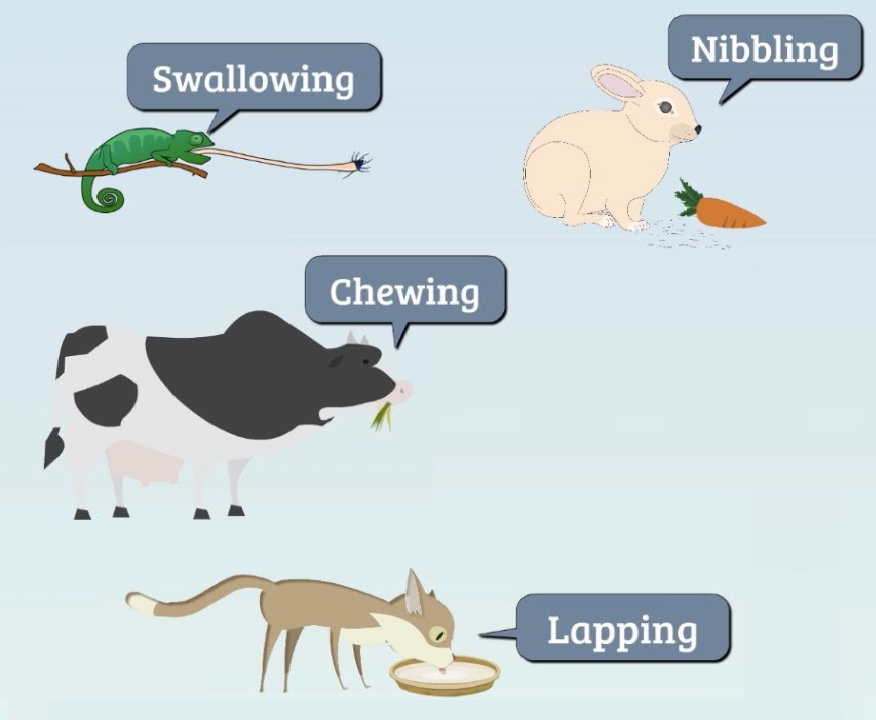
AnimalsWays of Taking in Food
Frog, chameleon, wall lizardUse tongue to catch insects.
Bee, butterfly, humming birdSuck nectar from flowers of plants.
HydraUses tentacles with sting cells to kill the prey and put it in the mouth.
ButterflyLong feeding tube to suck nectar from flowers of plants.
SnakesSwallow the whole animal in one go.
Aquatic animalsFilter tiny food particles floating nearby and feed upon them.

Digestion in Human Beings

  • The breakdown of complex components of food such as carbohydrates, proteins and fats into simpler substances such as glucose, amino acids and fatty acids respectively is called digestion.
  • Digestion in human beings is carried out in the alimentary canal of the digestive system.
  • The alimentary canal is about 8-9 metres long and consists of buccal cavity, oesophagus, stomach, small intestine, large intestine, rectum and anus.

Passage of Food in the Alimentary Canal

  • Food is crushed and broken into small particles in the mouth with the help of teeth. It is then mixed with saliva.
  • This chewed soft food then passes through the oesophagus in a wave-like movement (peristalsis) and moves to the stomach.
  • In the stomach, food mixes with gastric juices and HCl.
  • From the stomach, the food moves into the small intestine.
  • In the small intestine, carbohydrates, proteins and fats are broken down with the help of juices secreted by the pancreas, the liver and the small intestine itself.
  • The broken down food is then absorbed by small projections present on the inner walls of the intestine called villi.
  • Finally, the food moves into the large intestine where most of the water is removed from the food and is then thrown out of the body through the anus.

Digestion in Grass-eating Animals
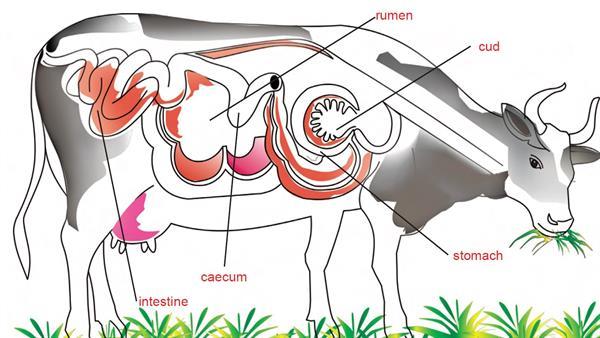
Digestion in herbivorous animals — lesson. Science CBSE, Class 7.
  • Cows and buffaloes fall in the category of grass-eating animals.
  • They quickly swallow the grass and store it in the rumen, where the food gets partially digested and is termed as cud.
  • The cud returns to the mouth in small lumps and the animal chews it. This process is termed as

rumination, and these animals are called ruminants.

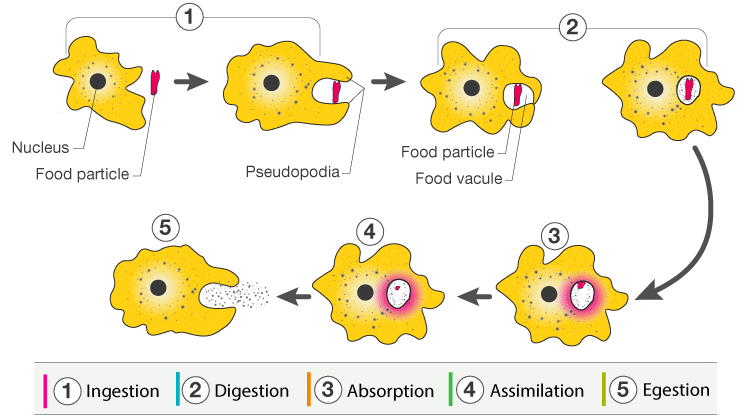
Feeding and Digestion in Amoeba
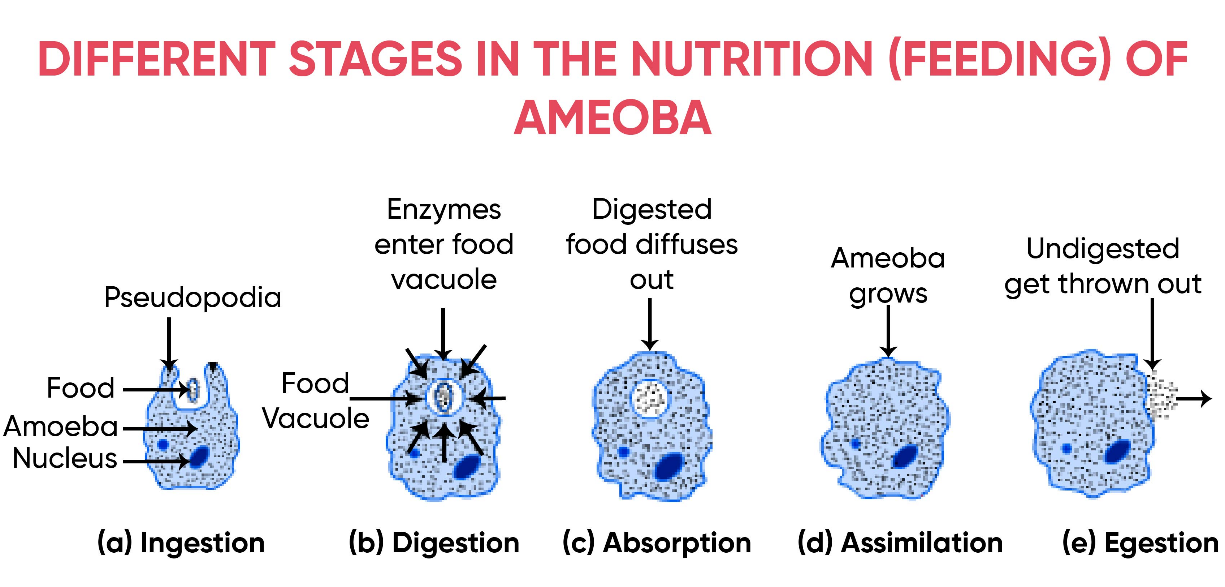
  • Amoeba is a unicellular microbe which has no definite shape, mouth or digestive system.
  • It constantly changes its shape and position in order to obtain food.
  • When it senses food, it pushes out pseudopodia or finger-like projections around the food and engulfs it.
  • The food gets trapped in food vacuoles.
  • In food vacuoles, the digestive juices are secreted which act on the food, breaking it into simpler substances.
  • Gradually, the digested food gets absorbed. These absorbed substances are used for growth, maintenance and multiplication.
  • The undigested food is expelled by the vacuole.

Small Intestine
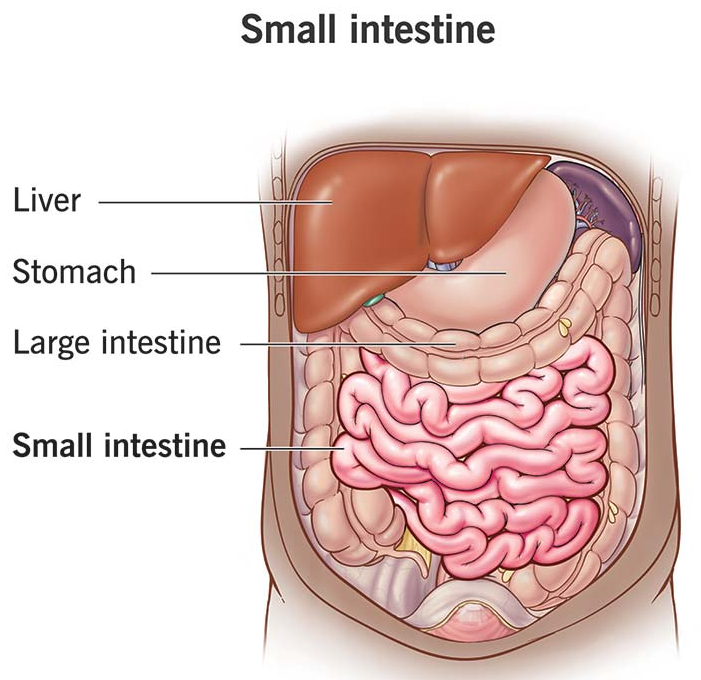
BIt is a coiled and narrow tube having 3 regions: duodenum, jejunum, and ileum. it is six to seven metres long and 2.5 cm in diameter.

Duodenum: Duodenum is the initial part of the small intestine. it is ‘C’ shaped, into which the bile and the pan creatic ducts open through a common bile duct.

Duodenal gland: Present mainly in duodenum; secretes mucous.

Jejunum: The part next to the duodenum is jejunum. It is a short region of small intestine before ileum.

Ileum: It is the longest part of the small intestine. The major part of the process of digestion of food takes place in the small intestine. The inner lining of the small intestine is produced into a number of finger-like projections called villi. Each villus is covered by a single layer of epithelium and contains blood capillaries and a small lymph vessel.

Highly organised system of blood capillaries up to villi for the transportation of absorbed food.

The villi increase the surface area for absorption. In between the villi are glandular pits having glands which secrete the digestive enzymes into the lumen of the intestine.
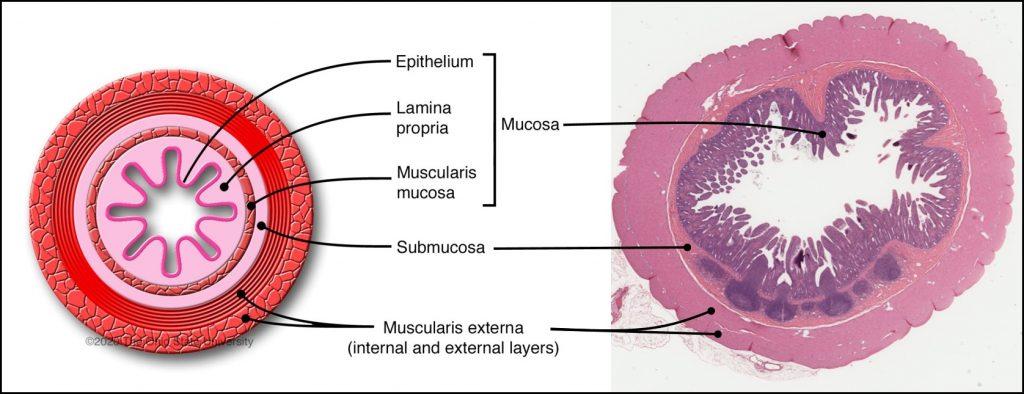
Small intestine – Veterinary Histology

lUMEN

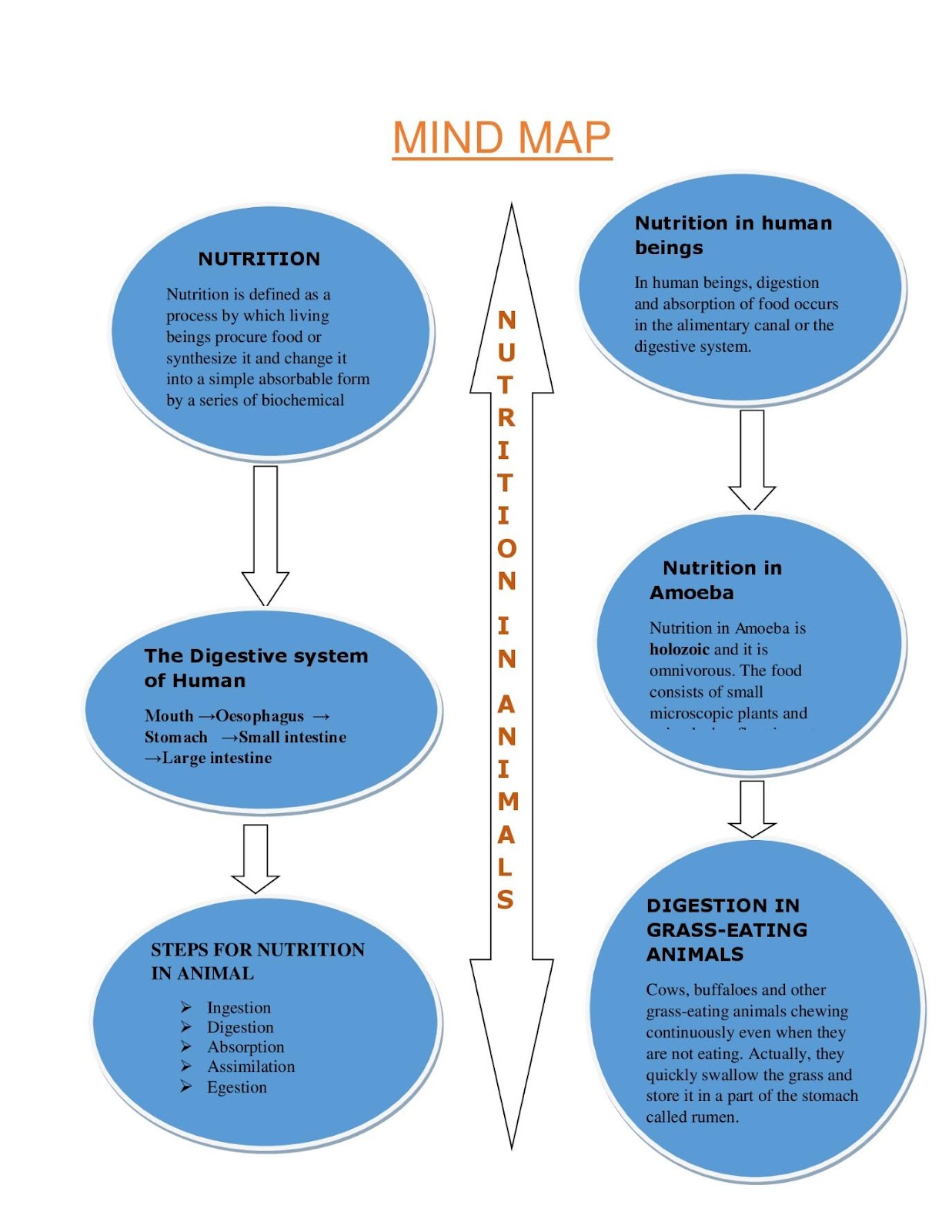
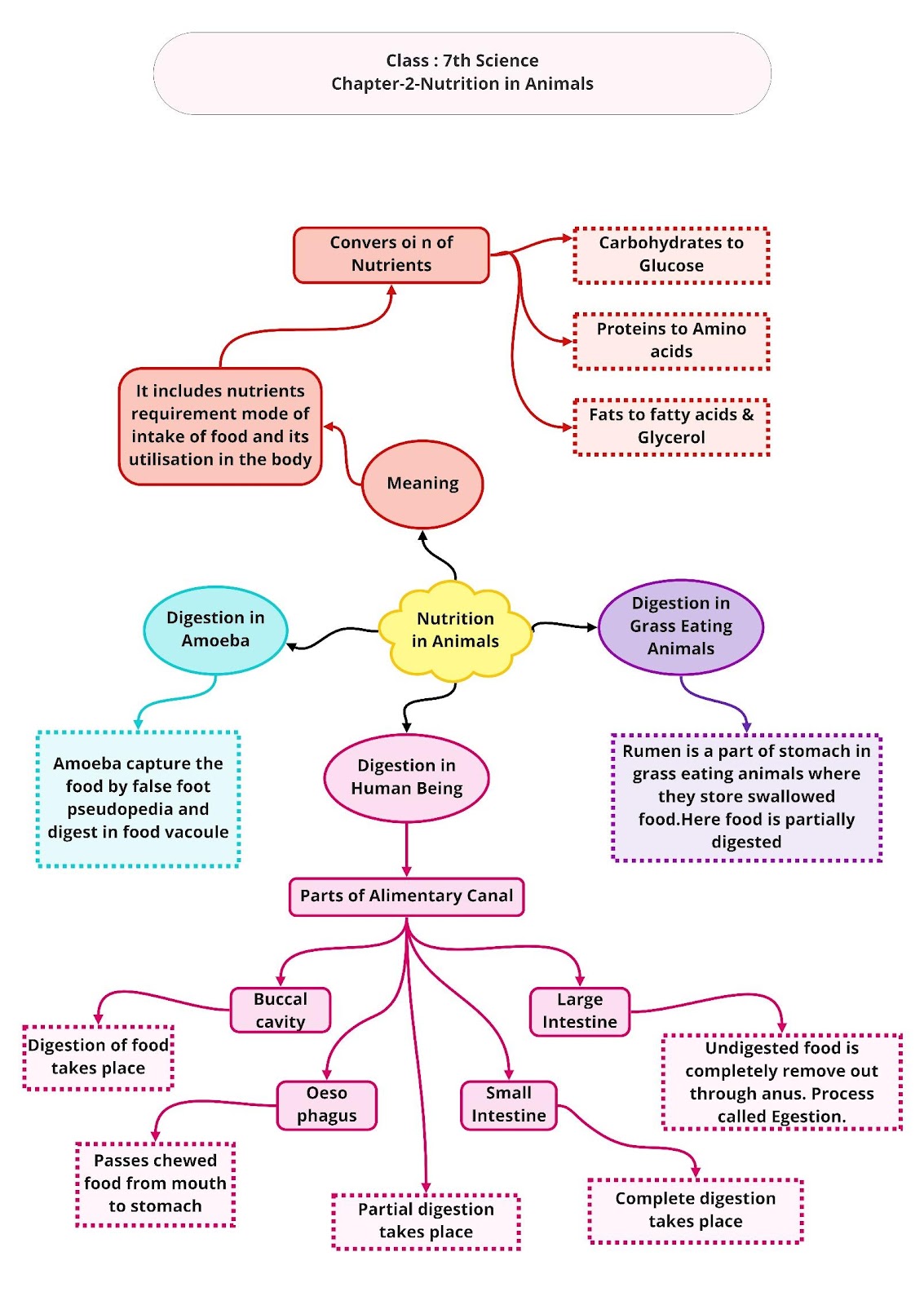
nutrition in animals mind map

Important Questions

  • Multiple Choice Questions:

Question 1. The false feet of Amoeba are used for

(a) movement only

(b) capturing food only

(c) capturing food and movement

(d) exchange of gases only

Question 2. The component of food which is complex is

(a) protein

(b) carbohydrate

(c) fat

(d) all of these

Question 3. The breakdown of complex components of food into simpler substances is called

(a) ingestion

(b) egestion

(c) assimilation

(d) digestion

Question 4. The way of taking food by bees is

(a) swallowing

(b) sucking

(c) filtering

(d) none of these

Question 5. Which of the following animals swallow its prey?

(a) Human beings

(b) Snakes

(c) Humming birds

(d) Ant

Answer

Question 6. Enzymes present in saliva converts

(a) starch into simple sugars

(b) proteins into amino acids

(c) complex sugars into simple sugars

(d) fats into fatty acids and glycerol

Question 7. From where do we take in food?

(a) Anus

(b) Mouth

(c) Stomach

(d) Oesophagus

Question 8. The digestive tract and the associated glands together constitute the

(a) digestive system

(b) oesophagus

(c) alimentary canal

(d) nutrition system

Question 9. The teeth of first set fall off at the age between

(a) 10 – 20

(b) 6 – 8

(c) 9 – 11

(d) 0 – 2

Question 10. The teeth of the first set that grew during infancy are called

(a) permanent teeth

(b) milk teeth

(c) starting teeth

(d) all of these

Question 11. The teeth of the second set that replace the milk teeth are known as

(a) permanent teeth

(b) temporary teeth

(c) milk teeth

(d) hard teeth

Question 12. The process of taking food in the body is known as

(a) egestion

(b) ingestion

(c) digestion

(d) assimilation

Question 13. How many types of teeth are there?

(a) 1

(b) 2

(c) 3

(d) 4

Question 14. The glands of mouth which secrete saliva are

(a) salivary glands

(b) pancreas

(c) lungs

(d) liver

Question 15. Starch is broken down into sugars by the action of

(a) saliva

(b) bile juice

(c) hydrochloric acid

(d) all of these

  • Fill In the Blanks:
  1. The ……………. present in the stomach kills the harmful bacteria that may enter along with the food.
  2. Animals get their food from ……………. either directly or indirectly by eating animals that eat plants.
  3. All organisms require …………….. for growth, repair and functioning of the body.
  4. We get hiccups when food particles enter the ……………..
  5. The …………….. of complex components of food into simpler substances is called digestion.
  6. Enzyme present in saliva is …………….. .
  • True or False:
  1. Diarrhoea is a condition in which one passes watery stool frequently.
  2. Oesophagus helps in the digestion of food.
  3. Ingestion is the breakdown of complex components of food into simple substances.
  4. Sugary products are the major cause of tooth decay.
  5. Food is taken in through the mouth.
  6. Alimentary canal begins at the anus and ends at the buccal cavity.
  • Very Short Question:
  1. Name the largest gland in the human body.
  2. Define digestion.
  3. Name the parts of alimentary canal.
  4. Name the glands that secrete digestive juice.
  5. Name the mode of feeding of ant and mosquitoes.
  6. Name ruminants.
  7. Name the different types of teeth.
  8. Name the finger like projection present in the inner wall of the small intestine.
  9. Name the organ responsible for removal of undigested and unabsorbed residues from human body.
  10. Name the type of food of ant
  • Short Questions:
  1. What do you mean by animal nutrition?
  2. What is digestion?
  3. Name different modes of feeding in animals?
  4. What are villi? What are their location and function?
  5. Where is the bile produced? Which component of the food does it digest?
  6. Name the type of carbohydrates that can be digested by ruminants but not by humans. Give the reasons also.
  7. Why do we get instant energy from glucose?
  8. What are Milk teeth and permanent teeth?
  • Long Questions:
  1. Can we survive only on raw, leafy vegetables/ grass? Discuss.
  2. Write one similarity and one difference between nutrition in amoeba and human beings.
  3. What are the functions of the tongue in human body?
  4. Explain tooth decay?
  5. What are secreted inside the stomach?
  • Answer Key-
  • Multiple Choice Answers:
  1. (c) capturing food and movement
  2. (d) all of these
  3. (d) digestion
  4. (b) sucking
  5. (b) Snakes
  6. (a) starch into simple sugars
  7. (b) Mouth
  8. (a) digestive system
  9. (b) 6 – 8
  10. (b) milk teeth
  11. (a) permanent teeth
  12. (b) ingestion
  13. (d) 4
  14. (a) salivary glands
  15. (a) saliva
  • Fill In the Blanks:
  1. acid
  2. plants
  3. food
  4. windpipe
  5. break down
  6. salivary amylase
  • True or False:
  1. True
  2. False
  3. False
  4. True
  5. True
  6. False
  • Very Short Answers:
  1. Answer: Liver
  2. Answer: The process of breakdown of complex substances of food into simpler form is called digestion.
  3. Answer: Buccal cavity, oesophagus, stomach, small intestine, large intestine, rectum and anus.
  4. Answer: Salivary gland, pancreas and liver
  5. Answer: The mode of feeding of ant: scraping and the mode of feeding of mosquitoes sucking.
  6. Answer: Grazing animals like: Cow, buffaloes and deer.
  7. Answer: Incisor, canine, premolar and molar.
  8. Answer: Villi
  9. Answer: Anus
  10. Answer: Ant: sugar, food particles
  • Short Answer:
  1. Answer: Animal nutrition includes requirement of nutrients, mode of intake of food, and its utilization in the body.
  2. Answer: Digestion is the process of breakdown of complex components of food such as carbohydrates into simpler substances that is absorbed and assimilated in the body.
  3. Answer: Scraping, chewing, brewing, capturing and swallowing, sucking etc. are the different mode of feeding in animals.
  4. Answer: The inner wall of the small intestine has thousands of finger-like outgrowths called villi.

These are found in small intestine. The villi increase the surface area for absorption of food.

  1. Answer: Bile is produced in the liver and is stored in a sac called the gall bladder. The bile plays an important role in the digestion of fats.
  2. Answer: Cellulose is the carbohydrate that can be digested by ruminants. Ruminants have large sac like structure between the small intestine and large intestine. The cellulose of the food is digested by the action of certain bacteria which are not present in human beings.
  3. Answer: Because glucose easily breakdown in the cell with the help of oxygen and give carbon dioxide, water and energy.
  4. Answer: The first set of teeth grows during infancy and they fall off at the age between six to eight years. These are termed as milk teeth. The second set that replaces them are the permanent teeth. The permanent teeth may last throughout our life or fall off during old age.
  • Long Answer:
  1. Answer: We know that animals like most of the bacteria, non-green plants and human being do not possess the ability to synthesize their own food. Therefore, they depend upon autotrophs for their food supply either directly or indirectly. The green plants (leafy vegetables/ grass) trap solar energy and manufacture their food in the form of glucose. So, leafy vegetables and grass can provide sufficient energy required for the survival of human being.
  2. Answer: Similarity: During the digestion of food, in amoeba digestive juices are secreted into the food vacuole. They act on the food and break it into simpler substances. In human being, the inner walls of stomach and the small intestine also secrete the digestive juices. The digestive juices convert complex substances of food to simpler ones. 

Difference: Amoeba feeds on some microscopic organisms. When it senses food, it pushes out pseudopodia around the food particles. The food is trapped in a food vacuole. Human beings take food through the mouth, digest and utilize it. The food is gradually digested as food travels through the various compartments.

  1. Answer: The functions of the tongue are as follows:

i. It is used for talking, it is not possible to talk without this.

ii. It mixes saliva with the food during chewing and helps in swallowing of food.

iii. Due to the presence of taste buds on it, It is used to identify the taste of food like sweet or salty etc.

  1. Answer: Our mouth contains some useful bacteria but if we do not clean our teeth and mouth after eating, many harmful bacteria also begin to live and grow in it. These bacteria break down the sugars present from the leftover food and release acids. These acids gradually damage the teeth and causes tooth decay.
  2. Answer: Gastric juice is secreted by the walls of stomach which contains HCl and Pepsin. HCl helps to kill the germs present in food. After mixing with the food it provides an acidic medium to the food which is essential for the activation of pepsin enzyme. Pepsin digests protein into peptides.


Class 7 Biology – CHAPTER 1 : NUTRITION IN PLANTS

0
A picture containing text

Description automatically generated

Nutrition in Plants

What is Nutrition?

The Role of Nutrition in Health
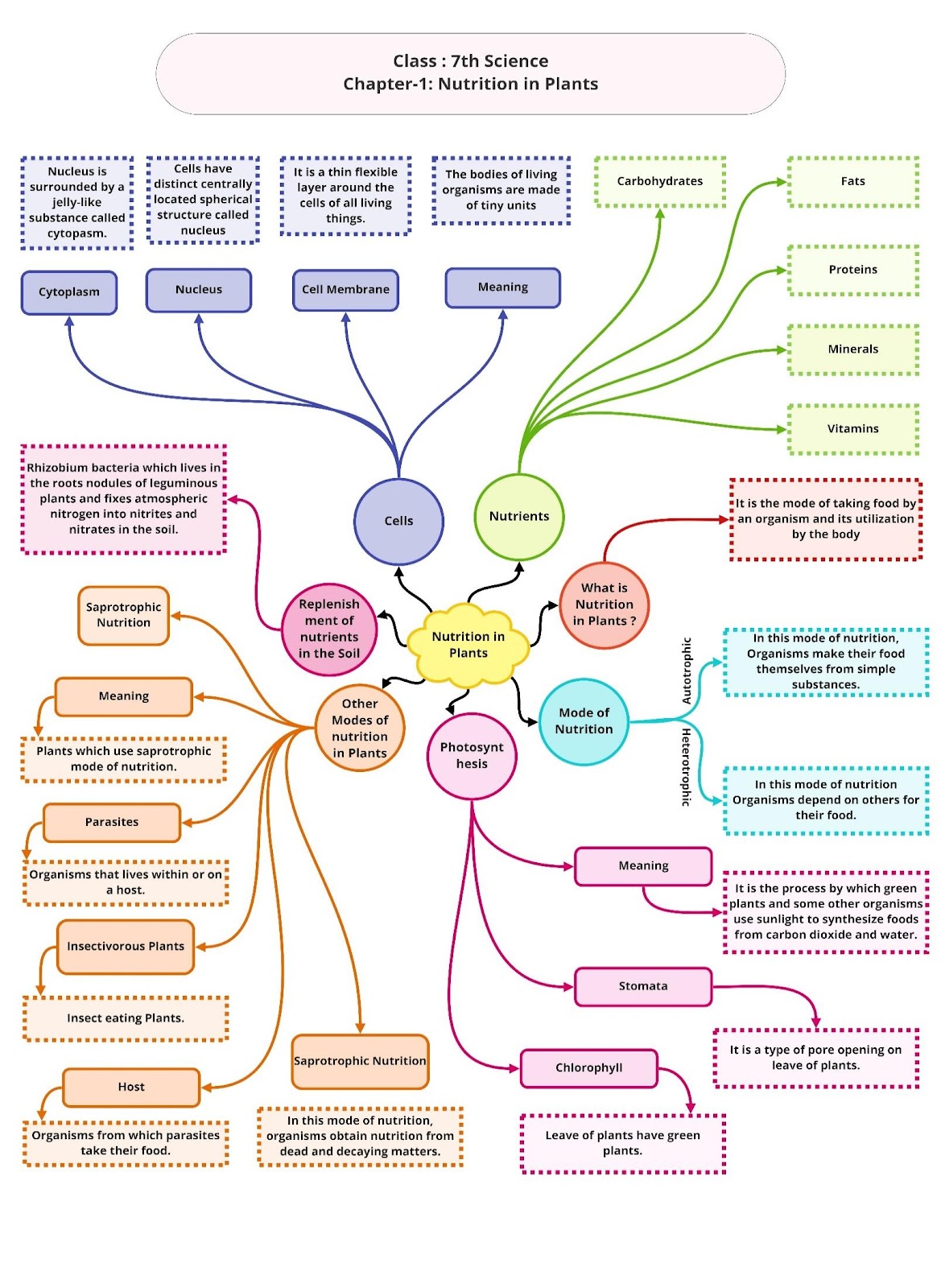
  • Nutrition is the mode of taking in food by an organism and its utilisation by the body.
  • Nutrients in animal – These are the substances required by our body for its growth, repair, work and maintenance of the body. Different types of nutrients are carbohydrates, fats, proteins, vitamins, minerals etc. Our daily energy need may vary according to our occupation, age, sex and under some specific conditions.
  • The nutrients present in the food help living organisms to build their body and to grow and repair damaged parts of the body.
Timeline

Description automatically generated with low confidence

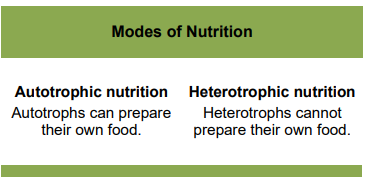
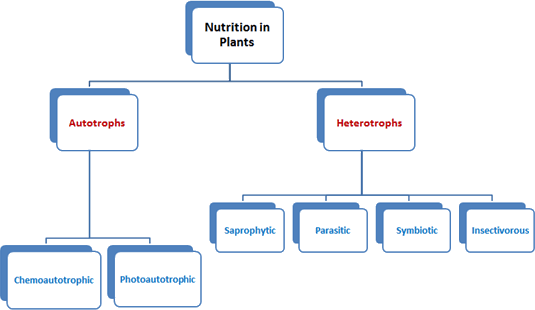
Autotrophic

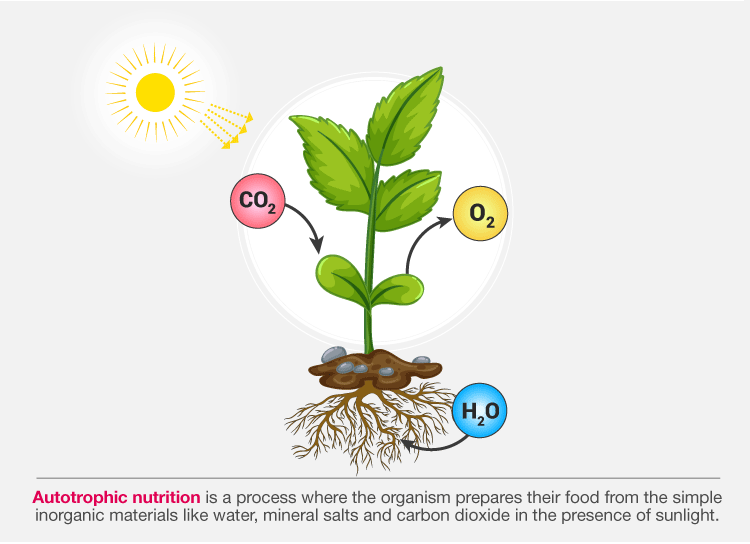
It is a mode of nutrition in which organisms prepare their own food. Inorganic molecules like CO2 and H2O are converted into organic molecules like carbohydrates in the presence of sunlight and chlorophyll.

E.g. Green plants. Autotrophs are further categorized as:

  • Photoautotrophs: Those which utilize sunlight for preparing their food e.g. green plants.
  • Chemoautotrophs: Those which utilize chemical energy for preparing their food, e.g. Purple sulphur bacteria.

Photosynthesis

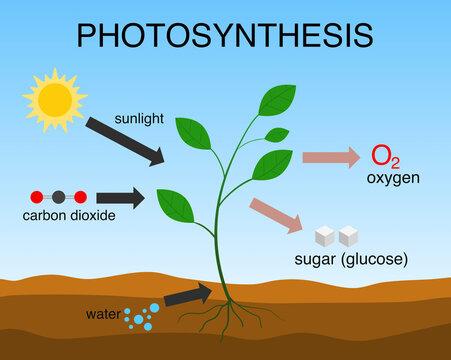
Photosynthesis Diagram Images – Browse 724 Stock Photos, Vectors, and Video  | Adobe Stock
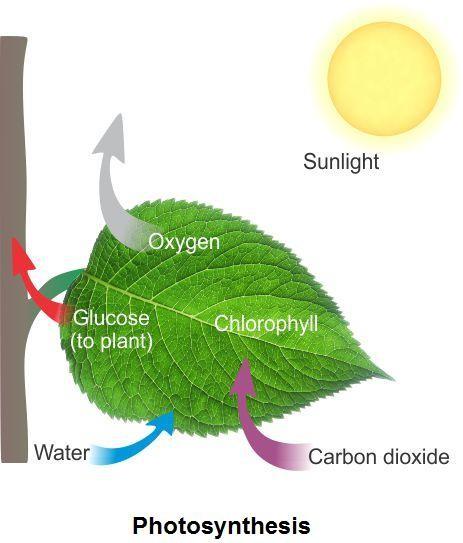
  • Plants prepare their own food in the presence of sunlight and the green pigment chlorophyll by a process termed as photosynthesis.
  • The process of photosynthesis requires carbon dioxide, water, minerals, sunlight and chlorophyll.
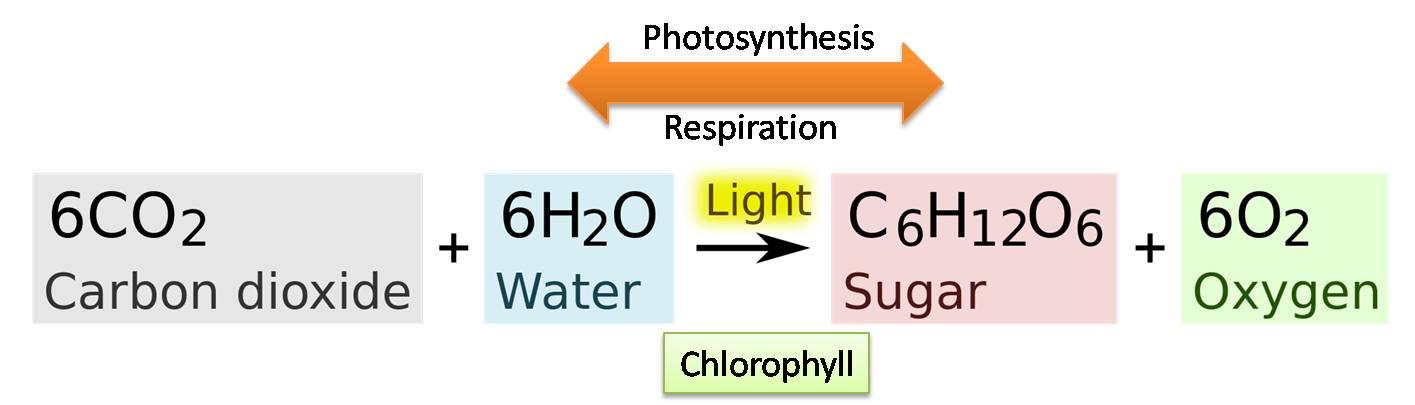
  • During photosynthesis, chlorophyll containing cells of leaves use carbon dioxide and water in the presence of sunlight to synthesise carbohydrates along with the release of oxygen.
  • Carbohydrates ultimately get converted to starch, and hence, the presence of starch in leaves indicates the occurrence of photosynthesis.
What is the correct balanced equation of Photosynthesis?

Importance of Photosynthesis

  • Photosynthesis is a unique process where solar energy captured by leaves is stored as food in plants.
  • The oxygen released in the atmospheric air during photosynthesis is useful because oxygen is required by all living beings including plants.

Synthesis of Plant food other than Carbohydrates

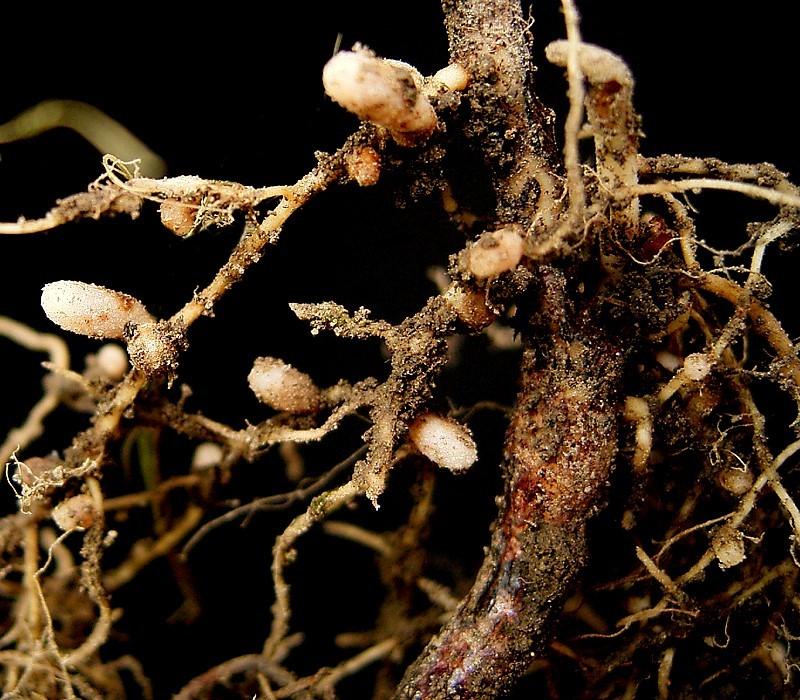
Rhizobium: nitrogen fixing bacteria – Inanimate Life
  • The soil contains some nitrogen-fixing bacteria which convert gaseous nitrogen into a more usable form and release it into the soil.
  • These bacteria are present in the root nodules of leguminous plants.
    Example: Rhizobium is usually found in the roots of gram, peas, moong and other legumes.
  • The plants provide food and shelter to the bacteria, and in return, the bacteria fix nitrogen for the plants.
  • Certain plants convert carbohydrate into oils and store them in seeds. Example: Sunflower seeds. The oil obtained from plant seeds is commonly known as vegetable oil.
  • Vitamins made by plants are contained in vegetables, fruits and cereals.
  • Plants combine some of the carbohydrate (made during photosynthesis) with nitrate minerals (obtained from soil) to make amino acids which are then made into proteins.

Other Modes of Nutrition in Plants

  • Some plants lack chlorophyll and hence, are unable to prepare their own food. This type of nutrition is termed as heterotrophic nutrition. Examples: Humans and all animals.
Diagram

Description automatically generated
Types of Heterotrophic NutritionExamples
ParasiticCuscuta plantIt does not have chlorophyll and consumes food prepared by other plants.
InsectivorousPitcher plantIt traps insects inside its pitcher and eats them.
SaprophyticFungiThese organisms take in nutrients from dead and decaying matter.
MushroomIt takes nutrition from rotting wood of a dead tree.
Symbiotic associationLichenLichens are a symbiotic association between algae and fungus.The fungus provides shelter, water and minerals to the alga, which in return provides food to the fungus.Algae contain chlorophyll and hence, are able toprepare food.

Replenishment of Nutrients in Soil

  • Plants use nutrients available in the soil. Due to this, the amount of nutrients keeps declining in the soil.
  • Fertilisers and manures which contain phosphorus, potassium, nitrogen etc. are constantly added to the soil from time to time to enrich the soil.
  • Gardeners also use fertilisers in lawns and potted plants.
  • Two common types of fertilisers are NPK (Nitrogen, Phosphorus and Potassium) and Urea.
  • In addition, the association between nitrogen-fixing bacteria and plants provides nitrogen, and hence, farmers need not add nitrogen fertiliser to the soil where leguminous plants grow.

Important Questions

  • Multiple Choice Questions:

Question 1. Fungi is a

(a) parasite

(b) autotroph

(c) saprotroph

(d) insectivore

Question 2. Human beings can be categorized as

(a) parasite

(b) heterotrophs

(c) saprotrophs

(d) autotrophs

Question 3. Human beings get food from

(a) plants

(b) animals

(c) neither (a) or (b)

(d) both (a) and (b)

Question 4. Parasites obtain their food from

(a) insects

(b) plants

(c) animals

(d) all of these

Question 5. Which part of plant is called food factory?

(a) Fruits

(b) Seeds

(c) Leaves

(d) Flowers

Question 6. The green pigment that is present in the leaves are called

(a) haemoglobin

(b) globulin

(c) albumin

(d) chlorophyll

Question 7. Which of the following is an insectivorous plant?

(a) Pitcher plant

(b) Cuscuta

(c) Algae

(d) Lichens

Question 8. Which of the following is a nutrient?

(a) Fats

(b) Vitamins

(c) Proteins

(d) All of these

Question 9. The organisms which prepare their own food are known as

(a) saprotrophs

(b) autotrophs

(c) heterotrophs

(d) none of these

Question 10. ________ is essential for all living organisms.

(a) Protein

(b) Fat

(c) Food

(d) None of these

Question 11. Photosynthesis will not occur in leaves in the absence of

(a) guard cells

(b) chlorophyll

(c) vacuole

(d) space between cells

Question 12. The raw materials used for photosynthesis are:

(a) CO2, O2, H2

(b) CO2, water

(c) N2, water

(d) O2 water

Question 13. The process by which green plants prepare their own food in the presence of sunlight is called

(a) saprophytic nutrition

(b) photosynthesis

(c) cellular nutrition

(d) nutrition

Question 14. Ultimate source of energy is

(a) chemical energy

(b) wind energy

(c) solar energy

(d) water energy

Question 15. Which one of the following is an autotroph?

(a) Lichens

(b) Algae

(c) Fungus

(d) Cuscuta

  • Fill In the Blanks:
  1. Solar energy is stored in leaves with the help of …………………
  2. All green plants are called …………………
  3. Plants and animals which depend on others for their food are called …………………
  4. The ………………… help in the opening and closing of the stomata.
  5. Plants can synthesize components of food other than carbohydrates such as ………………… and …………………
  6. In ………………… nutrition organisms prepare their food themselves
  • True or False:
  1. Green plants are autotrophs.
  2. Oxygen is not released during photosynthesis.
  3. Yeast and mushrooms are useful for us.
  4. Food is essential for all living organisms.
  5. The sun is the ultimate source of energy for all living beings.
  6. The cell is enclosed by a thin outer boundary called cytoplasm.
  • Very Short Question:
  1. Name some components of food.
  2. Define nutrients.
  3. Give an example of autotrophs.
  4. Give an example of heterotrophs.
  5. Plants prepare their food by using raw materials present in ___________.
  6. What do you mean by nutrition?
  7. Name the food factories of plants.
  8. Name the tiny pores present on the surface of leaves.
  9. Name the green pigment present in leaves.
  10. ____________ helps leaves to capture the energy of sunlight
  • Short Questions:
  1. What is Nutrients?
  2. How humans and animals are directly or indirectly dependent on plants.
  3. What is food?
  4. Why do we need food?
  5. How do plants obtain the raw materials from the surroundings?
  6. What is cell?
  7. What is the cell membrane?
  8. What is tissue?
  • Long Questions:
  1. Sun is called the ultimate source of energy for all living organisms. Comments.
  2. What is Symbiosis? What is Symbiotic relationship?
  3. Explain the two mode of nutrition in plants.
  4. What are stomata? Explain their function.
  5. How is sunlight used by the plant for photosynthesis?
  • Answer Key-
  • Multiple Choice Answers:
  1. (c) saprotroph
  2. (b) heterotrophs
  3. (d) both (a) and (b)
  4. (d) all of these
  5. (c) Leaves
  6. (d) chlorophyll
  7. (a) Pitcher plant
  8. (d) All of these
  9. (b) autotrophs
  10. (c) Food
  11. (b) chlorophyll
  12. (b) CO2, water
  13. (b) photosynthesis
  14. (c) solar energy
  15. (b) Algae
  • Fill In the Blanks:
  1. Chlorophyll
  2. Autotrophs
  3. Heterotrophs
  4. Guard cell
  5. Proteins, fats
  6. Autotrophic
  • True or False:
  1. True
  2. False
  3. True
  4. True
  5. True
  6. False
  • Very Short Answers:
  1. Answer: Carbohydrates, proteins, fats, vitamins and minerals.
  2. Answer: Carbohydrates, proteins, fats, vitamins and minerals are essential components of food, these components are called nutrients.
  3. Answer: All green plants.
  4. Answer: Animals and human beings.
  5. Answer: Surrounding
  6. Answer: Nutrition is the mode of taking food by an organism and its utilization by body.
  7. Answer: Leaves
  8. Answer: Stomata
  9. Answer: Chlorophyll
  10. Answer: Chlorophyll
  • Short Answer:
  1. Answer: Carbohydrates, proteins, fats, vitamins, and minerals are components of food. The chemical substance present in components of food is necessary for our body and is called nutrients.
  2. Answer: All living organisms require food. Plants can make their food themselves but animals including humans cannot. They get it from plants or animals that eat plants. Thus, humans and animals are directly or indirectly dependent on plants.
  3. Answer: Food is the source of energy, and every cell of an organism gets energy by the breakdown of glucose. The cells use this energy to carry out vital activities of life.
  4. Answer:  Living organisms need food to build their bodies, to grow, to repair damaged parts of their bodies and provide the energy to carry out life processes.
  5. Answer: Water and minerals present in the soil are absorbed by the roots and transported to the leaves.

Carbon dioxide from air is taken in through the tiny pores present on the surface of the leaves. Such pores are called stomata. These pores are surrounded by ‘guard cells.

  1. Answer: The bodies of living organisms are made of tiny units called cells therefore Cell are called the building blocks of living organism. Cells can be seen only under the microscope. Some organisms are made of only one cell. They are called Unicellular Ex. Amoeba, Paramecium etc. Living organism made up of many cells are called Multicellular like man, tree etc.
A picture containing text, vector graphics

Description automatically generated
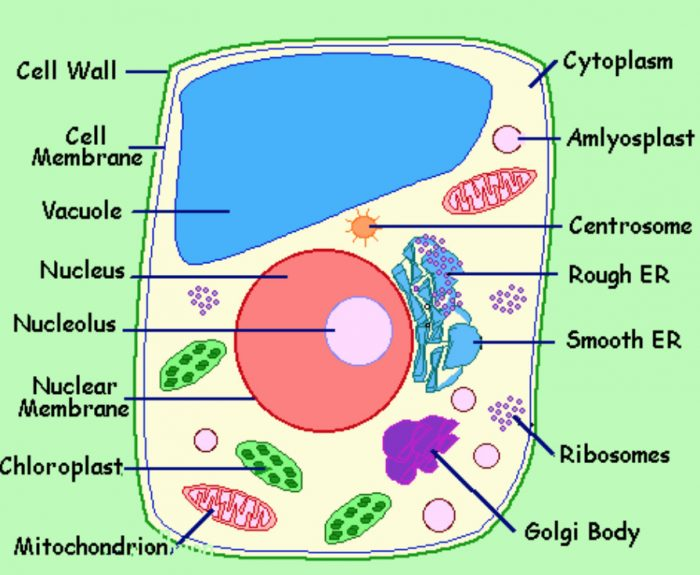
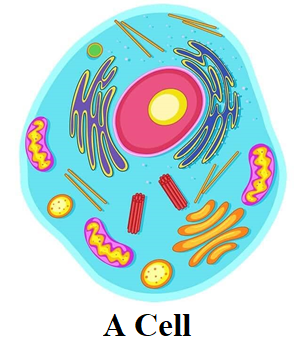
  1. Answer: The cell is enclosed by a thin outer boundary, called the cell membrane Most cells have a distinct, centrally located spherical structure called the nucleus The nucleus is surrounded by a jelly-like substance called cytoplasm.
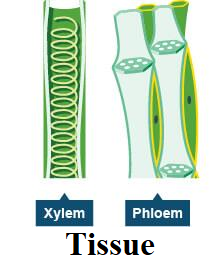
  2. Answer: A tissue is a group of cells that perform specialized function in an organism. For example, the vascular tissue for the transport of water and nutrients in the plant is called the xylem.
A group of test tubes

Description automatically generated with low confidence
  • Long Answer:
  1. Answer: The solar energy is very important to carry out the process of photosynthesis, it is captured by the leaves and stored in the plant in the form of food. And this in turn use by other organism to get food to obtain energy Thus, we say that sun is the ultimate source of energy for all living organisms.
  2. Answer: Symbiosis: It is the type of nutrition in which two different kinds of depend on each other for their nutrition. In this both the organisms are benefited by each other Example: Lichen. In this one alga and one fungus live together and remain in symbiotic relationship.

Symbiotic Relationship: Some organisms live together and share shelter and nutrients. This type of relationship is called symbiotic relationship.

  1. Answer:  
Diagram

Description automatically generated

 Autotrophs or Autotrophic: – In this mode of nutrition organisms make their food themselves from simple substances. All green plants are Autotrophs (Auto means self and trophs means nourishment)

Heterotrophs or heterotrophic: – Heterotrophic organisms are those who obtain food from other organisms. Since these organisms depend on other organisms for their food, they are called consumers. All animals and non-green plants like fungi come under this category.

  1. Answer: Stomata are tiny pores on the underside of the leaf surface that are surrounded by guard cells. Their functions are to exchange gases by diffusion for photosynthesis and respiration and to cause transpiration by evaporation of water from the leaf surface.
  2. Answer: Sunlight is the energy source for photosynthesis. It is trapped by the green pigment chlorophyll that is present in the leaves and all green parts pf the plants. The chlorophyll is present in organelles called chloroplasts. Most of the chlorophyll is present in the leaves and therefore leaves are the major site for trapping sunlight to convert it to chemical energy.

Class 7 Civics – CHAPTER 8 : A SHIRT IN THE MARKET

0
Civics Practitioner - CCHS - Credly

A SHIRT IN THE MARKET

Life of a Cotton Farmer

The life of a cotton farmer is not easy. Many farmers who grow cotton have small farms and have to work hard to harvest the cotton crop. After harvesting the cotton, the farmers generally sell the cotton to the nearby traders. Some traders also provide loans to the farmers at very high interest rates. Also, while providing the loans, they sometimes put forth the condition before the farmers that they would sell their cotton produce only to them. The farmers are thus forced to sell their cotton to the same trader, who gives them a minimum price for their produce. This results in the exploitation and poverty of the cotton farmers.

Role of Weavers in the Production of Cloth

  • Merchants give work to the weavers depending on the type of order they receive for making a cloth.
  • The weavers generally get yarn from the merchants. This is beneficial to the weavers as they do not have to spend their money on purchasing the yarn.
  • Also they do not have to worry about selling the cloth made, as this responsibility is taken by the merchants. Weavers also know in advance the kind of the cloth they need to weave.
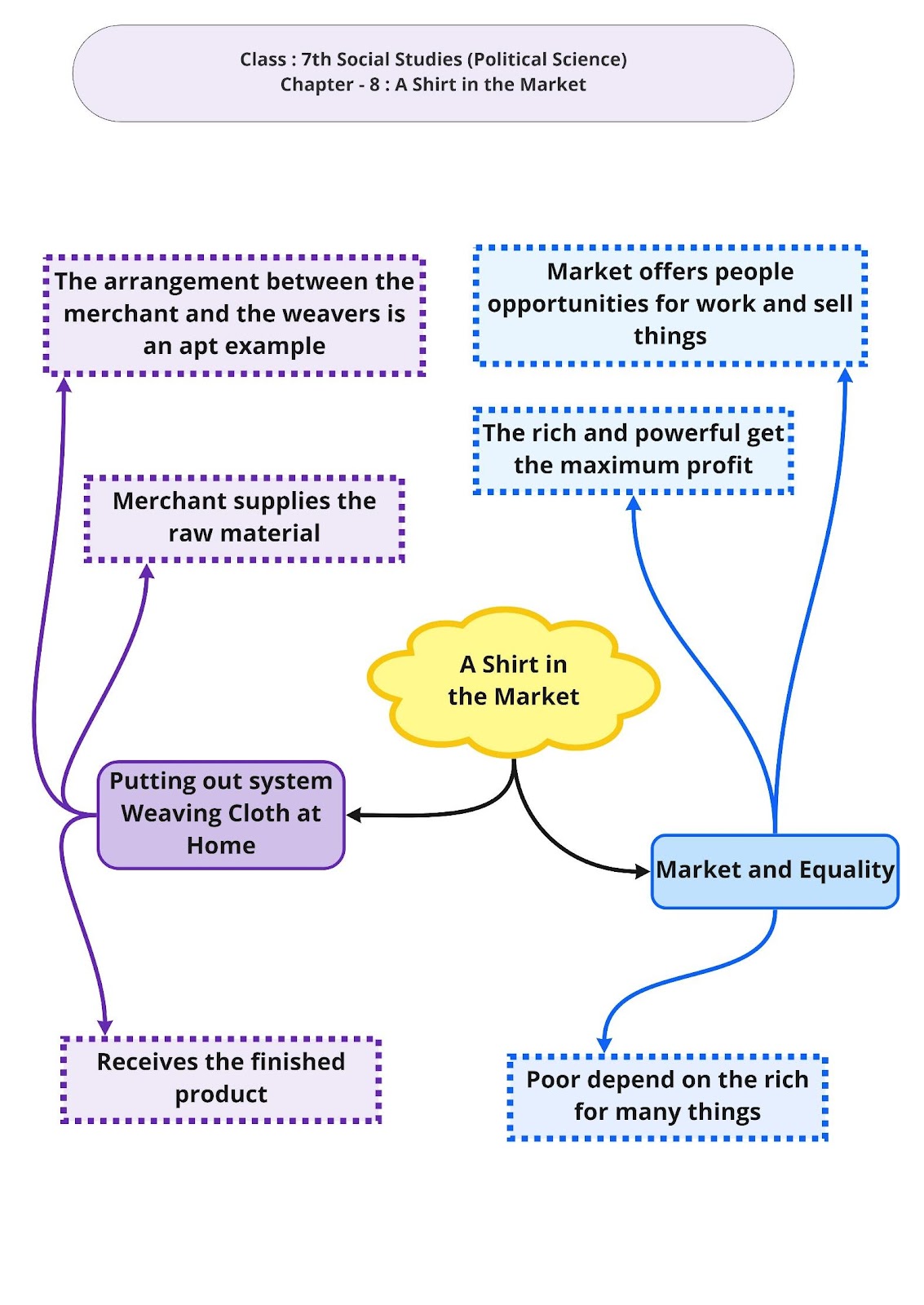
  • This arrangement between a merchant and a weaver is known as the putting out system. In this system, the merchant provides the raw materials to the weavers and buys the finished products from them. This system is practiced in the weaving industries in many parts of the country.
  • One negative aspect of the above arrangement between the merchants and the weavers is that it makes the merchants very powerful. They pay a very little amount to the weavers for weaving the cloth.
  • The merchants then sell the cloth to garment factories and earn huge profits. In this way, the market favours the merchants more than it favours the weavers.
  • The life of a weaver is not easy. Weavers buy looms for weaving cloth by borrowing money at a high rate of interest.
  • Once the looms are purchased, they work along with their family members on the loom stretching up to twelve hours per day.
  • Despite this, most weavers are able to earn only Rs. 3,500 per month through their work.

Role of Garment Factories

  • The cloth, woven by the weavers, is sold to the garment factories by the merchants at a high profit.
  • The garment factory then makes shirts, dresses, saris and other kinds of clothing from the cloth.
  • The garment factories either sell these finished products to shops in various parts of the country or export the cloth to foreign countries.
  • The foreign buyers are generally large stores who do business strictly on their own terms. They purchase the finished cloth at very cheap rates. Besides, they purchase products of high quality and expect the products to be delivered at the given time.
  • The suppliers try their best to meet the demands of these store houses.
  • Garment factory owners try to reduce the cost of production in order to maximise their profits.
  • This is done by hiring workers at extremely low wages.
  • Mostly, workers in the textile industry work the maximum at the lowest possible wages.
  • Workers have no job security as they can be asked to leave during lean period.
  • Women are generally employed for thread cutting, buttoning, ironing and packaging and are paid minimum wages.

Gainers in the Markets

Purchasing and selling of cloth takes place at every step in the market. The gainers in this market are merchants and garment factories who make huge profits. The garment stores which sell their products at very high prices make the most profits. The cotton farmers and weavers who do the majority of the work suffer as they do not get paid according to the work they do.

Equality in the Markets

  • In the textile market, garment exporters make moderate profits while garment stores and foreign businessmen make huge profits.
  • The wages of the workers in the factories are so low that they are barely able to fulfill their day to day needs.
  • Similarly the cotton farmers are also not able to earn enough to fulfill the daily needs of their family as they do not get a fair price of the cotton they sell in the market.
  • Therefore, we see that everyone does not gain and earn equally in the markets.
  • The growers and producers do not get just profits for their work while the rich and powerful earn maximum from the markets. Since these merchants have money, own land and shops, the poor sections of society depend upon them for various resources.
  • Because the poor people are dependant on the rich sections of society, they are exploited by the rich.
  • Hence laws should be framed to protect the interests of the farmers and the weavers.
  • One such step is the formation of various cooperatives of producers to ensure that the laws are followed strictly.

Important Questions

  • Multiple Choice Questions:

Question 1. The Impex garment factory employs mostly:

(a) Women

(b) Men

(c) Children

Question 2. The workers in the garment factory work atleast:

(a) 1 to 3 hours

(b) 10 to 12 hours

(c) 6 hours

Question 3. Who links the producer of cotton to the buyer at the supermarket?

(a) A chain of market

(b) Only wholesalers

(c) None

Question 4. Small farmers are exploited by:

(a) Consumers

(b) Producers

(c) Big traders

Question 5. The one of the world’s biggest bi-weekly market of Erode is located in:

(a) Kerala

(b) Karnataka

(c) Tamil Nadu

Question 6. How a merchant distributes work among the weavers?

(a) Based on orders received

(b) Based on wages

(c) Based on ages

(d) None of these

Question 7. What do you think large farmers would sell their cotton?

(a) Weekly market

(b) Market

(c) Export

(d) Import

Question 8. Who sends the manufactured garments to other countries of the world?

(a) Exporter

(b) Importer

(c) Manufacturer

(d) Worker

Question 9. Who buys the bales of cotton to convert them into yarn?

(a) Ginning mill

(b) Spinning mill

(c) Cleaning mill

(d) Weaving mill

Question 10. What is linked in the chain of market?

(a) Producer and buyer

(b) Producer and retailer

(c) Producer and worker

(d) None of these

Question 11. Why do you think more women are employed in the Impex garment factory?

(a) They don’t take leave

(b) They agree to work at lowest wages

(c) They do finishing work

(d) None of these

Question 12. Why women are employed in garment factories?

(a) Buttoning

(b) Ironing

(c) Packaging

(d) All of the above

Question 13. How a merchant distributes work among the weavers?

(a) Based on orders received

(b) Based on wages

(c) Based on ages

(d) None of these

Question 14. Where can one-buy branded product from

(a) Wholesale market

(b) Neighbour shops

(c) Shopping complex

(d) Weekly market

Question 15. Which is the largest cloth market in the world?

(a) Tamil Nadu

(b) Delhi

(c) Ahmedabad

(d) Agra

  • Fill in the blanks:
  1. Spinning is done by _______.
  2. Small farmers are exploited by _______.
  3. _______ is a factory where seeds are removed from cotton balls.
  4. The arrangement between the merchant and the weavers is termed as ________.
  5. _______ is the amount that is left or gained from earnings after deducting all the costs.
  • Write true (T) or false (F):
  1. The trader keeps an account of the yarn given and pays them money for weaving this into cloth.
  2. Most often, the big farmers need to borrow money to meet their expenses.
  3. The weavers and their families spend long hours working on the looms.
  4. Cultivation of cotton requires high levels of inputs such as fertilisers and pesticides.
  • Very Short Questions:
  1. Why is a weekly market called so?
  2. Why is there a competition among the shops in the weekly market?
  3. Who is Scuneer? What does he do?
  4. Give some examples of roadside stalls.
  5. How are shops in the neighbourhood useful?
  6. Where are goods produced?
  7. Why do we not buy directly from the producer?
  8. Who is a retailer?
  9. Who is Aftab?
  10. How are buyers different people?
  • Short Questions:
  1. Explain the conditions of employment as well as the wages of workers in the garment exporting factory.
  2. Differentiate between a large farmer and a small farmer.
  3. How garment exporting factories maximise their own profit?
  4. Merchants hold lot of power. Explain how
  5. In what way weavers dependent upon cloth merchants?
  • Long Questions:
  1. Where do you think the large farmers would sell their cotton? How is their situation different from small and poor farmers?
  2. Write in brief about shopping complexes and malls.
  3. What is the job of a wholesale trader?
  4. How are shop owners in a weekly market and those in a shopping complex very different people?
  5. Write a brief note on ‘Aftab—the wholesaler in the city’.

ANSWER KEY –

  • Multiple Choice Answer:
  1. (a) Women
  2. (b) 10 to 12 hours
  3. (a) A chain of market
  4. (c) Big traders
  5. (c) Tamil Nadu
  6. (a) Based on orders received
  7. (b) Market
  8. (a) Exporter
  9. (b) Spinning mill
  10. (a) Producer and buyer
  11. (b) They agree to work at lowest wages
  12. (d) All of the above
  13. (a) Based on orders received
  14. (c) Shopping complex
  15. (a) Tamil Nadu
  • Fill in the blanks:
  1. cotton mill
  2. big traders
  3. Ginning mill
  4. putting-out system
  5. Profit
  • Write true (T) or false (F):
  1. True
  2. False
  3. True
  4. True
  • Very Short Answer:
  1. A weekly market is called so because it is held in a specific day of the week.
  2. In the weekly market there are many shops that sell the same goods. This creates competition among them.
  3. Sameer is a small trader in the weekly market. He buys clothes from a large trader and sells them in six different markets in a week.
  4. Vegetable hawker, fruit vendor, mechanic.
  5. These types of shops are close to our home and we can go there any time. As the buyer and seller know each other these shops also provide goods on credit.
  6. Goods are produced in factories, on farms and in homes.
  7. It is because the producer is not interested in selling goods in small quantities.
  8. A retailer is a small trader who buy goods from the wholesale trader and sells this to the consumer.
  9. Aftab is a wholesaler in the city. He purchases vegetables in bulk and sells them to hawkers and shopkeepers.
  10. There are many buyers who cannot afford evan the cheapest of goods. While others frequently visit malls and buy different items.
  • Short Answer:
  1. The conditions of employment and wages of workers in the garment factory can be described as mentioned below:

Conditions of employment – unhygienic conditions, no regular service, highly congested place, no job security, no proper arrangement of urinals / bathrooms / drinking water etc. 

Wages – very low and unfair wages, no regular job, contract job, unfair deal.

  1. A Large farmers sell their crop to the crop market at higher prices. Their situation is quite different from poor and small farmer because a small poor farmer needs to borrow money for cultivation and at the other time of exigencies. They have to sell their crops to the traders as they took loan from them and had no bargaining power. Large farmers don’t depend on others for money to start cultivation.
  2. They maximise their own profits by getting maximum work from workers at lowest price and supply the foreign buyers at cheap rates.
  3. Weaver weaves clothes that have been made on order from the merchant. Merchant also provide them yarn to weave clothes.
  4. Weaver weaves clothes that have been made on order from the merchant. Merchant also provide them yarn to weave clothes.
  • Long Answer:
  1. Large farmers would sell their cotton to the cotton market at higher prices. Their situation is quite different from poor and small farmer because unlike them, A small poor farmer needs to borrow money for cultivation and at the other time of exigencies. They have to sell cotton to the traders as they took loan from them and had no bargaining power. Large farmers don’t depend on others for money to start cultivation.
  2. Shopping complexes and malls are usually found in urban areas. These are large multi-storeyed air-conditioned buildings with shops on different floors. These shops sell both branded and non-branded goods. Fewer people visit malls because they sell costly items. Only well-to-do people can afford to buy these items.
  3. A wholesale trader buys goods from the producer in large quantities. He then sells them to other traders, say small traders. These small trader sell different items to the final consumer. Thus, the wholesale trader establishes link between the producer and the consumer. It is through these links of traders that goods reach faraway places.
  4. Both are undoubtedly different people:
  1. The shop owners in a weekly market are small traders who run their shop with little money. On the other hand the shop owners of a shopping complex are big parties. They have a lot of money to spend on their shops.
  2. What these two types of shop owners earn is also not equal. The weekly market trader earns little compared to the profit of a regular shop owner in a shopping complex.
  3. Aftab is a wholesaler of vegetables. His work usually starts around 2 o’clock in the early morning. This is the time when vegetables reach the market or mandi and with them start the activities. The vegetables come in trucks, matadors, etc. and soon the process of auctions begins. Aftab participates in this auction and decides what he will buy. He buys vegetables in bulk. After that he sells them to hawkers and shopkeepers who usually come to him around six in the morning.

Class 7 Civics – CHAPTER 7 : MARKETS AROUND US

0
Civics Practitioner - CCHS - Credly

MARKETS AROUND US

We purchase the products we require from the market. There are many kinds of markets.

Different Kinds of Markets

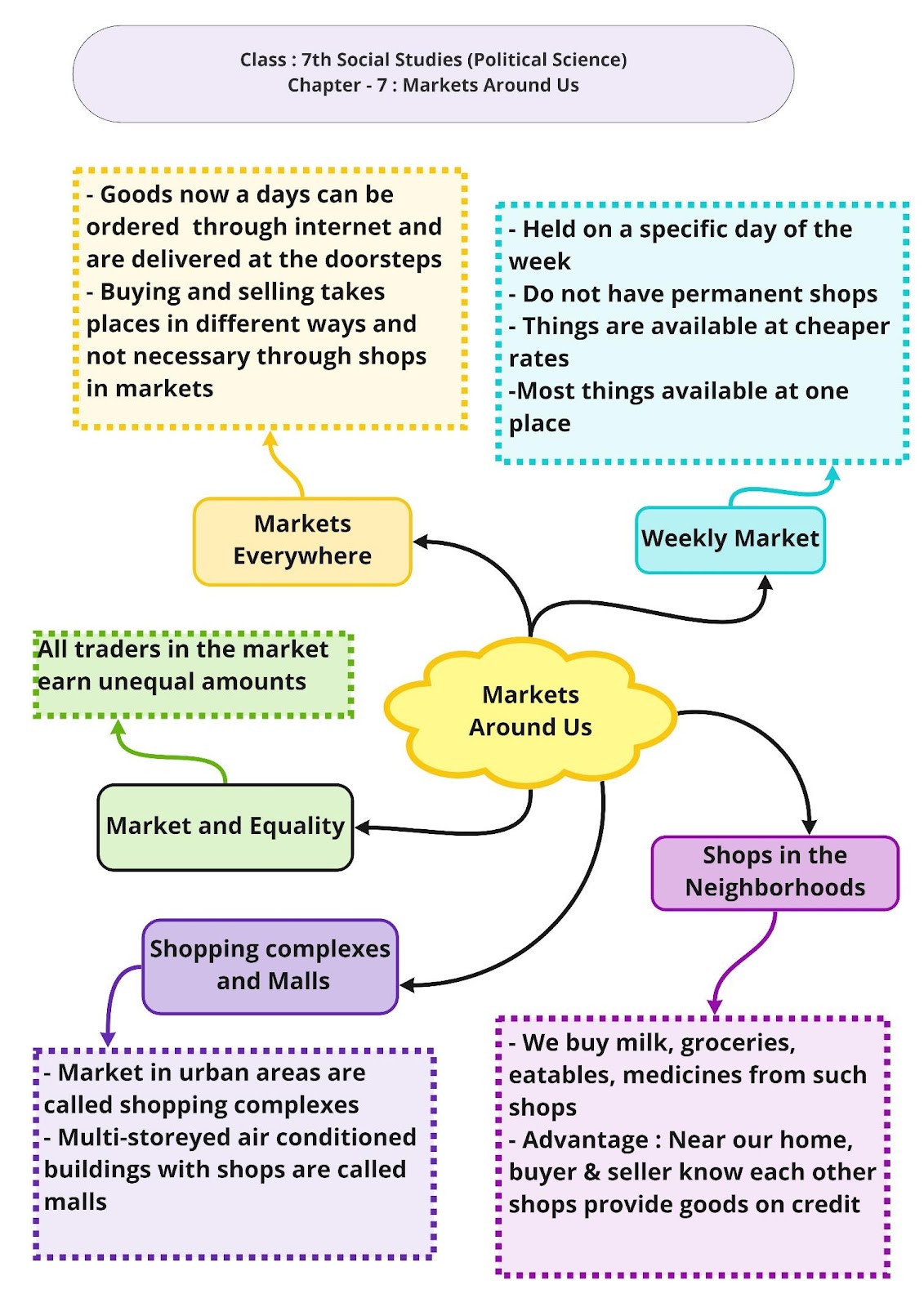
Weekly Markets

  • The weekly markets are held on a particular day of the week.
  • There are no permanent shops in the weekly markets. Traders set up their shops at one place in a particular and close them in the evening. The next day, they set up their shops in some other place.
  • Many people prefer to buy things from the weekly markets as products are available at low costs. Products are available in the weekly markets at cheap rates because:
    • Shops are not permanent and hence traders do not have to pay rent, electricity charges or fees to the government.
    • Members of the family manage the shops. Therefore, the shop owners do not have to hire workers to manufacture or sell the products.
    • In the weekly markets, many shops sell the same goods. Hence the prices are competitive.
  • One advantage of the weekly markets is that many products such vegetables, clothes, groceries etc are available at one place.
  • Weekly markets also provide a large variety of goods to the consumers.

Shops in the Neighborhood

  • Many shops are located in our neighbourhood areas.
  • While many shops such as medical, stationary, garment etc. are permanent, some shops like those selling vegetables or fruits are temporary as they sell their products on the roadside.
  • Shops in neighbourhood areas are useful in the following ways:
    • These are nearby our homes and hence we can purchase the products according to our convenience.
    • Since the buyer and seller know each other, these shops also sell products on credit.

Shopping Complexes and Malls

  • Shopping complexes and malls are usually located in the urban areas.
  • In a shopping complex, many shops are located within the premises of a building.
  • In a shopping mall, various shops are located on different floors of one separate air conditioned building.
  • Many expensive branded and non branded products are available in the shopping complexes and malls.
  • Many companies sell their products in the urban areas through the showrooms located in a shopping mall or complex.
  • Only few people are able to purchase goods from shopping complexes and malls as the products are  expensive.

Chain of Markets

Many people are linked to the process of production, transportation and selling of goods in the markets:

  • The people who produce the goods are known as producers.
  • After producing the goods, many traders purchase the products in large quantities. They are called the wholesalers.
  • The wholesalers then transport the purchased goods to different parts of a state or country.
  • They then sell the goods to a retailer, who finally sells it to the consumers.

We find markets everywhere. Many medical representatives visit doctor’s clinics in order to sell medicines. Today, we do not even need to visit the market for purchasing products. We can order various products online while sitting at home. Therefore, it can be said that buying and selling takes place at different places.

Markets and the Concept of Equality

Buyers and sellers buy and sell products according to their economic status. While a small trader may set up his/her shop in the weekly market, a rich trader may sell his/her products in a shopping complex or a mall. A shopkeeper in a weekly market earns less due to competition and the low prices of the products. But his/her counterpart in a mall has a high earning as the products are sold at higher rates. Thus, both of them earn an unequal amount.

Similarly, buyers are also differently placed. Only a few people are able to afford expensive branded products. Most people purchase commodities either from the weekly markets or from shops nearby.

Important Questions

  • Multiple Choice Questions:

Question 1. ________ spins the cotton into yarn

(a) Trader

(b) Ginning

(c) Seller

(d) Spinning

Question 2. Erode market is situated in

(a) Kerala

(b) Andhra Pradesh

(c) Odisha

(d) Tamil Nadu

Question 3. If the weavers were to buy yarn on their own and sell cloth, they would probably earn

(a) Three times more

(b) Five times more

(c) Four times more

(d) Two times more

Question 4. What is required to do cashless shopping?

(a) Ration card

(b) Credit card

(c) Driving license

(d) All of these

Question 5. What refers to buying and selling in large quantities?

(a) Weekly market

(b) Wholesale

(c) Mall

(d) Cineplex

Question 6. Who is a retailer?

(a) Small traders

(b) Whole sale

(c) Sales man

(d) None of these

Question 7. What do you mean by malls?

(a) Multi-storied building

(b) Wholesaler

(c) Retailers

(d) None of these

Question 8. Seller of weekly market earn ________ than the seller of the mall

(a) Less

(b) More

(c) Extremely larger

(d) Equal to

Question 9. On looms yarn is woven into

(a) Saree

(b) Bale

(c) Cloth

(d) Cotton

Question 10. The final product reaches the buyers through a

(a) Consumers

(b) Agents

(c) Chain of market

(d) Wholesaler

Question 11. ___________ Government runs a Free School Uniform programme in the state. The government procures the cloth for this programme from the powerloom weaver’s cooperatives.

(a) Tamil Nadu

(b) Kerala

(c) Andhra Pradesh

(d) Delhi

Question 12. Who is traders?

(a) People between employee and consumer

(b) People between producer and consumer

(c) People between staff and employee

(d) None of these

Question 13. Order of Chain of marketing

(a) Producer-Agents -Retailer- Wholesaler

(b) Agents- Producer -Wholesaler-Retailer

(c) Producer-Wholesaler-Retailer-Agents

(d) Producer-Agents-Wholesaler-Retailer

Question 14. What is done in the wholesale markets?

(a) Goods reach here at very last

(b) Goods are very higher in price

(c) Goods first reach here

(d) None of these

Question 15. What are link between producers in traders?

(a) Wholesaler

(b) Customer

(c) Retailer

(d) None of these

  • Fill in the blanks:
  1. A _______ market held on a specific day of the week.
  2. People between the producer and the final consumer are _______.
  3. A _______ is an enclosed shopping space.
  4. A _______ does not have a permanent shop.
  5. Weekly markets are advantageous as products here are _______.
  • Write true (T) or false (F):
  1. When things are sold, it encourages production and new opportunities are created for people to earn.
  2. People use their visiting cards to make ‘online purchases’.
  3. Shops in the neighbourhood are useful in many ways.
  4. People who buy and sell thing in bulk are called retailers.
  5. People who buy and sell thing in bulk are called retailers.
  • Very Short Questions:
  1. What do advertisements do?
  2. What do you mean by the word branding?
  3. Why is the consumer confused? Or What makes the consumer confused?
  4. What do the advertisers do to convince the consumer?
  5. How are brand values conveyed to us?
  6. When products are advertised by cricket heroes and film stars, we feel tempted to buy them. Why?
  7. Advertisements aim to get people to buy a particular brand’. What does this really mean?
  8. Why do companies show the advertisements again and again?
  9. Under what pressure do companies show the advertisements again and again?
  10. What do you mean by social advertisements?
  • Short Questions:
  1. Why weekly markets are cheaper than permanent shops?
  2. Why Neighbourhood market is preferred by the Indians?
  3. Differentiate between shopping complexes and malls.
  4. Establish relationship between the market and the inequality?
  5. Differentiate between permanent and temporary shops.
  • Long Questions:
  1. How are small businessmen affected in this age of advertisements?  
  2. Mention the drawbacks of advertising.
  3. What brand values are used by the two daals namely Top Taste Daal’ and ‘Best Taste Daal’?
  4. How is personal emotion being used in the Care Soap advertisement?
  5. What role do advertisements play in our lives?  

ANSWER KEY –

  • Multiple Choice Answer:
  1. (d) Spinning
  2. (d) Tamil Nadu
  3. (a) Three times more
  4. (b) Credit card
  5. (b) Wholesale
  6. (a) Small traders
  7. (a) Multi-storied building
  8. (a) Less
  9. (c) Cloth
  10. (c) Chain of market
  11. (a) Tamil Nadu
  12. (b) People between producer and consumer
  13. (d) Producer-Agents-Wholesaler-Retailer
  14. (c) Goods first reach here
  15. (b) Customer
  • Fill in the blanks:
  1. weekly
  2. traders
  3. mall
  4. hawker
  5. cheaper
  • Write true (T) or false (F):
  1. True
  2. False
  3. True
  4. False
  5. True
  • Very Short Answer:
  1. They attract people’s attention to their products.
  2. The naming of a product is called branding.
  3. Sometimes there are two or more advertisements of a similar product. This makes the consumer confused because it becomes difficult for him to differentiate one product from the other/others.
  4. They start claiming certain special values for their brand.
  5. Brand values are conveyed to us through the use of visuals and words.
  6. It is because persons whom we consider our heroes tell us that those products are worth buying.
  7. It means that after we see an advertisement we should want to buy the brand.
  8. They do so in order to get it stick in people’s minds.
  9. There are so many advertisements in the market. This creates a pressure on the companies and they start showing the advertisements again and again to make it most popular.
  10. Social advertisements are advertisements made by the State or private agencies. These advertisements have a larger message for the society.
  • Short Answer:
  1. Permanent shops have to incur a lot of expenditure like shop rent, electricity, fees to the government etc., but a weekly market shop owner don’t have to bear these expenses. Permanent shops holder also have to pay wages to their workers but weekly market shop owner have helpers from their family members, and thus they don’t need to hire workers. And are cheaper than permanent shops.
  2. Neighbourhood markets are near our house, one can go there at any day of the week. The buyers and sellers know each other and these shops also provide goods on credits.
  3. Markets mostly in urban areas having many shops are called shopping complexes. In many urban areas there are large multi-storeyed air conditioned building with shops on different floors, knows as malls.
  4. Shop owner in weekly market and in shopping complexes are different people. One is small trader with little money while other can spend lot of money. They also earn unequal amounts. Similarly buyers are also different, there are many who are not able to afford the cheapest goods while buys only branded items from shopping malls. Thus it forms an inequality amongst people.
  5. Permanent shops contains goods that are expensive in comparison to goods of temporary shops. Permanent shops store the things they sell in their shops but temporary shops owner store goods to be sold at their home.
  • Long Answer:
  1. Advertising a product is a costly affair no doubt but this is the only way to sell products in the market. Large companies have no dearth to money and therefore they can easily advertise their products. But these are small businessmen also who have no money to show their products on television or national newspapers and magazines. They often have to sell their products in weekly markets and neighbourhood shops.

Advertising also makes us believe that packaged and branded things are better than things sold loose. We often forget that the quality of a product has little to do with packaging that it comes in. This shift to packaged products negatively affects the sales of several small business forcing people out of their livelihoods.

  1. Advertising shows certain drawbacks which are as follow:
  1. We are citizens of a democratic country. It means we all are equal. But advertising always focuses on the lives of the rich and influential persons. It tends to promote a certain lack of respect for the poor. They are not the faces we most often see in advertisements and therefore we cease to think about them.
  2. Advertising uses personal emotions of the people. Those who are capable to buy certain brands feel exalted but there are many who cannot afford to buy them. The personal emotions of these people are hurt badly.
  3. Advertising promotes the sale of packaged products. This negatively affects the sale of things which do not come in packets. This forces many people out of their livelihoods.
  4. Advertising by focussing on the lives of the rich and famous helps us forget about issues of poverty, discrimination and dignity, all of which are central to the functioning of equality in a democracy.
  1. The two daals namely Top Taste Daal’ and ‘Best Taste Daal’ are saying two different things. Top Taste Daal’ is appealing to our social tradition of treating guest extremely well. On the other hand ‘Best Taste Daal is appealing to our concern for our children’s health and that they eat things that are good for them. Values such as treating our guests well and making sure and children get nutritious food are used by brands to create brand values. These brand values are conveyed through the use of visuals and words to give us an overall image that appeals to us.
  2. The Care Soap advertisement uses the mother’s concern for her child. It tells the mother that her love and care is best shown through using this particular brand of soap. Because of this, mothers begin to feel that using this soap is a sign of how much they love their child. In this way, the advertisement uses the love of a mother for her child to sell this expensive soap.

Just think about those mothers who cannot afford this soap. They might begin to feel that they are not giving their children the best care.

  1. Advertisements play a major role in our lives. They influence us to a great extent. We watch advertisements, discuss them and often judge people according to the brand products they use. Whenever we see cricket heroes and film stars advertising different products we feel tempted to buy those products. It is because persons whom we consider our heroes tell us that they are worth buying. Advertisements tell us how we should live our lives, what we should aspire and dream for, how we should express our love, what it means to be smart, successful and beautiful. Thus, advertisements have a significant role in our lives. In the present scenario, we cannot think of a life without advertisements.

Class 7 Civics – CHAPTER 6 : UNDERSTANDING MEDIA

0
Civics Practitioner - CCHS - Credly

UNDERSTANDING MEDIA

Media is the plural form of the word ‘medium’. It refers to all the means of communication, everything ranging from a pamphlet to satellites. Television, radio and newspapers are called the mass media as they reach millions of people, cutting across the boundaries of countries.

Technological Advancements in Media

  • Means of communications have changed in the recent past due to the advancement of technology.
  • Due to a constant change in technology, the medium of communications has also changed and become innovative.
  • Mass media such as television, radio and newspapers are able to reach out to millions of people due to the technologies which are used by them.
  • Newspapers and magazines are called print media as they are portable and lightweight publications printed on papers.
  • Television and radio are called electronic media as they are electronic items and the related technology is required to access these mediums. Television has been one of the products of technological advancement.
  • Technology plays a big role in making the means of communication more accessible to the people. Electronic media have seen a considerable improvement in the quality of sound and images as a result of technological innovations.
  • Technological innovations have changed the lives of millions of  people.

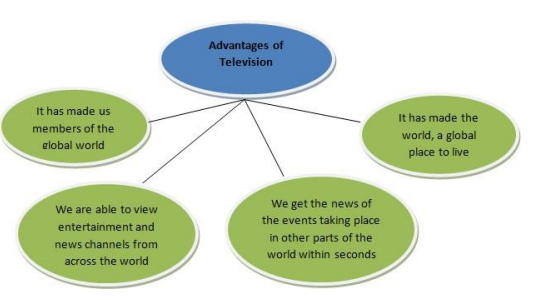
Following are the advantages of television

Diagram

Description automatically generated

Inflow of Money in the Media

  • The technology used in media is extremely expensive. For example, while broadcasting news, a television studio has a news reader, makeup artists, cameramen, sound recorders, transmission satellites etc. This means that many employees need to be paid.
  • As technology keeps on changing, a large amount of money is spent on acquiring the latest technologies. As a result, mass media requires huge sums of money. Thus, many television channels and newspapers are a part of big business houses.
  • One of the major sources from where mass media make money is through the advertisements of various products. Products are advertised in order to influence people into buying them.

Media and Democracy

Media play a very important role in a democracy

  • It provides people with information about the working of the government.
  • Through media, citizens learn about various laws and Acts which are passed by the government.
  • Based on the news reported by the media, people may organise protests, start a signature campaign and hold rallies to oppose any oppressive laws passed by the government.
  • Media sees to it that the government does not abuse its power.
  • It acts as a link between the government and the people.
  • Through all the above measures, media can force the government to reconsider its decisions.
  • Media decides the stories which have to be focused upon. It sets the agenda as it focuses on an issue, widely publicises it and brings it to the attention of the people. It influences the thinking process of the people.
  • It plays an important role in framing public opinion.
  • In the past, media has drawn the attention of the people to many issues. One such issue was the increase in the levels of pesticides in aerated drinks.
  • However, media also fails to highlight some essential issues. For example, many areas in our country do not get clean drinking water. Media over the years has not highlighted this issue as it should have been.

Balanced Reporting

It is very important for the media to provide balanced reporting to the people. A balanced report is one in which all aspects of a news story are discussed and the readers are left to arrive to their own conclusions. A balanced report is never judgmental.

The media is able to present balanced reporting only when it is independent and not under the control of any authority. However, media is not always independent. This is because of the following reasons:

  • The government has a sizable control over the media.
  • The government may censor some news. When the government prevents a news item, scenes of a movie or the lyrics of a song from being published or shared with the public, it is known as censorship.
  • The emergency was promulgated in 1975-77 by the government, during which it censored many news items.
  • However, today we find that government generally does not censor any news items though it does censor films. Despite this, we find the absence of balanced reporting.
  • According to various researches, balanced reporting is absent in media because many news channels are controlled by business houses. Thus, they try to use these channels in the interests of their business.
  • Media gets money through advertisements. Hence it usually does not report against those people who give them the advertisements.
  • People need to think from various angles before forming an opinion about any issue. It is important to focus on the areas as to who has written an article? Who gets benefited from this news? Who is being neglected in the news item and why? It is only after pondering over these points that we should form our opinion over any news item.

Local Media

  • Many people have realised that the media are not interested in covering the lives of ordinary people. Hence, several local groups have started their own media.
  • They have made use of the radio, started several local newspapers and published many newsletters which focus on the local problems.
  • Many organisations use the community radio and advise farmers about the quality of seeds and fertilisers. They also make documentary films on the hardships suffered by the poor communities.
  • Khabar lahariya is a newspaper which is run by eight Dalit women in the Chitrakoot District of Uttar Pradesh. The news paper is written in the bundeli language and focuses on cases of corruption and violence against women.
Diagram

Description automatically generated

Important Questions

  • Multiple Choice Questions:

Question 1. Television was invented by:

(a) J.L. Baird

(b) Dr. Alexander Graham Bell

(c) Isaac newton

Question 2. Khabar Leahriya is a:

(a) Magazine

(b) Newspaper

(c) Novel

Question 3. Media is often controlled by:

(a) Government

(b) Prime minister

(c) Business houses

Question 4. Which of the following comes under print media?

(a) Phone

(b) TV

(c) Newspaper

Question 5. Television, radio and newspaper are called:

(a) Mass media

(b) Print media

(c) Local media

Question 6. what is one positive aspect of television?

(a) Enabled people to waste their money

(b) Enabled ourselves as member of larger global world

(c) Enabled people to spend their time

(d) None of these

Question 7. what do you mean by mass media?

(a) Television

(b) Radio

(c) Both a and b

(d) None of these

Question 8. what is Khabar Lahriya?

(a) Local magazine

(b) Story book

(c) Local newspaper

(d) None of these

Question 9. Between which period’s media was censored in India?

(a) 1990-1992

(b) 1975-1977

(c) 1952-1954

(d) 1978-1979

Question 10. Which of these is a part of print media?

(a) T.V.

(b) Radio

(c) Newspaper

(d) None of these

Question 11. Which is the local newspaper written in bundeli?

(a) Times of India

(b) Dainik paper

(c) Khabar Lahriya

(d) None of these

Question 12. Who was the inventor of mechanical television?

(a) John Michael

(b) John L. Baird

(c) Gutenberg

(d) None of these

Question 13. what is the consequences of the media setting the agenda by reporting on the fashion week rather than the slum demolitions?

(a) To earned a huge amount of money

(b) To earn the confidence

(c) To earn the sympathy of people

(d) None of these

Question 14. Why is it necessary for media to be independent?

(a) To earn salary

(b) To encourage company

(c) To write balanced report

(d) None of these

Question 15. what do you mean by factual information?

(a) Information about completed issue

(b) Information about issue that is often not complete

(c) Information about future topics

(d) None of these

  • Fill in the blanks:
  1. One way in which the mass media earns money is by _____ different things.
  2. Changing technology or machines help ……………. to reach more people.
  3. Media is the plural of the word _______.
  4. Electronic typewriter in journalism was invented in _______.
  5. Media uses advertising as a tool to raise _____.
  • Write true (T) or false (F):
  1. The technology that mass media uses keeps changing.
  2. An independent media means that government should control and influence its coverage of news.
  3. Since TV time costs so much money, only those programmes that can attract the maximum number of viewers are shown.
  4. The print media offers a large variety of information to suit the tastes of different readers.
  • Very Short Questions:
  1. Name various forms of communication.
  2. What does the word ‘media’ mean?
  3. Mention any one positive aspect of television.
  4. Mention one way in which the mass media earns money.
  5. Why are some advertisements shown repeatedly on the television screen?
  6. What are the various ways through which people express their dissatisfaction to any of the government’s decision which does not go in their favour?
  7. What do you mean by a balanced report?
  8. Why is it necessary for media to be independent?
  9. Why does media sometimes focus on a particular aspect of a story?
  10. What does media’s close relationship with business often mean?
  • Short Questions:
  1. How television is like a ‘window on the world’?
  2. What do you found most useful about internet?
  3. What do you mean by ‘public protest’?
  4. What is an independent media?
  5. What is mass media?
  • Long Questions:
  1. In what ways does the media play an important role in a democracy?
  2. How does technology affect the media industry?
  3. Can you give this diagram a title? What do you understand about the link between media and big business from this diagram?
  4. You have read about the ways in which the media ‘sets the agenda’. What kind of effect does this have in a democracy? Provide two examples to support your point of view.
  5. How can we say that media is far from freedom?

ANSWER KEY –

  • Multiple Choice Answer:
  1. (a) J.L. Baird
  2. (b) Newspaper
  3. (c) Business houses
  4. (c) Newspaper
  5. (a) Mass media
  6. (b) Enabled ourselves as member of larger global world
  7. (c) Both a and b
  8. (c) Local newspaper
  9. (b) 1975-1977
  10. (c) Newspaper
  11. (c) Khabar Lahriya
  12. (b) John L. Baird
  13. (a) To earned a huge amount of money
  14. (c) To write balanced report
  15. (b) Information about issue that is often not complete
  • Fill in the blanks:
  1. advertising
  2. media
  3. medium
  4. 1940
  5. revenue
  • Write true (T) or false (F):
  1. True
  2. False
  3. True
  4. True
  • Very Short Answer:
  1. Radio, television, newspapers, Internet.
  2. Radio, television, newspapers, Internet and several other forms of communication are collectively known as media.
  3. Television has enabled us to think of ourselves as members of a larger global world.
  4. The mass media earns money by advertising different things like cars, clothes, tea, etc.
  5. Same advertisements are shown repeatedly on the television screen just to make people’s mind to go out and buy what is advertised.
  6. They do so by writing letters to the concerned minister, organising a public protest, starting a signature campaigns and asking the government to rethink its programme, etc.
  7. A balanced report is one that discusses all points of view of a particular story and then leaves it to the readers to make up their minds.
  8. Only then media can write a balanced report.
  9. It is because media believes that this will make the story interesting.
  10. It means that media will fail to give a balanced report.
  • Short Answer:
  1. Television is like a ‘window on the world’ because a lot of our impressions about the world around us are formed by what we see on TV.
  2. We always get the latest information on internet as we can read latest news and gain knowledge about the latest products within minutes of their release.
  3. When a large number of people come together and openly state their opposition to some issue is termed as public protest. Organising a rally, starting a signature campaign, blocking roads etc. are some of the ways in which this is done.
  4. An independent media means that no one should control and influence its coverage of news. No one should tell the media what can be included and what should not be included in a news story.
  5. TV, radio and newspapers are a form of media that reaches millions of people, or the masses, across the country and the world and, thus, they are called mass media.
  • Long Answer:
  1. Role of media in a democracy:
  1. In a democracy, the media plays a very important role in providing news and discussing events taking place in the country and the world. It is on the basis of this information that citizens can, for example, learn how government works.
  2. It also criticizes the unpopular policies and programme of the government.
  3. It forms the public opinion.
  4. It raises issues and problem related to common people.
  5. It also acts as reminder for the government about their promises.
  1. Changing technology, or machines, and making technology more modern, help media to reach more people. It also improves the quality of sound and the images that we see. But technology does more than this. It also changes the ways in which we think about our lives. For example, today it is quite difficult for us to think of our lives without television. Television has enabled us to think of ourselves as members of a larger global world. Television images travel huge distances through satellites and cables. This allows us to view news and entertainment channels from other parts of the world.
  2. The title can be ‘Media and Big business houses’.

From this diagram it is clear that some big business houses have their own television channels and newspapers. They show news of interest to the people on television and newspaper and advertise their own product in between. Independent media houses also advertise product of big business houses to make money. As a result, most television channels and newspapers are part of big business houses. People buy these advertised products of the big business houses and money flow back to them.

  1. The media also plays an important role in deciding what stories to focus on, and therefore, decides on what is newsworthy. By focusing on particular issues, the media influences our thoughts, feelings and actions, and brings those issues to our attention.

Example:

  1. The media drew our attention to alarming levels of pesticides in cola drinks. They published reports that indicated the high level of pesticides and, thus, made us aware of the need to regularly monitor these colas according to international quality and safety standards.
  2. The media drew our attention to suicide committed by farmers which leads to large scale movement and forced the government to look further on this issue.
  3. However, the reality is that media is far from independent. This is mainly because of two reasons:
  1. The first is the control that the government has on the media. When the government prevents either a news item, or scenes from a movie, or the lyrics of a song from being shared with the larger public, this is referred to as censorship. There have been periods in Indian history when the government censored the media.
  2. Second, at times, it is in the interest of these businesses to focus on only one side of the story. Media’s continual need for money and its links to advertising means that it becomes difficult for media to be reporting against people who give them advertisements.

Class 7 Civies – CHAPTER 5 : WOMEN CHANGE THE WORLD

0
Civics Practitioner - CCHS - Credly

WOMEN CHANGE THE WORLD

Stereotypic Roles of Women

A stereotype is an assumption or preconceived notion about a person, community or place which is not backed by any logic or reason. For example, girls are expected to talk softly but boys can pass off being aggressive.

Many people today believe in stereotypes. For example, women are supposed to be gentle and patient. This is the reason certain occupations are considered to be built especially for women. For instance, almost all nurses and receptionists are women. On the other hand, men are considered to be scientists, pilots, army men and police as people believe in the stereotypic notion that these professions require technical minds and physical power, in  which women are generally considered to be lacking. In most families, education of the girl child is not considered important. The education of boys is given more importance than that of the girls.

Women in the Nineteenth Century

  • In the nineteenth century many schools were opened up, but women were not expected to read or write.
  • Many people opposed the education of girls and as a result women struggled to attain education.
  • However, women who did get educated began to question the general attitude of the people towards women education.

During this time, there were some women who not only learned to read and write amid oppositions but also worked towards the education of women. Some of these women and their achievements are:

Rashsundari Devi (1800-1890)

  • She was born in West Bengal. She is considered to be the first woman in India who wrote her autobiography titled ‘Amar Jiban’.
  • She was a house wife belonging to a rich landlord’s family where women were not allowed to read and write. It was believed that an educated woman brought bad luck to her husband.
  • Rashsundari Devi secretly learned to read and write as she wanted to read Chaitanya Bhagabat (a book based on the life of a saint).
  • She would often work on her reading at mid-night when everyone was asleep.
  • Rashsundari Devi took help from her son’s books in order to learn to read. After a long period of time she learned to read was finally able to read the Chaitanya Bhagabat.
  • She later also learned to write and wrote her autobiography in which she had discussed her busy work routine at home every day.

Pandita Ramabai (1858-1922)

  • Pandita Ramabai championed the cause of women’s education.
  • She was educated at home by her parents.
  • Due to her keenness towards her studies, she not only learned Sanskrit but also learned Marathi and Bengali.
  • Due to her knowledge of the Sanskrit language, she was conferred with the title of ‘Pandita’.
  • She encouraged female education and to achieve this aim, in 1898, she set up a Mission in Khedgaon near Pune. This mission not only imparted education to girls and widows but also encouraged them to become independent.
  • In this mission, women were trained in many arts and crafts such as carpentry and running a printing press.
  • Pandita Ramabai’s contribution to the Indian society in the nineteenth century is highly recommendable.

Rokeya Sakhawat Hossain (1880-1932)

  • Rokeya Sakhawat Hossain was born in a rich family. Though she was taught to read and write Urdu, she was not encouraged to learn English and Bangla languages. It was felt that the learning of these two languages would expose girls to new ideas.
  • She however secretly learned the Bangla and English languages and became a writer.
  • Her famous work is the story titled ‘Sultana Dreams’. In this story, a woman named Sultana reaches a place called ladyland where women had the freedom to study, learn and create innovations. Thus women in her story were controlling rains and flying planes in the nineteenth century.
  • Later in 1910, she opened a school for girls at Kolkata, which is still functioning till date and is known as the Sakahwat Memorial Girls School.

Differences between the Education of Boys and Girls

  • Today, both boys and girls attend schools in large numbers. However, there still remains a difference between the education of boys and girls.
  • The census which is conducted by the government after every ten years, provide us information about the people living in India like the percentage of literate people, sex ratio, about the occupation of men and women etc.
  • To estimate the level of literacy, children above seven years of age are taken into account. They are considered as literate if they are at least able to write their names.
  • According to the census of 1961, about 40 percent of all the boys and men were literate while only 15 percent of all girls and women were educated.
  • In the census of 2001, while 76% of males were literate, the literacy rate of the females was only 54%. The percentage of educated females is still lower than the percentage of educated males.
  • What is more noticeable is that the literacy rates of the Dalit and Muslim girls are less than the literacy rates of the total female population of India.
  • Statistics have shown that the literacy rates of Muslim girls were even less than those of the Dalit girls.

Reasons for Low Literacy Rates among the Dalit, Muslim and Adivasi Children

  • Lack of proper schools in the rural and the poor areas.
  • Many schools are located many kilometres away from the villages. Lack of proper transport facilities forces the children to drop out from the schools.
  • Many families are so poor that they are unable to afford the cost of educating their children.
  • Many Dalit children leave their schools as they are discriminated against by the upper caste children and teachers.

Women’s Movement

Women have not gained all their rights in various fields such as education, health, legal rights automatically. They had to struggle for gaining their rights. The struggles waged by them in order to gain their rights are known as the Women’s Movement. Many women, organisations and men have participated in the women’s movement to help women gain these rights. Some strategies which are adopted for making people aware of the women’s rights are:

Campaigns

  • Campaigns help the women to protest and fight against discriminations which are made against them.
  • In 2006, as a result of several campaigns, a law was passed which gave legal protection to women against domestic violence.
  • Many campaigns were organised by various women organisations through street plays, protests and by approaching the courts to demand the banishment of dowry from the country.
  • Sexual harassment of women in the work place and other institutions became an act punishable by law due to the organisation of large scale campaigns by women.

Making People Aware

One way to fight against the discrimination of women is to make people aware by staging street plays, composing songs and holding public meetings.

Protests

When some grievous injustice takes place against women, or a law is passed hurting their interests, protests are held by various women groups. Taking out public rallies and holding demonstrations leave a deep impact on the minds of the people.

Showing Solidarity

The solidarity shown by women together helps them fight various issues. When women empathise and sympathise with one another, the women’s movement becomes stronger.

Important Questions

  • Multiple Choice Questions:

Question 1. Driving her train was written by:

(a) Rokeya Sekhawat Hossain

(b) Ramabai

(c) Neeta Lai

Question 2. Ramabai was given the title of ‘pandita’ because she could read and write the language:

(a) English

(b) Sanskrit

(c) Hindi

Question 3. Rashsundari Devi was from:

(a) Bengal

(b) Maharashtra

(c) manipur

Question 4. Who became the first woman engine driver of the northern

(a) Laxmi Lakra

(b) Rashsundari Devi

(c) Rokeya Sakhawat Hossain

Question 5. International women’s day is celebrated on:

(a) 7 March

(b) 8 March

(c) 9 March

Question 6. what do you mean by stereotypes?

(a) All boys are superior in class

(b) All people are behaved in a particular manner

(c) Rich people are higher in class

(d) None of these

Question 7. In which year the law was passed to give women protection from domestic violence?

(a) 2000

(b) 2001

(c) 2006

(d) 2005

Question 8. what percentage of ST girls leaves school at primary level?

(a) 36%

(b) 67%

(c) 49%

(d) 78%

Question 9. what was the title given to Rama bai?

(a) Swami

(b) Intellectual

(c) Lady

(d) Pandita

Question 10. What is the main aim of families in general for the future of girls?

(a) Higher education

(b) Marriage

(c) Good career

(d) None of these

Question 11. Who were the famous women who make changes in other women’s life?

(a) Rashsundari Devi

(b) Ramabai

(c) Rokeya Sakhawat Hossain

(d) All of the above

Question 12. Which famous book is written by Rashsundari Devi?

(a) Amar Jiban

(b) Godan

(c) Madhushala

(d) None of these

Question 13. what do you mean by women’s movement?

(a) Movement planned by senior citizen

(b) Women struggle for improvement in life

(c) Men struggle for improvement in life

(d) None of these

Question 14. why many girls do not continue their education?

(a) Poverty

(b) Discrimination

(c) Both a and b

(d) None of these

Question 15. which are the languages Rokeya Sakhawat learned?

(a) Bangla

(b) English

(c) Both a and b

(d) None of these

  • Fill in the blanks:
  1. _______ are pressurised to think about getting a job that will pay a good salary.
  2. Showing solidarity is an important part of the education of _______.
  3. Rokey Hossain in started a school for _______.
  4. Amar Jiban was written by _______.
  5. Scheduled caste is the official term for _____.
  • Write true (T) or false (F):
  1. Laxmi Lakra is from a poor tribal family in Madhya Pradesh.
  2. Many women and men made efforts to open schools for girls.
  3. In 1910, Rokeya Sakhawat Hossain started a school for girls in Kolkata, and to this day, the school is still functioning.
  4. Rokeya Sakhawat Hossain was born into a poor family who owned no land.
  • Very Short Questions:
  1. What is the percentage of women engaged in agricultural work in our country?
  2. What does agricultural work mean to these women?
  3. When we think of a farmer we only think of a man. Why?
  4. Why was Ramabai given the title ‘Pandita’?
  5. How did women support men in the pottery trade?
  6. Mention any one stereotype about what women can or cannot do?
  7. How did Laxmi Lakra break the stereotype that only men could be engine drivers?
  8. What changes came to be seen with the emergence of new ideas about education and learning in the 19th century?
  9. Who was Rashsundari Devi? What did she write in her autobiography?
  10. What did Rokeya Sakhawat Hossain do for the girls?
  • Short Questions:
  1. How do you think stereotypes, about what women can do and what they cannot do, affect women’s right to equality?
  2. Describe few methods of struggle used by women to raise their issues.
  3. Who set up a Mission in Khedgaon near Pune in 1898? How did the Mission prove beneficial for the women?
  4. Why was Rokeya Sakhawat Hossain stopped from learning Bangla and English? How did she manage to team these languages?
  5. Why do you think learning alphabets was actually important to women like Rashsundari Devi, Ramabai and Rokeya?
  • Long Questions:
  1. Give a brief life sketch of Laxmi Lakra.
  2. Was Rashsundari Devi a superstitious woman? If not, why not?
  3. Although the literacy rates have increased since independence, what remains the worrying factor with respect to gender?
  4. Who wrote the story Sultana’s Dream? What is the story all about?
  5. What are the various ways women apply to fight discrimination and seek justice?

ANSWER KEY –

  • Multiple Choice Answer:
  1. (c) Neeta Lai
  2. (b) Sanskrit
  3. (a) Bengal
  4. (a) Laxmi Lakra
  5. (b) 8 March
  6. (b) All people are behaved in a particular manner
  7. (c) 2006
  8. (c) 49%
  9. (d) Pandita
  10. (b) Marriage
  11. (d) All of the above
  12. (a) Amar Jiban
  13. (b) Women struggle for improvement in life
  14. (c) Both a and b
  15. (c) Both a and b
  • Fill in the blanks:
  1. Boys
  2. women
  3. girls
  4. Rashsundari Devi
  5. Dalit
  • Write true (T) or false (F):
  1. False
  2. True
  3. True
  4. False
  • Very Short Answer:
  1. 83.6% of women are engaged in agricultural work.
  2. Plating, weeding, harvesting and threshing.
  3. It is because major portion of the agricultural work is done by man. Women only assist them.
  4. It was because she could read and write Sanskrit. It was a remarkable achievement as women were not allowed such knowledge those days.
  5. They collected the mud and prepared the earth for the pots.
  6. Women can be good teachers but they are incapable of dealing with technical things.
  7. She became the first woman engine driver for Northern Railways.
  8. Schools became more common and communities that had never learnt reading and writing started sending their children to school.
  9. Rashsundari Devi was a housewife from a rich landlord’s family in west Bengal. She wrote about her everyday life experiences in her autobiography.
  10. She started a school for girls in Kolkata which is functioning even today.
  • Short Answer:
  1. Stereotypes about what women can or cannot do affects women’s right to equality because they are considered weak and incapable of doing strong works. And thus women are called inferior to men. They are paid less salaries / wages than their man counterparts.
  2. Following are the methods of struggle that women’s movement used to raise their issues:
  1. Raising awareness through street plays, songs and public meetings. 
  2. Protesting through public rallies and powerful way of drawing attention to injustice.
  1. Pandita Ramabai setup a Mission in Khedgaon near Pune in 1898. This was the place where widows and poor women were encouraged not only to become literate but to be independent. They were taught a variety of skills from carpentry to running a printing press, skills that are considered male preserve. This Mission is still active today and does a lot for women’s upliftement.
  2. In those days, English was seen as a language that would expose girls to new ideas, which people thought were not correct for them. Therefore, it was mostly boys who were taught English. However, Rokeya Sakhawat Hossain wished to learn these two languages in addition to Urdu. Fortunately, she got the support of her elder brother and an elder sister and ultimately learnt to read and write Bangla and English.
  3. Learning the alphabet was so important to women like Rashsundari Devi, Ramabai and Rokeya because after learning alphabet they could achieve their goals and fulfill their dreams and contribute the society.
  1. Rashsundari Devi: Wrote “Amar Jiban”, first autobiography written by an India woman.
  2. Ramabai: She set up a mission in Khedagaon where widows and poor women are taught variety of skills from carpentry to running a printing press.
  3. Rokeya: She started a school for girls in Kolkata in 1910 and thus helped other girls to get education.
  • Long Answer:
  1. Laxmi Lakra belongs to a poor tribal family in Jharkhand- She studied in a government school. She studied hard and did well and then went on to get a diploma in electronics. She then took the railway board exam and passed it on her first attempt. She became the first woman engine driver for Northern Railways. In this way she broke stereotype that engine drivers could be men only. She says “I have challenges and the moment somebody says it is not for girls. I make sure I go ahead and do it”. Laxmi has had to do this several times in her life—when she wanted to take electronics, when she rode motorcycles at the polytechnics and when she decided to become an engine driver.
  2. Rashsundari Devi was a housewife from a rich landlord’s family in West Bengal. She was not allowed to learn to read and write. During her time, some 200 years ago, there was a prevalent belief that if a woman learnt to read and write, she would bring bad luck to her husband. Rashsundari Devi took this belief as false because she was not at all superstitious. She took strict decision and taught herself how to read and write in secret, well after her marriage. She even wrote her autobiography in Bangla at the age of 60. Her book titled Amor Jiban is the first known autobiography written by an Indian woman.
  3. It is true that the literacy rates have increased since independence. According to the 1961 census, about 40% of all boys and men were literate compared to 15% of all girls and women. In the census of 2001, these figures have grown to 76% for boys and men and 54% for girls and women. This means that the proportion of both men and women who are able to read and have at least some amount of schooling has increased. But the worrying factor is that the percentage of male is still higher than the female group. The gap exists even today.
  4. It was Rokeya Sakhawat Hossain who wrote the story Sultana’s Dream in 1905 at the age of 25. The story is all about Sultana’s dream. In her imagination she reaches a place called Ladyland. Ladyland is the place where women had the freedom to study, work and create inventions like controllin’ rain from the clouds and flying air cars. In this Ladyland, the men had no freedom at all.

They had been sent to seclusion. Their aggressive guns and other weapons of war defeated by the brain-power of women. As Sultana travels in the Ladyland, She awakes suddenly and becomes disappointed to see the reality.

  1. The various ways women apply to fight discrimination and seek justice are as follow:
  1. It has proved to be a great success. It has led to a new law being passed in 2006. This law gives legal protection to women against domestic violence which includes physical and mental violence within then- homes.
  2. Women by dint of campaigning made the Supreme Court to formulate guidelines in 1997 to protect women against sexual harassment at workplace. They also campaigned for bringing justice to those families which have become pray to dowry deaths. As a result of their campaigns, dowry laws were changed to punish families who seek dowry.
  3. Raising Awareness. Women, in order to fight-discrimination, work hard to raise public awareness on women’s rights issues. They do so through several means such as street plays, songs and public meetings.
  4. Whenever a law or policy acts against the interest of the women, they rise in protest by holding public rallies and demonstrations. These are powerful ways of drawing attention to injustices.
  5. Showing Solidarity. Women associated with the Women’s movement also believe in showing solidarity with other women and their causes.

Class 7 Civics – CHAPTER 3 : HOW THE STATE GOVERNMENT WORKS

0

Chapter 3: HOW THE STATE GOVERNMENT WORKSCivics Practitioner - CCHS - Credly

HOW THE STATE GOVERNMENT WORKS

India is a democratic country where people choose their own representatives. Since the country is divided into various states, the people not only elect the members of the Central Government but also choose the Government of the State in which they live.

Elections in the State

  • In India, every state has a government which looks after the administration of that state. The state is divided into several areas or constituencies.
  • Every state has a different number of constituencies depending upon its size.
  • While Sikkim has 32 legislative constituencies, the state of Uttar Pradesh has 403, which is the highest number of legislative constituencies in any state,
  • People elect one representative from each constituency who represents them in the State Legislative Assembly.
  • A person who gets elected from a constituency in the state elections becomes a Member of Legislative Assembly or a MLA.
  • The MLAs elected may belong to different political parties.
  • A political party whose MLAs win more than half of the seats in the Assembly elections of a state becomes the ruling party and forms the government in that state. The MLAs belonging to the other political parties become the ‘Members of the Opposition’.
  • After the elections, the MLAs of the ruling party elect their leader (who has also been elected as MLA), to become the Chief Minister.
  • The Chief Minister in turn elects the other ministers, who look after the various departments.
  • In a Legislative Assembly, all the elected MLA’s belonging to the ruling and opposition parties meet and discuss the laws and the working of the government.
  • An MLA who is also a minister has to not only look after the working of his department but also the development of the constituency from which he is elected.
  • While the government looks after the overall development of the state, a MLA looks after the development of the constituency from which he/she is elected.
  • An Act can become a law only when it is passed by the members of the Legislative Assembly. Members can discuss and debate and ask questions about the working of the government.

Powers and functions of Legislative Assembly

The legislative assembly has mainly two types of powers. These are Legislative and Financial powers.

The Legislative Power: The subjects of administration are divided into three lists. These are union list, state list and concurrent list. The legislative assembly makes law for subjects mentioned, in the state list and the concurrent list.

The Financial Power: The assembly passes the state budget, money bills, permission for levying taxes and fixing salaries of the members of state legislature.

Money bills are always introduced in the legislative assembly.

How Does A Bill Become A Law

There are two types of bills: Money bill and Non-money bill. Money bill is introduced in the legislative assembly and the non-money bill can be introduced either in Legislative Assembly or Legislative Council. There are three stages for a bill to be passed.

  • First Stage: In this stage the bill in introduced and its title is read out to the members.
  • Second Stage: The house refers the bill to the selected committees where a detailed discussion is held. This is called second reading.
  • Third stage: In the third reading, the bill goes to the other house and the same procedure is followed.

After a stipulated time of 3 months the bill is considered to be passed by both the houses. Finally it goes to the governor for his consent. In case of money bills, Legislative Council can make recommendations. It can delay the bill for 14 days only but it should be passed in Legislative Assembly after the 14 days.

Opposition party :

The elected representatives who are not the members of the ruling party belong to the opposition party. The representative together plays the role of questioning government decisions and actions. They also raise new issues for consideration in the Assembly.

Ruling party :

The political party that has the majority is known as the ruling party.

Press conference :

A gathering of media persons who are invited to hear about and ask questions on a particular issue and are then expected to report on this to the larger public.

Powers of the governor

Executive powers: The leader of the majority party is appointed as Chief Minister by the Governor. He also appoints the other ministers. He appoints other top officials such as Advocate General and members of State Public Service Commission.

Discretionary power: The Governor works on the advice of the council of ministers. In certain situations he is forced to take independent decisions, which is called the discretionary power. At times when the state is under the President’s rule he can take a discretionary decision.

Legislative power: The Governor inaugurates the first session of the assembly after the elections. Every bill passed by the Legislative Assembly, should have his approval. He can pass ordinance or a law in case the assembly is not in session.

Financial Power: No money bill or budget can be introduced in the house without the Governor’s approval.

Judicial power: Governor can grant pardon or reduce the punishment of people convicted under the state laws.

The first woman Governor of independent India was Sarojini Naidu. She was appointed as Governor of Uttar Pradesh in 1947.

Chief minister and his council of ministers

All powers regarding the administration of state are vested with the Chief Minister and his ministry. He remains in power as long as he enjoys the support of the members.

Power and Functions of Chief Minister Chief minister is the leader of the ruling political party which has got majority in the election. He is a vital link between the Governor and the Council of ministers. Each minister is individually and collectively answerable to him. His main powers are : –

  • Determines the policies.
  • Supervises the administration of the state.
  • Allocates portfolio to all ministers.
  • Coordinates the work of the council of ministers.

Powers and Functions of the Council of Ministers The administration of a state takes place through various departments and different ministers are responsible for the portfolios. The main function is to run the departments according to the policies laid down by the Council of ministers. They bring bills in the assembly for discussion and approval.

The Working of the Government

  • The Chief Minister is the Executive Head of the State who supervises the works of the various ministers.
  • The Ministers of the State head different departments such as the Health, Agriculture, Education, Revenues, Public Works Department etc. They formulate the policies and supervise the working of their department.
  • The government can pass new laws for the state on various matters such as education, health and sanitation.
  • The ministers also have to answer the questions put to them by the members of the opposition party regarding the working of their departments.
  • Media such as television networks and newspapers discuss several issues regarding the working of the ministers and their departments. Any harmful policy can lead to debates and heated discussions in the public forum.
  • The government has to respond to the various issues. They not only answer the questions asked by the members of opposition in the legislature but also hold press conferences to explain and defend certain decisions taken by them.

We find that people are supreme in a democracy. They elect their own representatives in the State Elections. If an MLA does not work up to the expectations of the people, the people may not vote for him/ her in the next general elections. Therefore, people have the main authority in the State Elections.

Important Questions

  • Multiple Choice Questions:

Question 1. The head of the executive is:

(a) Governor

(b) Minister

(c) Chief minister

Question 2. Government works at levels:

(a) 4

(b) 3

(c) 2

Question 3. How many assembly constituencies Himachal Pradesh has?

(a) 56

(b) 68

(c) 67

Question 4. An MLA is elected by the:

(a) People

(b) Government

(c) Chief minister

Question 5. Who appoints the chief minister and other minister?

(a) Prime minister

(b) MLA

(c) Governor

Question 6. Ministers and their portfolio are decided by:

(a) Chief minister

(b) Prime minister

(c) Governor

Question 7. what do you mean by Legislature?

(a) Member of opposition party

(b) Member in legislative assembly

(c) Member in ruling party

(d) None of these

Question 8. what does MLAs dual responsibilities mean?

(a) As a MLA

(b) As a minister

(c) Both a and b

(d) None of these

Question 9. what name is given to the elected representatives who are not member of ruling party?

(a) Opposition

(b) Constituency

(c) Majority

(d) Press conference

Question 10. Who becomes the chief minister?

(a) Leader of the winning party

(b) Leader of the losing party

(c) Prime minister of the country

(d) President of the country

Question 11. what is the full form of MLA?

(a) Member of Law Authority

(b) Member of Legal Arm

(c) Member of Legislative Assembly

(d) Member of Legislative Arm

Question 12. What do you mean by majority?

(a) Situation when more than half the number is on one idea

(b) Situation when less than half the number is on one idea

(c) Situation of equal voting

(d) None of these

Question 13. What were organized by the assembly to discuss about government work?

(a) Live session

(b) Press conference

(c) Janta polls

(d) none of these

Question 14. What do you mean by coalition?

(a) Group of poor farmers

(b) Group of rich merchants

(c) Group of parties working together

(d) None of these

Question 15. By whom the governor is appointed?

(a) MLA

(b) Central Government

(c) President

(d) None of these

  • Fill in the blanks:
  1. The head of the state is the _________.
  2. ORS packets are given to those who are suffering from ________.
  3. The governor of the state is appointed by the ______ government.
  4. ______ is the leader of the ruling party.
  5. Every MLA is elected from one are(a) This area is known as ______.
  • Write true (T) or false (F):
  1. Some MLAs have dual responsibilities: one as an MLA and the other as a minister.
  2. In a monarchy, people organise meetings to voice their opinions and protest against the government.
  3. Members of the Legislative Assembly (MLAs) are elected by the people.
  • Very Short Questions:
  1. How is the Governor of a state appointed?
  2. Whose responsibility is it to nm various government departments or ministers?
  3. How will you define a Legislative Assembly?
  4. Define the term ‘government’.
  5. Who is the head of the executive?
  6. Why did the Chief Minister and the minister for health visit Patalpwam district?
  7. Why are press conferences organised?
  8. What do you know about a wallpaper?
  9. Why do people in a democratic set up organise meetings?
  10. The government works at three levels. Name them.
  • Short Questions:
  1. Define the term press conference.
  2. Explain the following terms–majority, ruling party, opposition.
  3. Explain the responsibility of a chief minister after election of MLAs.
  4. What is role of the party that does not form government?
  5. Who becomes a Chief Minister? What is his/her role in a state?
  • Long Questions:
  1. How does a government function in a state?
  2. What do you mean by an MLA? Is it necessary to become a member of any political party to become an MLA?
  3. What is the process of formation of government in a state?
  4. How do the people in power like the chief minister and the minister take action?
  5. How did some MLAs become Ministers? Explain.

ANSWER KEY –

  • Multiple Choice Answer:
  1. (c) Chief minister
  2. (b) 3
  3. (b) 68
  4. (a) People
  5. (c) Governor
  6. (a) Chief minister
  7. (b) Member in legislative assembly
  8. (c) Both a and b
  9. (a) Opposition
  10. (a) Leader of the winning party
  11. (c) Member of Legislative Assembly
  12. (a) Situation when more than half the number is on one idea
  13. (b) Press conference
  14. (c) Group of parties working together
  15. (b) Central Government
  • Fill in the blanks:
  1. Governor
  2. diarrhoea
  3. central
  4. Chief minister
  5. constituency
  • Write true (T) or false (F):
  1. True
  2. False
  3. True
  • Very Short Answer:
  1. The Governor of a state is appointed by the Central Government.
  2. It is the responsibility of the Chief Minister and other ministers to run various government departments or ministers.
  3. A Legislative Assembly is a place where all the MLAs, from the ruling party as well as the opposition, meet to discuss various things.
  4. The term ‘government’ refers to the government departments and various ministers who head them.
  5. The Chief Minister is the head of the executive.
  6. They went to visit the families who had lost their relatives due to the spread of diarrhoea. They also visited people in the hospitals.
  7. Press conferences are oraganised to discuss various current issues.
  8. A wallpaper is an interesting activity through which research can be done on particular topics of interest.
  9. They do so to voice their opinions and protest against the government if any of its actions is not in their favour.
  10. The government works at three levels namely:
  • Local
  • State
  • Natural
  • Short Answer:
  1. Press conference is a gathering of journalists from the media who are invited to hear about and ask questions on a particular issue and are then expected to report on this to the larger public.
  2. A political party whose MLAs have won more than half the number of constituencies in a state can be said to be in a majority. The political party that has the majority is called the ruling party and all other members are called the opposition.
  3. After the elections, the MLAs of the ruling party elect their leader who becomes the chief minister. The chief ministers select other ministers.
  4. As per the Constitution all the parties which do not take part in the formation of government are called opposition parties. In our democratic set up the role of the opposition parties is in no way less important than the ruling party. The opposition parties keep a watch over the functioning of the ruling party. They take part in every discussion and debate held in the Assembly. They can check and protest any wrong action of the government.
  5. Chief Minister is the leader of the ruling party. He/She is elected out of the total members of the party gaining majority in the general election. He/she is the executive head of the government. He/She is responsible for every action of the government. He/she also coordinates between the government at the centre and the state.
  • Long Answer:
  1. A government is headed by the Chief Minister. The Chief Minister, in order to manage the functioning of the government, appoints ministers at various levels like cabinet ministers, state ministers and deputy ministers. Every government departments is headed by a cabinet minister who is directly accountable for the functioning of the particular department. The heads of the government departments who are bureaurates, are responsible for the handling of the government decisions. The bureaurates project and get the works completed. The ministers give approval to the works.
  2. The term MLA stands for a Member of Legislative Assembly. He/She is elected through a general election and represents a particular constituency. It is not necessary for one to be a member of a political party to become a MLA. He/she can contest the election as an independent candidate also. In some cases, he/ she is sponsored by a political party. But one thing is necessary that he/she must be a citizen of India and fulfil the requisite qualifications for the post.
  3. A general election is conducted to elect representatives from various constituencies. The party which earns more than half of the total seats is said to be in a majority. That party is usually called for forming the government.

Sometimes, no party gains clear majority. In that case the party with maximum elected members tries to get support from the like-minded parties or independent candidates. The party that proves to have maximum supporters in that way is allowed to form government. Otherwise there would be re-election.

  1. They do so through various departments like the Public Works Department, the Agriculture Department, the Health Department, the Education Department and so on. They also have to answer questions that are asked in the Legislative Assembly and convince people asking the questions that proper steps are being taken. At the same time, newspapers and the media widely discuss the issue and the government has to respond, for example, by holding the press conferences.
  2. After the elections, a political party whose MLAs have won more than half the number of constituencies in a state can be said to be in a majority. The political party that has the majority is called the ruling party and all other members are called the opposition. The MLAs belonging to the ruling party will elect their leader who will become the chief minister. The chief minister then selects other people as ministers. After the elections, it is the Governor of the state who appoints the chief minister and other ministers.

Class 7 Civics – CHAPTER 2 : ROLE OF THE GOVERNMENT IN HEALTH

0
Civics Practitioner - CCHS - Credly

Role of The Government in Health

Health refers to the state of being free from any illness or injury. Health does not only mean freedom from diseases but also implies clean drinking water, adequate food and clean surroundings for the people. A healthy mind ensures a healthy body. One also needs to remain free from any mental strain. A healthy mind and a healthy body lead to the development of the overall personality of an individual. In a democracy, people elect their own representatives who formulate policies aimed at the development of their constituencies. A democratic government is a welfare government whose basic work is to provide education and healthcare facilities to its people.

Health Care Facilities in India

Healthcare facilities include everything which requires care and services needed by the patients. It includes hospitals, primary health centres and laboratories for testing,

ambulance services, medicines, medical equipments, doctors, nurses and other health professionals. Some facts about health care services in India are:

  • Though India has the largest number of medical colleges in the world, which produce more than 15,000 doctors per year, most of the doctors are settled in the urban areas. This impacts the health services in the rural areas.
  • Though healthcare facilities have grown substantially over the years, lakhs of people still die due to malaria and tuberculosis.
  • While many people visit India for medical treatment, we are unable to provide clean drinking water to all our people.
  • India is the fourth largest producer of medicines in the world but more than half of the children in the country suffer from malnutrition as they do not get nutritious and adequate food to eat.

The above facts give us the contrasting picture of the health care situation in India. India has a large number of doctors, clinics and hospitals. The country also has a public health care system. This means that many hospitals and health centres are run by the government to treat people across the country. India has also made great technological advancement in medical sciences. However we also see that the overall health situation in India is poor. We are not able to provide basic health care facilities to the people. In many places, people do get clean drinking water due to which they suffer from various water borne diseases such as diarrhea, hepatitis etc. Let us understand the difference between the public and private health care services in India.

Public Health Services

India is a democratic country and according to our constitution, the primary duty of the government is to ensure the welfare of the people. One of the welfare activities of the government is to provide basic healthcare facilities to the people at low costs. Following are some features of the public health care system in India:

  • The chains of hospitals and health centres in India which are run by the government are called public health services.
  • These health centres not only provide treatment for common illnesses but also perform complicated surgeries.
  • Health centres in the villages usually have a trained nurse and a health worker. They treat people suffering from common illnesses. They work under the supervision of doctors at the Primary Health Centre (P.H.C.).
  • A P.H.C. looks after many villages.
  • At the district level, a district hospital supervises the work of all the health centres in a particular district.
  • In big cities, the government has opened many hospitals (known as governmental hospitals) which provide treatment to people belonging to all economic sections.

Public health services are so named because of the following reasons:

  • The health centres and hospitals have been set up by the government for providing health services to all the people.
  • The financial resources of these hospitals come from a part of the taxes which are paid by the people.
  • These health services are provided to the people at either low costs or free of cost. This has been done so that even poor people are able to afford these services.
  • Public health services make people aware of the consequences of diseases such as malaria, tuberculosis, jaundice, cholera etc.

Awareness is spread among the people through campaigns, street plays, advertisements in the media etc.

Private Health Services

Private health services refer to those services which are offered by privately owned clinics or hospitals. These are either owned by an individual or by an organisation. Private hospitals are generally equipped with modern medical equipments and laboratories. Usually, many facilities such as ultrasound, X-ray etc. are located within the premises of these hospitals.

The cost of treatment in private hospitals or clinics is high. Patients have to spend a large sum for every medical facility which is availed by them. Urban areas have many privately owned clinics and hospitals. Sometimes, many big companies run the private hospitals. They also manufacture and sell medicines.

Draw backs of Private Healthcare Services

  • Health facilities in India are not equally accessible to all the people.
  • While the private health services are increasing, the quantity and quality of public health services remains the same.
  • Private health services are mostly concentrated in the urban areas.
  • The cost of treatment in privately owned clinics and hospitals is so high that common people cannot afford them.
  • In order to earn profits, many private hospitals encourage incorrect practices. The doctors recommend unnecessary tests and prescribe expensive medicines.

Inequalities in Accessing Healthcare Facilities

  • It has been estimated that only 20 percent of the total population of India can afford the medicines which are prescribed to them during their illness. It has also been reported that forty percent of the people who are admitted into hospitals due to their illness have to borrow money for their treatment.
  • Poor people are more prone to illness as they are undernourished. They also do not have the basic amenities such as clean drinking water, clean surroundings and proper sanitation facilities. Further, expenditures on illness worsen their situation.
  • Gender discriminations also affect the health of women. Since the health of women is not given any importance, they are not immediately taken to the doctor.

Steps Which Can Be Taken to Improve the Situation

  • The government needs to provide quality healthcare services to the people especially to the poor sections of the society.
  • Since most diseases emanate from unhygienic surroundings and lack of proper sanitation facilities, people should be made aware of the advantages of living in clean surroundings.
  • This can be achieved through media advertisings, campaigns, street plays etc.
  • One of the effective methods to improve the health services for the people is to allocate budgets to the panchayats. In this way, the panchayats can ensure

that proper planning and execution is carried out for the provision of clean water, food, women’s health etc.

  • The State Government of Kerala followed this method when it allocated forty percent of its health budget to the panchayats. This step improved the general health status of the people at the village level. However, they faced some problems such as shortage of medicines and insufficient number of medical professionals.
  • Another method of improving the health standards of the people was tried by the Government of Costa Rica. It decided not to have an army. The money which was to be used for maintaining an army was instead spent on the health, education and fulfilling the general needs of the people.
  • The Costa Rican government spent money on providing clean drinking water, proper sanitation facilities, nutritional food and housing facilities to its citizens.

Important Questions

  • Multiple Choice Questions:

Question 1. Costa Rica is a country in:

(a) Europe

(b) South America

(c) North America

Question 2. The healthiest country in the American continent is:

(a) Brazil

(b) Canada

(c) Costa Rica

Question 3. The services that are easily available in rural areas is:

(a) Public services

(b) Private services

(c) None

Question 4. In 1996 the state that gave 40% of the entire state budget to Panchayats is:

(a) Tamil Nadu

(b) Karnataka

(c) Kerala

Question 5. Health care is divided into:

(a) 6 categories

(b) 2 categories

(c) 3 categories

Question 6. Which country has the largest number of medical colleges in the world?

(a) United states of America

(b) India

(c) China

Question 7. In India about how many people die from tuberculosis every year?

(a) 5 lakh

(b) 2 lakh

(c) 7 lakh

Question 8. RMPs are found in:

(a) Urban areas

(b) Rural areas

(c) Posh areas

Question 9. what do you mean by ‘medical tourist’?

(a) People from other village

(b) Foreigners came for medical treatments

(c) Indian goes for medical treatments in other countries

(d) None of these

Question 10. where do most doctors prefer to settle?

(a) Urban areas

(b) Rural areas

(c) Foreign region

(d) None of these

Question 11. How many people die by tuberculosis every year?

(a) 2 lakh

(b) 3 lakh

(c) 5 lakh

(d) 1 lakh

Question 12. which one is not a water borne disease?

(a) Diarrhea

(b) Hepatitis

(c) Worms

(d) Cancer

Question 13. what does PHC means?

(a) Private health center

(b) Public health center

(c) Primary health center

(d) All of these

Question 14. How many children die every year in India?

(a) 2 million

(b) 5 million

(c) 1 million

(d) 4 million

Question 15. what do you mean by an OPD?

(a) Operation patient department

(b) Out Patient Department

(c) Out premier department

(d) None of these

  • Fill in the blanks:
  1. In India _______ cases of malaria are reported every year.
  2. Registered Medical Practitioners are referred by _______.
  3. _______ is a service that is organized by an individual or company for its own profit.
  4. _______ health concerns are generally ignore(d).
  5. Government uses _______ money for providing many public services.
  • Write true (T) or false (F):
  1. Ranjan got costly medical treatment.
  2. Private services are concentrated in rural areas.
  3. If people do not get adequate food to eat or have to live in cramped conditions, they will be prone to illness.
  4. The private health service is a chain of health centres and hospitals run by the government.
  5. Adequate healthcare is available to all in India.
  • Very Short Questions:
  1. What do people in a democratic country expect the government?  
  2. Where do most doctor prefer to settle?
  3. Name some water borne diseases.
  4. What problem do rural people face whenever they come in a grip of an illness?
  5. What do we need to prevent and treat illnesses?
  6. What do you mean by a public health care system?
  7. What happened to Hakim Sheik?
  8. Why did Hakim Sheik file a case in the court?
  9. Who got costly medical treatment—Aman or Raryan?
  10. What did the court ask the State Government in Hakim Sheik case?
  • Short Questions:
  1. What do you mean by proper and adequate health care facilities?
  2. Differentiate between public health care system and private health care system.
  3. Why government hospitals are less expensive as compared to private hospitals?
  4. Describe the function of public health system.
  5. Why it is important to pay taxes to government?
  • Long Questions:
  1. Compare public health services with those of private health services.
  2. What is Costa Rican approach? Explain.
  3. What major changes were made by the Kerala government in the state in 1996?
  4. What did the court say in the case of Hakim Sheik?
  5. How can you say that adequate healthcare is not available to all?

ANSWER KEY –

  • Multiple Choice Answer:
  1. (b) South America
  2. (c) Costa Rica
  3. (a) Public services
  4. (c) Kerala
  5. (b) 2 categories
  6. (b) India
  7. (a) 5 lakh
  8. (b) Rural areas
  9. (b) Foreigners came for medical treatments
  10. (a) Urban areas
  11. (c) 5 lakh
  12. (d) Cancer
  13. (c) Primary health center
  14. (a) 2 million
  15. (b) Out Patient Department
  • Fill in the blanks:
  1. 2 million
  2. RMPs
  3. Private
  4. Women’s
  5. tax
  • Write true (T) or false (F):
  1. True
  2. False
  3. True
  4. False
  5. False
  • Very Short Answer:
  1. People in a democratic country expect the government to work for their welfare.
  2. Most doctors prefer to settle in urban areas.
  3. Diarrhoea, worms, hepatitis.
  4. They have to travel long distances to reach a doctor.
  5. We need appropriate healthcare facilities such as health centres, hospitals laboratories for testing, ambulance services, etc.
  6. This is a system of hospitals and health centres run by the government.
  7. One evening in 1992, he accidently fell off a running train and suffered head injuries.
  8. Hakim Sheik filed a case in the court because of the indifferent attitude of various government hospitals that refused to admit him.
  9. Ranjan got costly medical treatment.
  10. The court asked the State Government to give Hakim Sheik the money that he had spent on his treatment.
  • Short Answer:
  1. Proper and adequate health care facilities mean adequate number of health centres and hospitals, laboratories with proper facilities for testing, quick ambulance service and blood bank facilities. All these services and facilities should be easily accessible to people.
  2. Public health care system runs by government, it is less costly. It involves government hospitals and health care centres, while private health care system is runned by people. It is expensive and involves private clinic and hospitals.
  3. Government hospitals are run by the taxes and fund collected by government from people. They are for welfare of people to provide better service without any profit. While a private hospital is run by a private person who bears all its expenses on his own.
  4. To provide quality health care service at low cost to people, it also includes taking necessary action against spread of various diseases like malaria, TB, cholera, jaundice etc.
  5. Because government uses tax money to provide services for benefits of public. Like defence, police judicial system, road and highways construction etc. it also funds some developmental programmes related with health and education. Tax money is used for relief and rehabilitation in case of natural disaster like floods, tsunami, earthquakes, etc. Space, missile and nuclear programmes are also funded from tax money.

The reasons behind it are:

  1. She cannot skip work when her daughter is ill.
  2. She does not have enough money to take her to doctor.
  3. She has to stand in a line in the government hospital for her turn to show her daughter to then doctor.
  • Long Answer:
  1. Public Health Services and Private Health Services – Comparision:
  1. Public health services are run by the government while private health services are managed by the individuals or companies.
  2. Public health services provide health care facilities either free or at a low cost so that even the poor can seek treatment easily. Thus, money-making is not a goal of public health services. So far private health services are concerned, they are run mainly for profit. They usually prescribe expensive medicines. It is common for private doctors to prescribe unnecessary medicines, injections or saline bottles when tablets or simple medicines can suffice.
  3. Public health services are found both in rural and urban areas. But private health services are concentrated in urban areas.
  4. We often find huge rush at the government hospitals. People have to wait for hours in a long queue. But private hospitals are maintained properly. People don’t face such long queues there.
  1. Coasta Rica is a country in North America. It is considered to be one of the healthiest countries in the countinent. The coasta Rican govt, gave much importance to the health of its citizens. It took an important decision and decided not to have an army. In this way it saved money and began to spend this money on health, education and other basic needs of the people. The costa Rican government believes that a country has to be healthy for its development and pays a sincere attention to the health of its people. The Costa Rican government provides all the basic services and amenities to all the people of the country. It provides clean drinking water, sanitation, nutrition and housing. Health education has been made an important part of the education and at all levels students are provided knowledge about health. The Costa Rican approach towards health is praiseworthy and inspiring.
  2. The Kerala government made some major changes in the state in 1996. It gave 40% of the entire state budget to panchayats so that they could plan and provide for their requirements. This made it possible for a village to make sure that proper planning was done for water, food, women’s development and education. In this way water supply schemes were checked, the working of schools and anganwadis was ensured and specific problems of the village were taken up. Health centres were also improved.

Inspite of all these efforts, some problems such as shortage of medicines, insufficient hospital beds, not enough doctors still exist and these are needed to be solved.

  1. The court said that the difficulty that Hakim Sheik had to face could have cost him his life. If a hospital cannot provide timely medical treatment to a person, it means that the protection of life is not being given. The court also said that it was the duty of the government to provide the necessary health services, including treatment in emergency situations. Hospitals and medical staff must fulfil their duty of providing essential treatment. As various government hospitals refused to admit him, the State Government was asked to give Hakim Sheik the money that he had spent on his treatment.
  2. We can say without any doubt that adequate healthcare is not available to all in our country. The reason is that private services are increasing but public services are not. As a result private services are mainly available to people. But these services are concentrated in urban areas and are very expensive. Poor people hardly afford them whenever there is illness in the family, they either borrow money or sell some of their possessions to pay for the expenses. Thus, medical expenses cause great hardship for the poor. Therefore, they avoid to go to a doctor unless it is very urgent. It has been found that women are not taken to a doctor in a prompt manner. Their health concerns are easily ignored. Many tribal areas have few health centres and they do not run properly.

Class 7 Civies – CHAPTER 1 : ON EQUALITY

0
Civics Practitioner - CCHS - Credly

ON EQUALITY

Equality is an important principle which is enunciated in the Indian constitution. The Indian constitution guarantees equality to all citizens irrespective of their caste, class, creed and gender.

Equality and the Indian Constitution

Equality refers to the state of being equal. Several kinds of inequalities exist in our society today. One of the most striking inequalities which exist in our country is based on the caste system. Economic, religious and gender inequalities are some other forms of inequalities.

The Indian Constitution came into force on January 26, 1950. The Constitution of India grants the principles of equality, liberty and justice  to all its citizens.

The principle of equality has been ensured by the  Constitution to the people mainly in the following ways:

  • Our Constitution declares every person to be equal before the law.  This means that every citizen of the country, whether rich or poor has  to obey the laws of the land.
  • The Constitution prohibits discrimination among the people on the  basis of caste, race, religion, gender or class.
  • Every person has the right to access public places such as parks, wells, bathing ghats and roads.
  • Untouchability has been abolished from the country.
  • Every citizen in the country above the age of 18 years has the right to vote. This is called universal adult franchise. Every person irrespective of his caste, sect, gender and class has the right to choose his/ her representative.

Article 15 of the Constitution

Article 15 of the Indian Constitution states that:

  • The state shall not discriminate among people on the basis of religion, race, gender or place of birth.
  • No citizen on the grounds of religion, caste, gender, or race can be barred from using –
  • Shops, restaurants, hotels and places of public  entertainment.
  • Wells, tanks, bathing ghats or public resorts,  maintained fully or partly out of the state funds, and which are for the use of the general public.

The government has made efforts to implement the principle of  equality as laid down in the Constitution in the following two  ways :

  • By making and passing laws.
  • By initiating various programmes or schemes which aim at helping the disadvantaged and the backward sections of society.

An example of one such scheme is the ‘Midday Meal Scheme’. Under this scheme, the government has to provide children in elementary schools with cooked lunch. Tamil Nadu was the first state in India which introduced this scheme. In 2001, the Supreme Court directed all the state governments to implement the Midday Meal Scheme. This programme has proved beneficial in the following ways:

  • Many poor children have not only been enrolled in the schools by their parents but also attend school regularly.
  • Earlier, children would often go home to eat lunch and would often not  return back for rest of the day. But with the implementation of the Midday Meal Scheme, the attendance has improved considerably.
  • Working mothers of children now do not have to interrupt their work for feeding the children.
  • This scheme has helped in reducing the caste prejudice as children belonging to all the castes eat their meals together.
  • Many Dalit women have been employed for cooking the food for the children.
  • This scheme has also enabled the poor children to concentrate on their studies as previously they were not able to do so due to hunger.

While some people are treated unequally on the basis of the caste system, some are discriminated against on the basis of religion. In many cities, houses are not given on rent to people belonging to one particular religious community.

Passing laws is alone not sufficient to create equality in society. One needs to respect the dignity and individuality of a person. We need to remember that no person is inferior. Everyone has to participate in the struggle against every kind of inequality which exists in our society today.

Inequalities in Other Countries

India is not the only democratic country in which several inequalities exist. Inequalities exist in many other countries as well. One such country is the United States of America, where discrimination still exists on the basis of skin colour. Many African Americans, whose ancestors were brought to America as slaves, still feel that they are discriminated against.

In the early 1940s and 1950s, the discrimination against the African Americans was at its highest. The Afro-American children could not study in the same schools in which the children of the White Americans studied. The Afro-Americans while travelling by bus had to either sit at the back of the bus or had to vacate their seat whenever a white person wanted to sit. On 1 December 1955, Rosa Parks an Afro-American woman while travelling in a bus, refused to give her seat to a white man. Her refusal led to the beginning of a movement against the treatment which was meted out to the Afro-Americans. This movement came to be known as the Civil Rights Movement. The Civil  Rights Act was passed in 1961 and it prohibited discrimination based on race, religion or national origin. However, Afro-Americans are still being discriminated against. Since the larger part of the Afro-American community is poor, they are only able to afford government schools, which do not have many facilities.

Equal right to vote :

  • In a democratic country, like India, all adults irrespective their religion, their education, caste, or rich or poor are allowed to vote. This is called Universal Adult Franchise.
  • The idea of universal adult franchise is based on the idea of equality.

Other kinds of equality :

  • The poverty is one of main basis of inequality in India.
  • A part from poverty, people in India experience inequality in different ways.
  • Caste is one of the more common forms of inequality in India.

Dalits (lower castes) still face discrimination in various ways.

Important Questions

  • Multiple Choice Questions:

Question 1. Universal adult franchise provides:

(a) Right to vote to citizens above 18 years

(b) Right to study

(c) Right to stand in election

Question 2. In the late 1950s, a movement took place in USA for the equal rights of African-American. It was:

(a) Civil movements

(b) Rights movement

(c) Civil rights movement

Question 3. Dalit means:

(a) Low

(b) High

(c) Broken

Question 4. Universal Adult Franchise gives:

(a) Political equality

(b) Social equality

(c) Economic equality

Question 5. In the late 1950s Civil Right Movement takes place in

(a) USA

(b) Canada

(c) India

Question 6. In the United States of America _______ were discriminated.

(a) Indian-American

(b) African-American

(c) American

Question 7. When was the Civil Rights Act was passed?

(a) 1965

(b) 1963

(c) 1964

(d) 1967

Question 8. what was the benefits of the mid-day meal programs?

(a) Attendance

(b) Enrolment

(c) Entertainment

(d) Both (a) and (b)

Question 9. when was the Mid-day meal scheme was started?

(a) 1999

(b) 2003

(c) 2001

(d) 2000

Question 10. when persons are treated unequally what is violated for them?

(a) Caste

(b) Religion

(c) Dignity

(d) Practice

Question 11. what does democracy mean?

(a) Unequal right to vote

(b) Equal right to vote

(c) Discrimination

(d) None of these

Question 12. what do you mean by Civil Rights Movement?

(a) African American demanded equal rights

(b) Indian freedom struggle

(c) British war with Mughals

(d) None of these

Question 13. what is the mid-day meal programs?

(a) Program to provide children with raw food

(b) Program to provide rations to parents

(c) Program to provide children with cooked lunch

(d) None of these

Question 14. what are the ways in which the Government has tried to implement the equality that guaranteed in the constitution?

(a) Through laws

(b) Through government schemes

(c) Both a and b

(d) None of these

Question 15. what is Joothan about?

(a) Rich girl

(b) Dalit boy

(c) upper caste boy

(d) None of these

  • Fill in the blanks:
  1. ______ is the soul of Indian democracy.
  2. The ______ caste people and Dalits are exploited the most.
  3. The Civil Rights Movement was started in the late 1950s for equal rights for ______.
  4. Joothan is an autobiography by _______.
  5. ______ is the first state in India to introduce the midday meal scheme.
  • Write true (T) or false (F):
  1. One of the more common forms of inequality in India is the caste system.
  2. Every person should not be treated with dignity.
  3. Establishing equality in a democratic society is a continuous struggle.
  • Very Short Questions:
  1. What is Joothan about?
  2. What suggestion was given to Ansaris by the property dealer?
  3. On what basis were the Ansaris treated unequally?
  4. What do you mean by ‘dignity’?
  5. What are the two ways in which the government has tried to implement the equality that guaranteed in the constitution?
  6. Who have been employed to cook the meal under midday meal scheme?
  7. How did B.R. Ambedkar view self-respect?
  8. What was the condition of the African-Americans in the United States of America prior to 1950s?
  9. What is known as the Civil Rights Movements?
  10. Give an example to show all people are equal according to Indian constitution.
  • Short Questions:
  1. Why universal adult franchise is important in a democracy?
  2. What is one of the main reasons which is responsible for continuance of discrimination?
  3. What is the position of equality in India, a democratic country?
  4. List the provision in the constitution for recognition of equality.
  5. Does Kanta has enough reason to doubt the equality level of citizens?
  • Long Questions:
  1. What are the provision made in the constitution for the recognition of equality?
  2. How can you say that establishment of equality in society is a continuous struggle?
  3. When persons are treated unequally, their dignity is violated. How?
  4. List four benefits of midday meal programme.
  5. Mention two different kinds of inequalities that exist in our country. Give examples.

ANSWER KEY –

  • Multiple Choice Answer:
  1. (a) Right to vote to citizens above 18 years
  2. (c) Civil rights movement
  3. (c) Broken
  4. (a) Political equality
  5. (b) Canada
  6. (b) African-American
  7. (c) 1964
  8. (d) Both (a) and (b)
  9. (c) 2001
  10. (c) Dignity
  11. (b) Equal right to vote
  12. (a) African American demanded equal rights
  13. (c) Program to provide children with cooked lunch
  14. (c) Both a and b
  15. (b) Dalit boy
  • Fill in the blanks:
  1. Equality
  2. lower
  3. African-American
  4. Omprakash Valmiki
  5. Tamil Nadu
  • Write true (T) or false (F):
  1. True
  2. False
  3. True
  • Very Short Answer:
  1. It is about the bitter experiences of growing up of a dalit boy.
  2. They were suggested to change their names and call themselves Mr and Mrs kumar.
  3. The Ansaris were treated unequally on the basis of religion.
  4. Dignity means thinking of one self and others as worthy of self-respect.
  5. (i) Through laws

(ii) Through government programmes or schemes to help unprivileged groups.

  1. Dalit women have been employed for this purpose.
  2. B.R. Ambedkar viewed self-respect as the most vital factor in life, without which man was cipher.
  3. Prior to 1950’s, the African-Americans were treated extremely unequally in the USA and denied equality through law.
  4. A movement took place in the USA in the late 1950’s to push for equal rights for African-Americans. This movement later came to be known as Civil Rights Movement.
  5. Right to vote given to all adult irrespective of their gender, caste, creed or socio-economic status.
  • Short Answer:
  1. In a democracy, universal adult franchise is important because of the following reasons:
  1. Democracy is the government of the people, by the people and for the people.
  2. Every adult irrespective of caste, creed, religion, region, sex, rich or poor people are allowed to vote. This is called universal adult franchise.
  3. Concept of universal adult franchise is based on equality.
  4. In democracy every citizen is equal.
  5. One of the main reasons for continuance of discrimination is that attitudes change very slowly:
  1. Persons are aware that discrimination is against the law. Still they continue to treat people unequally on the basis of their caste, religion, disability, economic status and sex.
  2. It is only when people begin to believe that no one is inferior and that every person deserves to be treated with dignity, that attitudes change.
  3. Establishing equality in a democratic society is a continuous struggle.
  4. Persons 12321s well as various communities in India contribute to remove inequalities.
  1. The Indian Constitution recognises every person as equal.
  2. This means that every person in the country, both male and female from all castes, religions, tribes, educational and economic backgrounds is equal.
  3. Inequality still exists. But at least, in democratic India, the principle of the equality of all persons is recognised.
  4. Earlier no law existed to protect people from discrimination and, ill-treatment.
  5. Now there are several laws that work to see that people are treated with dignity and as equals.
  1. Every person, right from president to a domestic worker is equal before the law.
  2. No person can be discriminated on the basis of caste, colour, race, religion, place of birth and gender.
  3. Each and every person has access to all public place like park, market, hotel etc.
  4. All persons can use publicly available well, roads, swimming pools, markets etc.
  5. Yes, Kanta has enough reasons to doubt whether she is really equal.

The reasons behind it are:

  1. She cannot skip work when her daughter is ill.
  2. She does not have enough money to take her to doctor.
  3. She has to stand in a line in the government hospital for her turn to show her daughter to then doctor.
  • Long Answer:
  1. The provisions made in the constitution for the recognition of equality are as follow:
  1. Every person is equal before the law. What this means is that every person, from the President of India to a domestic worker like Kanta, has to obey the same laws.
  2. No person can be discriminated against on the basis of their religion, caste, race place of birth or whether they are male or female.
  3. Every person has access to all public places including playgrounds, hotels, shops and markets. All persons can use publicly available wells, roads and bathing ghats.
  4. Untouchability has been abolished.
  5. Inspite of several efforts made by the government inequalities still exist in our society. Even today low caste people are being discriminated against and treated unequally. The reason behind it is that people refuse to think of them as equal even though the law requires it. This attitude of the people is so deeply rooted that it cannot change all of a sudden. It will take a lot of time. Even though people are aware that discrimination is against the law, they continue to treat others unequally on the basis of caste and religion. People are also discriminated against on the basis of economic status, disability and gender.

Unless people believe that every person deserves to be treated equally and with dignity, the present attitude cannot be rooted out. Changing people’s attitude is a very slow process and hence establishment of equality in society is a continuous struggle.

  1. When persons are treated unequally their dignity is violated because they feel humiliated.
  2. The dignity of both Omprakash Valmiki and the Ansaris was violated because of the way in which they were treated.
  3. By picking on him and making him sweep the school, because of his caste, Omprakash Valmiki’s schoolmates and teachers badly hurt his dignity and made him feel as if he was less than equal to all other students in the school.
  4. Being a child Omprakash Valmiki could do very little about the situation that he was in. It was his father who felt angry by this unequal treatment. He confronted the teachers.
  5. The Ansaris’ dignity was also hurt when persons refused to lease their apartments to them.
  6. The suggestion of the property dealer to change their name also violated their dignity or self-respect. Hence, they refused this suggestion.
  7. Omprakash and the Ansaris do not deserve to be treated like this. They deserve the same respect and dignity as others.
  8. Following are the benefits of mid-day meal programme:
  1. It has helped increase the enrolment and attendance of poor children in school.
  2. Students earlier used to go home for lunch and never returned after that. This practice has been stopped.
  3. It has also helped reduce caste prejudices because both lower and upper caste children in the school eat this meal together, and in quite a few places, Dalit women have been employed to cook the meal.
  4. The midday meal programme also helps reduce the hunger of poor students who often come to school and cannot concentrate because their stomachs are empty.
  5. This lead to increase in literacy rate of a state and removal of inequality among rich and poor children from schools.
  6. Two different kinds of inequalities that exist in our country are—inequalities based on the caste system and that based on the religion. Omprakash Valmiki was treated extremely unequally because he was a dalit. In school, his headmaster made him sweep the school and the playground. The Ansaris were treated unequally on the basis differences of religion. They were looking to rent an apartment in the city. They were about to take an apartment at the first sight. But the moment the land lady knew their names she declined to rent the house.

Class 7 Geography – CHAPTER 7 : LIFE IN THE DESERTS

0
A picture containing diagram

Description automatically generated

Life in the Deserts

Based on temperature and rainfall, deserts may be classified as cold deserts and hot deserts. Deserts receive extremely low rainfall, experience extreme temperatures and have scanty vegetation. People generally live in those parts of a desert where water is available so that cultivation could be carried out.

The Sahara Desert

The Sahara Desert is the largest hot desert in the world. It lies in the African Continent. It has an area of around 8.54 million sq. km, which is almost three times the size of India. The Sahara Desert is spread through eleven countries, Algeria, Chad, Egypt, Libya, Mali, Mauritania, Morocco, Niger, Sudan, Tunisia and Western Sahara.

The most interesting thing to note about the Sahara Desert is that it was once a lush green plain where many animals such as elephants, lions, giraffes, sheep and cattle lived. Scientists have found the skeletons of fish in the desert. The gradual change in the climate turned this region into a desert.

Map

Description automatically generated

Oasis

An oasis is a lush green island in a desert which is usually surrounded with date palms. An oasis is formed when winds blow away the sand creating depressions. When underground water reaches the surface of a depression, an oasis is formed. An oasis is a fertile area where people can grow date palms and some crops. Though, generally oases are small water bodies, some of them can also be very large. The Tafilalet Oasis in Morocco is once such large oasis with an area of 13,000 sq. km.

Climate

  • The climate of the Sahara Desert is extremely hot and dry.
  • As the temperatures are high, the rate of evaporation is also high.
  • Days are hot with temperatures reaching around 50°C at times. The highest temperature in the Sahara desert has been recorded to be 57.7°C in 1922 at Al Aziza, Libya.
  • During the nights, the temperatures usually drop down to zero degrees.
A picture containing text, nature

Description automatically generated

Flora and Fauna

  • Palms, dates, acacia and cactus are generally found growing in the hot deserts.
  • Around an oasis, animals such as camels, scorpions, jackals, foxes and varieties of snakes can be found.

People

  • The Sahara Desert is sparsely populated due to its extreme climate.
  • Two main groups of people living here are the Bedouins and Tuaregs.
  • These are nomadic tribes who move from place to place. People of these tribes rear animals such as goats, camels, sheep and horses. These animals provide them with milk and leather.
  • The people living here wear heavy robes which protects them against the dust storms and hot winds.
  • Settled inhabitants in the Sahara desert live mostly in the oasis of the Nile Valley in Egypt. The availability of water allows them to grow date palms and crops such as rice, barley, wheat and beans. Cotton is also grown in Egypt.
  • Vast deposits of minerals in this region have transformed the life of the people. Oil is the major source of revenue for the people. Apart from oil, iron, manganese, uranium and phosphorus are also found here.
  • The settled region of the Sahara Desert has been going undergoing a steady change. Many glass buildings have been constructed and trucks are used for the purpose of salt trade.
  • Many nomadic tribes are taking up work in the cities especially in organisations dealing with oil and gas operations.
A group of men sitting on a rock

Description automatically generated with low confidence

Ladakh – A Cold DesertBedouins

Ladakh is a cold desert lying in the Great Himalayas, located in the eastern region of Jammu and Kashmir. Leh is the capital of Ladakh. The region is bounded by the Karakoram Range in the north and the Zanskar Mountains in the south. The River Indus flows through this region. Ladakh is home to several glaciers such as the Gangri Glacier.

Map

Description automatically generated

Climate

  • As Ladakh is located at a great altitude, the climate here is extremely cold and dry.
  • Since the air at such a high altitude is thin, the heat of the Sun can be felt intensely.
  • While during the day, the temperatures may just rise above zero degrees, in the nights, the temperature may fall as low as -30°C.
  • During winters the temperature generally remains below -40°C.
  • Ladakh lies in the rain shadow of the Himalayans. This means that the region is sheltered from the rain bearing winds by the mountains. Rainfall is very scarce and it hardly rains above 10 cm every year.
  • The region experiences cold winds with intense sunlight during the day time.

Flora and Fauna

  • Due to the extreme climate and low rainfall the vegetation is scanty, though plenty of grass can be found at lower altitudes for the animals to graze.
  • Willows and poplars are the two species of trees which are generally found in the region.
  • During the summer, people grow fruits such as apples, apricots and walnuts.
  • Redstarts, robin, Tibetian snowcock and raven are some species of birds which can be found here.
  • Animals such as wild sheep, wild goats and yak are some commonly found animals. These animals are reared for their milk and milk products. Sheep are reared for wool.
  • The Tibetan antelope or the Chiru has been listed as endangered species. It is famous for producing wool known as shahtoosh which is known for its light weight.

People

  • Majority of the people in Ladakh are either Muslims or Buddhists. Several Buddhist monasteries can be found in this region. Some famous monasteries here are Hemis, Shey and Lamayuru.
  • People cultivate potatoes, barley, peas, beans and turnip.
  • During the winter, people stay indoors celebrating various festivities and ceremonies.
  • Women in Ladakh are very hard working as they work in house, fields, manage small businesses and look after the shops.
  • Tourism is a major activity in this region as many people visit the snow capped mountains, grompas, and glaciers.
  • Since very few resources are available to the people, they do not waste any resources. People in the region live in harmony with nature.
  • Leh is connected to the Kashmir Valley through the National Highway 1A.
A picture containing text, outdoor, building

Description automatically generated

Important Questions

  • Multiple Choice Questions:

Question 1. Which of the following mineral is not found in the Sahara desert among the following?

(a) Gold

(b) Phosphate

(c) Manganese

Question 2. Which of the following country is not touched by the Sahara desert?

(a) Egypt

(b) Libya

(c) Saudi Arabia

Question 3. Ladakh is located in the:

(а) Western side of the Jammu and Kashmir

(b) Eastern side of the Jammu and Kashmir

(c) Northern side of Jammu and Kashmir

Question 4. An animal found in Sahara is:

(a) Jackal

(b) Ostrich

(c) Lion

Question 5. The altitude in Ladakh varies from 3000 m in Kargil to more than ………….. m in Karakoram.

(a) 7,000

(b) 8,000

(c) 9,000

Question 6. Sahara desert touches how many countries?

(a) 12

(b) 11

(c) 9

Question 7. The world’s largest desert is:

(a) Sahara

(b) Thar

(c) Ladakh

Question 8. One animal whose hair is not used to make woollen clothes is:

(a) Sheep

(b) Goat

(c) Lion

Question 9. The cold desert is: 

(a) Ladakh

(b) Sahara

(c) Thar

Question 10. Nile valley is located in:

(a) Egypt

(b) Ghana

(c) Mali

Question 11. What is another name of Khapa-chan?

(a) Sahara

(b) Ladakh

(c) Egypt

(d) None of these

Question 12. Where is Drass located?

(a) In Ladakh

(b) In Sahara

(c) In Egypt

(d) None of these

Question 13. What do you mean by the Gangri?

(a) River

(b) Glacier

(c) Pond

(d) Waterfall

Question 14. How many countries touch Sahara desert?

(a) 11

(b) 12

(c) 20

(d) 17

Question 15. Sahara is located in which part of Africa?

(a) Eastern

(b) Northern

(c) Western

(d) Southern

  • Fill in the blanks:
  1. Cactus is found in ______ desert.
  2. Gravel plains are found in _______.
  3. ______ is the capital of Ladakh.
  4. Khapa-chan means _________.
  5. Lamayuru is a famous _______ monastery.
  • Write true (T) or false (F):
  1. Deserts are characterised by scanty vegetation.
  2. Yak’s milk is used to make cheese and butter.
  3. Hyenas found in Sahara desert is a bird.
  4. Ladakh is a hot desert.
  5. Manali – Leh highway crosses four passes.
  • Very Short Questions:
  1. How many countries are touched by the Sahara desert? Name them.
  2. What are the two characteristic features of a desert?
  3. Mention the day and night temperatures of the Sahara desert.
  4. What vegetation is found in the Sahara desert?
  5. Name the two nomadic tribes living in the Sahara desert.
  6. Name the animals reared by the Bedouins and Tuaregs.
  7. What do these animals provide them?
  8. Name the countries associated with the discovery of oil.
  9. Ladakh is made up of two words. Mention these words with their meaning.
  10. Where is Ladakh located? 
  • Short Questions:
  1. Describe the Climate of the Sahara desert.
  2. Mention the summer and winter activities of the people of the Ladakh desert.
  3. Describe the flora and fauna found in the Sahara desert.
  4. How did the Sahara become a desert?
  5. Why do nomadic tribes of Sahara desert rear livestock?
  • Long Questions:
  1. Describe the people of the Sahara desert Also write about their activities.
  2. Describe the flora and fauna found in the Ladakh desert.
  3. Write about the people of Sahara desert?
  4. What are the climatic conditions of the Ladakh desert?
  5. What are the summer and winter activities of the people of Ladakh?

ANSWER KEY –

  • Multiple Choice Answer:
  1. (a) Gold
  2. (c) Saudi Arabia
  3. (b) Eastern side of the Jammu and Kashmir
  4. (a) Jackal
  5. (b) 8,000
  6. (b) 11
  7. (a) Sahara
  8. (c) Lion
  9. (a) Ladakh
  10. (a) Egypt
  11. (b) Ladakh
  12. (a) In Ladakh
  13. (b) Glacier
  14. (a) 11
  15. (b) Northern
  • Fill in the blanks:
  1. Sahara
  2. Sahara
  3. Leh
  4. snow land
  5. Buddhist
  • Write true (T) or false (F):
  1. True
  2. True
  3. False
  4. False
  5. True
  • Very Short Answer:
  1. The Sahara desert touches eleven countries—Algeria, Chad, Egypt, Libya, Mali, Mauritania, Morocco, Niger, Sudan, Tunisia and Western Sahara.
  2. The climate of a desert is either very hot and dry or very cold and dry. The vegetation is sparse.
  3. The day temperature—It may soar as high as 50°C.

The night temperature—Nearing zero degrees.

  1. Vegetation in the Sahara desert is comprised of cactus, date, palms and acacia.

Green islands with date palms can be seen near the oases.

  1. The Bedouins and Tuaregs.
  2. Goats, Sheep, Camels and horses.
  3. These animals provide them with milk and hides.
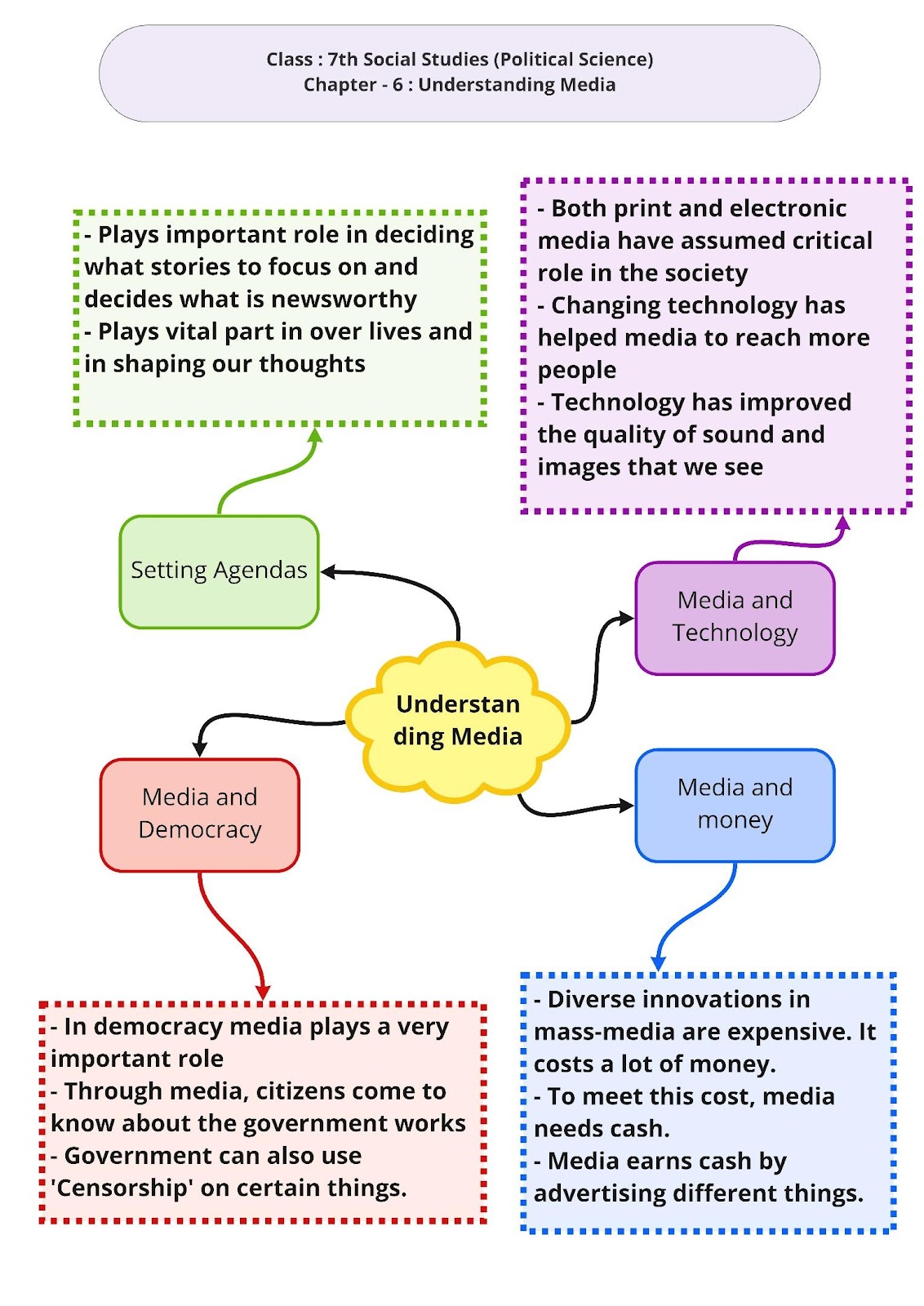
  4. Algeria, Libya and Egypt.
  5. The two words with which Ladakh is made up of are La meaning mountain pass and Dak meaning country.
  6. Ladakh is located in the Great Himalayas, on the eastern side of Jammu and Kashmir.
  • Short Answer:
  1. The Sahara desert experience scorching hot and parch dry climate. The rainy season occurs for the short time. The sky is cloudless and clear. Days are extremely hot. The temperatures during the day may rise as high as 50°C. The nights may be freezing cold with temperatures nearing zero degrees.
  2. In the summer season the people of the Ladakh desert are busy in cultivation work. They grow crops such as barley, potatoes, peas, beans and turnip. The climate during winters is very harsh and people keep themselves engaged in festivities and ceremonies. The women manage the house and fields with great efficiency. They also manage small business and shops.

  3. Flora: The Sahara desert has vegetation such as cactus, date palms and acacia. In same places there are oases where one can see green islands with date palms.

Fauna:The animals found in the Sahara desert are camels, hyenas, jackals, foxes, scorpions, several varieties of snakes and lizards.

  1. Sahara once used to be a lush green plain. Cave paintings in Sahara desert show that there used to be rivers with crocodiles. Elephants, lions, giraffes, ostriches, sheep, cattle and goats were common animals. But the change in climate has changed it to a very hot and dry region.
  2. Nomadic tribes of Sahara desert rear livestock because these animals provide them with milk, hides from which they make leather for belts, slippers, water bottles; hair is used for mats, carpets, clothes and blankets.
  • Long Answer:
  1. The Sahara desert experiences harsh climate. Despite that various groups of people such as the Bedouins and Juaregs live here. These are nomadic tribes who pursue different activities. They rear animals such as goats, sheep, camels and horses. They get jnilk and hides from these animals. They prepare leather from hides. This leather is used in making belts, slippers, water bottles. They use the hair of these animals in making mats, carpets, clothes and blankets. The people of the Sahara desert wear heavy robes to protect themselves from the dust storms and hot winds.

The oasis in the Sahara desert and the Nile valley in Egypt support settled population. Since water is available, people grow date palms. They also grow rice, wheat, barley and beans.

The Sahara is undergoing change with fast speed. Tuaregs, the nomadic tribe, are now acting as guides to foreign tourists. More and more nomadic herdsmen are migrating to cities in search of jobs in oil and gas operations.

  1. Flora: Vegetation is scanty in the Ladakh desert. There are scanty patches of grasses and shrubs. Groves of willows and poplars are seen in the valleys. During the summers, fruit trees such as apples, apricots and walnuts grow.

Fauna: Several species of birds are found in the Ladakh desert. Robins, redstarts, Tibetan snowcock, raven and hoopoe are common. The animals found in this region are wild goats, wild sheep, yak and special kinds of dogs.

  1. People of Sahara desert:
  1. The Sahara desert despite its harsh climate has been inhabited by various groups of people, who pursue different activities.
  2. Among them are the Bedouins and Tuaregs. These groups are nomadic tribes rearing livestock such as goats, sheep, camels and horses. They wear heavy robes as protection against dust storms and hot winds.
  3. The oasis in the Sahara and the Nile Valley in Egypt supports settled population. Since water is available, the people grow date palms. Crops such as rice, wheat, barley and beans are also grown. Egyptian cotton, famous worldwide is grown in Egypt.
  4. The cultural landscape of the Sahara is undergoing change. Tuaregs are seen acting as guides to foreign tourists. More and more nomadic herdsmen are taking to city life finding jobs in oil and gas operations.
  5. Climatic conditions of the Ladakh desert:
  1. The altitude in Ladakh varies from about 3000m in Kargil to more than 8,000m in the Karakoram. Due to its high altitude, the climate is extremely cold and dry. The air at this altitude is so thin that the heat of the sun can be felt intensely.
  2. The day temperatures in summer are just above zero degree and the night temperatures well below –30°C. It is freezing cold in the winters when the temperatures may remain below –40°C for most of the time.
  3. As it lies in the rain shadow of the Himalayas, there is little rainfall, as low as 10 cm every year. The area experiences freezing winds and burning hot sunlight.
  4. In the summer season the people are busy cultivating barley, potatoes, peas, beans and turnip. The climate in winter months is so harsh that people keep themselves engaged in festivities and ceremonies. The women are very hard working. They work not only in the house and fields, but also manage small business and shops.