


Rational Numbers
- The numbers of the form xv, where x and y are natural numbers, are known as fractions.
- A number of the form pq[q 0], where p and q are integers, is called a rational number.
- Every integer is a rational number and every fraction is a rational number.
- A rational number pq is positive if p and q are either both positive or both negative.
- A rational number pq is negative if one of p and q is positive and the other one is negative.
- Every positive rational number is greater than 0.
- Every negative rational number is less than 0.
- If pq is a rational number and ‘m’ is a non-zero integer, then pqpmqm. Here, pqand pmqm are known as equivalent rational numbers.
- If pq is a rational number and ‘m’ is a common divisor of p and q, then pqpmqm. Here, pqand pmqm are known as equivalent rational numbers.
- Two rational numbers are equivalent only when the product of numerator of the first and the denominator of the second is equal to the product of the denominator of the first and the numerator of the second.
- A rational number pq is said to be in standard form if q is positive and the integers p and q have no common divisors other than 1.
- If there are two rational numbers with a common denominator then the one with the larger numerator is greater than the other.
- Rational numbers with different denominators can be compared by first making their denominators same and then comparing their numerators.
- There are infinite rational numbers between two rational numbers.
- Two rational numbers with the same denominator can be added by adding their numerators, keeping the denominator same.
pqrq [pr]q
- Two rational numbers with different denominators are added by first taking the LCM of the two denominators and converting both the rational numbers to their equivalent forms having the LCM as the denominator.
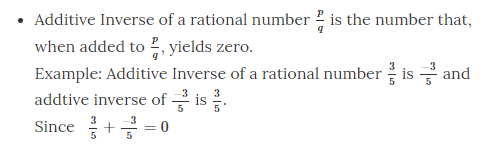
- While subtracting two rational numbers, we add the additive inverse of the rational number to be subtracted to the other rational number.
pq rs pq (additive inverse of rs)
- To multiply two rational numbers, we multiply their numerators and denominators separately, and write the product as product of numeratorsproduct of denominators
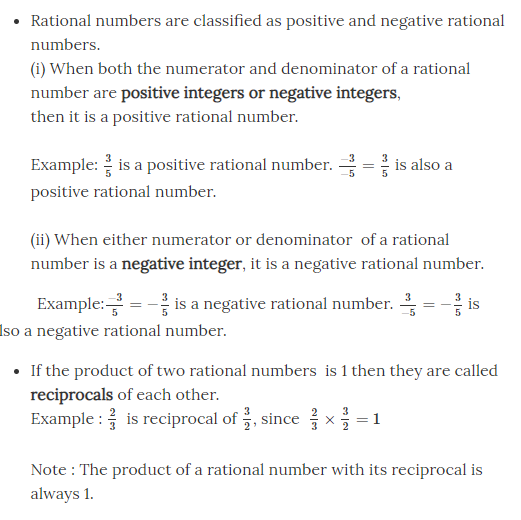
- Reciprocal of pq is qp.
- To divide one rational number by the other non-zero rational number, we multiply the first rational number by the reciprocal of the other.
Rational Numbers
A rational number is defined as a number that can be expressed in the form
pq
, where p and q are integers and q≠0.
In our daily lives, we use some quantities which are not whole numbers but can be expressed in the form of
pq
Hence, we need rational numbers.
Equivalent Rational Numbers
By multiplying or dividing the numerator and denominator of a rational number by a same non zero integer, we obtain another rational number equivalent to the given rational number. These are called equivalent fractions.


Rational Numbers in Standard Form
A rational number is said to be in the standard form if its denominator is a positive integer and the numerator and denominator have no common factor other than 1.
Example: Reduce


Here, the H.C.F. of 4 and 16 is 4.

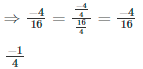
is the standard form of


LCM
The least common multiple (LCM) of two numbers is the smallest number (≠0) that is a multiple of both.
Example: LCM of 3 and 4 can be calculated as shown below:
Multiples of 3: 0, 3, 6, 9, 12, 15
Multiples of 4: 0, 4, 8, 12, 16
LCM of 3 and 4 is 12.
Rational Numbers between Two Rational Numbers
There are unlimited number (infinite number) of rational numbers between any two rational numbers.
Example: List some of the rational numbers between −35 and −13.
Solution: L.C.M. of 5 and 3 is 15.
⇒ The given equations can be written as


⇒ −615, −715, −815 are the rational numbers between −35 and −13.
Note: These are only few of the rational numbers between −35 and −13. There are infinte number of rational numbers between them. Following the same procedure, many more rational numbers can be inserted between them.
Properties of Rational Numbers

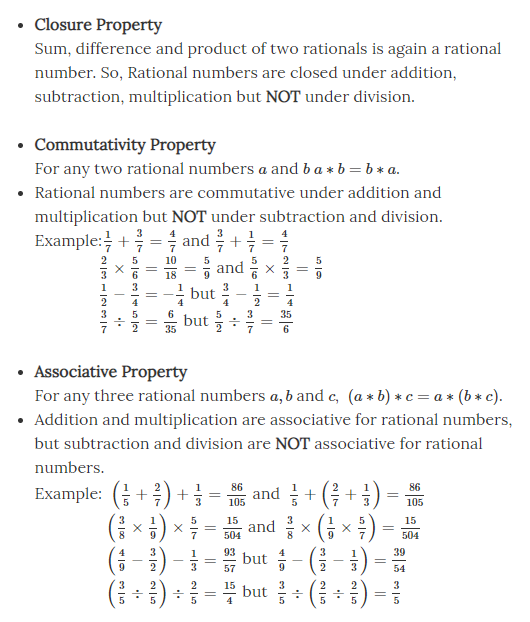
Addition of Rational Numbers


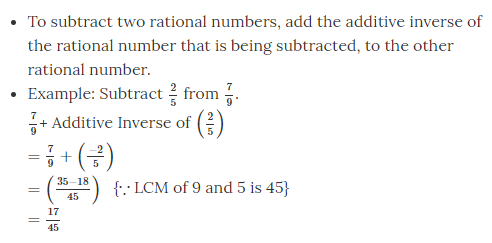
Subtraction of Rational Numbers

Multiplication and Division of Rational Numbers

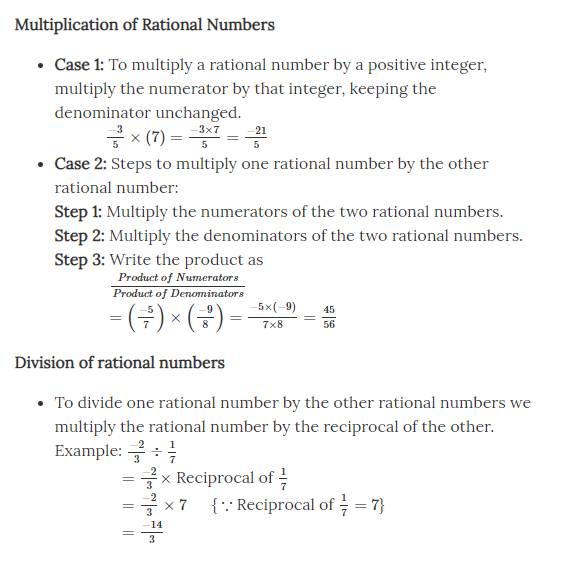
Negatives and Reciprocals

Additive Inverse of a Rational Number

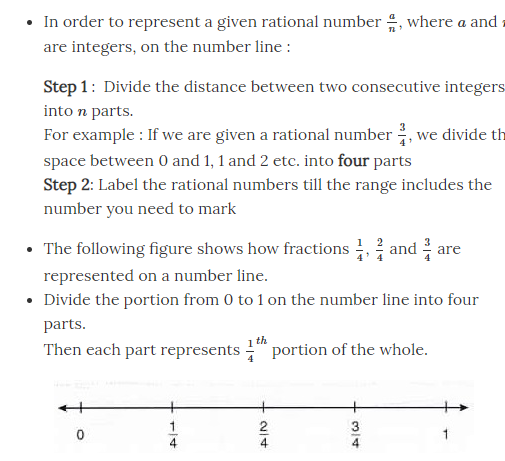
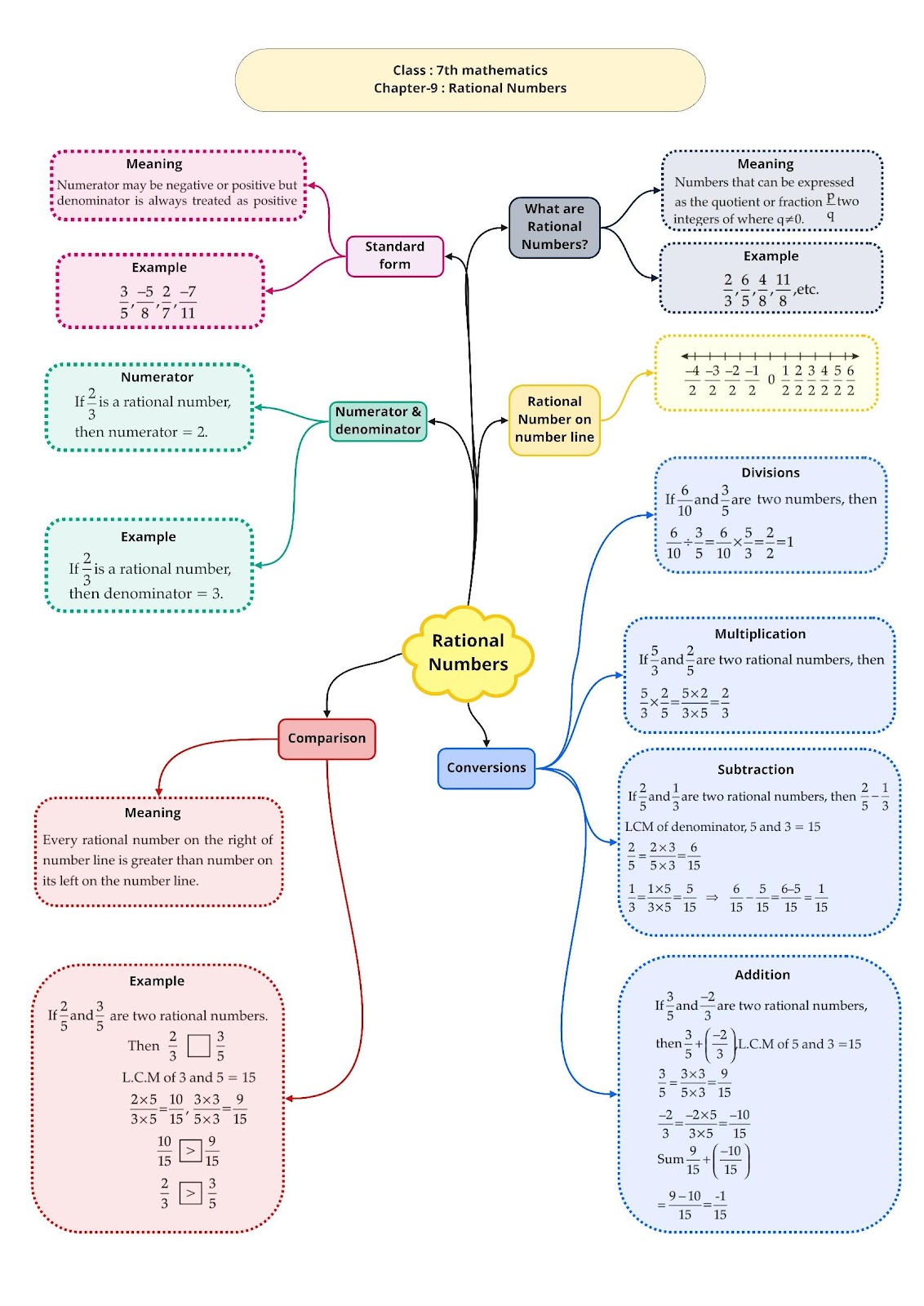
Rational Numbers on a Number Line

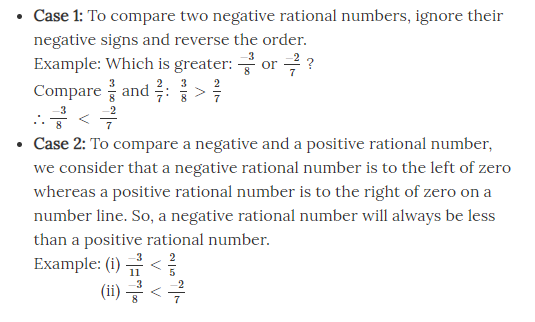
Comparison of Rational Numbers


Important Questions
Multiple Choice Questions:
Question 1. The numerator of the rational number 1100 is
(a) 100
(b) 1
(c) 10
(d) 99
Question 2. The denominator of the rational number 47 is
(a) 7
(b) 4
(c) 3
(d) 11
Question 3. The denominator of the rational number 713 is
(a) 13
(b) 7
(c) 6
(d) 91
Question 4. The numerator of the rational number -34 is
(a) -3
(b) 3
(c) 4
(d) -4
Question 5. The numerator of the rational number −29 is
(a) -2
(b) 2
(c) -9
(d) 9
Question 6. The denominator of the rational number 5-3 is
(a) 5
(b) -3
(c) 3
(d) 8
Question 7. The denominator of the rational number 3-7 is
(a) 7
(b) -7
(c) 3
(d) -3
Question 8. The numerator of the rational number -2-5 is
(a) 2
(b) -2
(c) 5
(d) -5
Question 9. the numerator of the rational number -5-3 is
(a) -5
(b) 5
(c) -3
(d) 3
Question 10. The denominator of the rational number -2-9 is
(a) -2
(b) 2
(c) 9
(d) -9
Question 11. The denominator of the rational number -6-5 is
(a) 6
(b) -6
(c) 5
(d) -5
Question 12. The denominator of the rational number -13-11 is
(a) -13
(b) 13
(c) 11
(d) -11
Question 13. The numerator of the rational number 0 is
(a) 0
(b) 1
(c) 2
(d) 3
Question 14. The denominator of the rational number 0 is
(a) 0
(b) 1
(c) -1
(d) any non-zero integer
Question 15. The numerator of a rational number 8 is
(a) 2
(b) 4
(c) 6
(d) 8
Very Short Questions:
- Find three rational numbers equivalent to each of the following rational numbers.
(i) -25
(ii) 37
- Reduce the following rational numbers in standard form.
(i) 35-15
(ii) -36-216
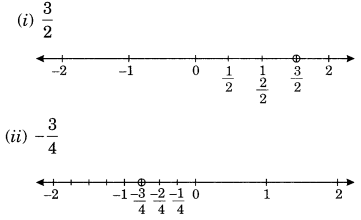
- Represent 32 and -34 on number lines.
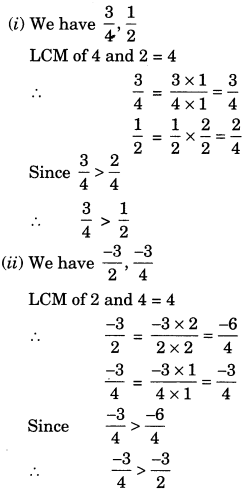
- Which of the following rational numbers is greater?
(i) 34,12
(ii) -32, -34
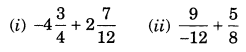
- Find the sum of

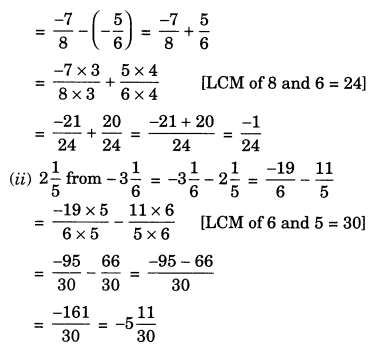
- Subtract:


Short Questions:
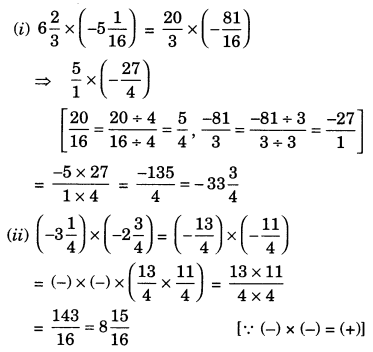
- Find the product:


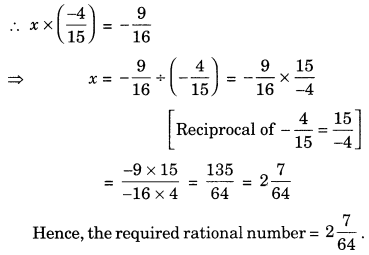
- If the product of two rational numbers is -916 and one of them is -415, find the other number.
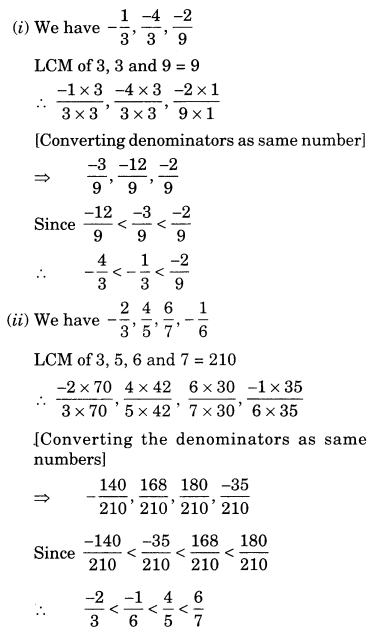
- Arrange the following rational numbers in ascending order.


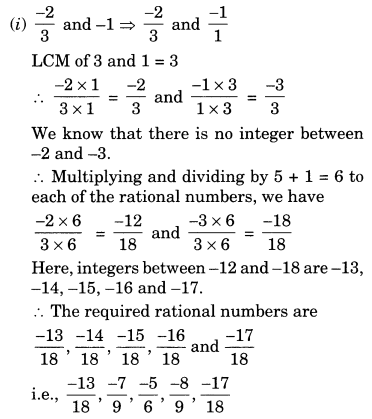
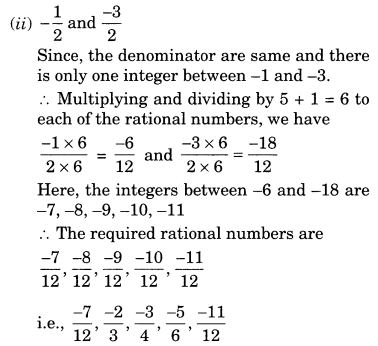
- Insert five rational numbers between:


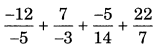
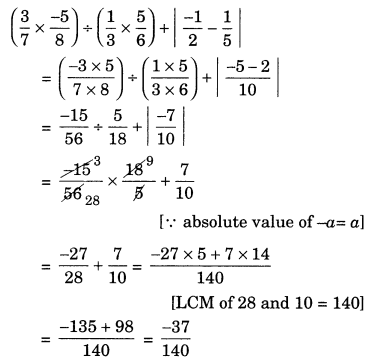
- Evaluate the following:

- Subtract the sum of -56 and -135 from the sum 223 and -625.
Long Questions:


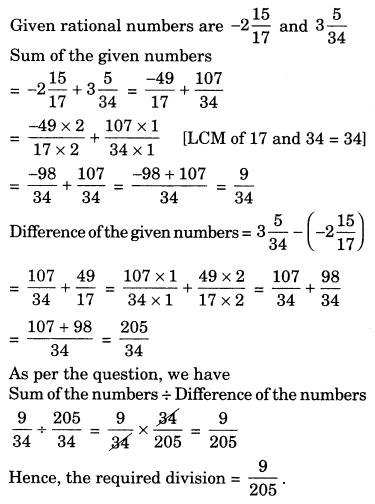
- Divide the sum of -21517 and 3534 by their difference.
- During a festival sale, the cost of an object is ₹ 870 on which 20% is off. The same object is available at other shops for ₹ 975 with a discount of 623 %. Which is a better deal and by how much?
- Simplify:
21.5 ÷ 5 –15of 20.5 – 5.5+ 0.5 × 8.5
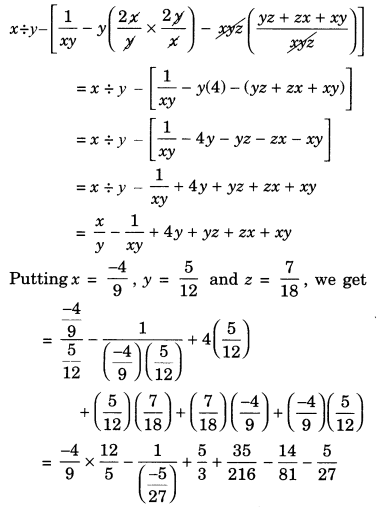
- Simplify:



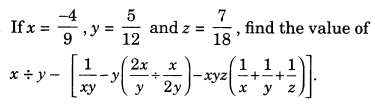
ANSWER KEY –
Multiple Choice Questions:
- (b) 1
- (a) 7
- (a) 13
- (a) -3
- (a) -2
- (b) -3
- (b) -7
- (b) -2
- (a) -5
- (d) -9
- (d) -5
- (d) -11
- (a) 0
- (d) -1
- (d) 8
Very Short Answer:

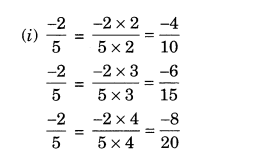

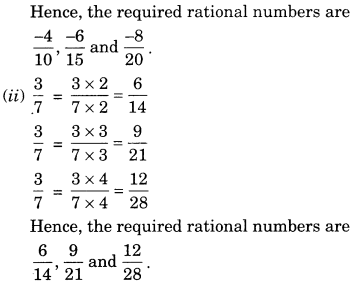

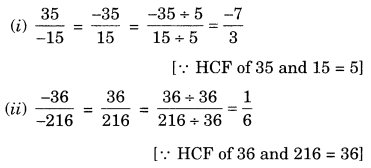


- Find the sum of

Short Answer:

- Let the required rational number be x.





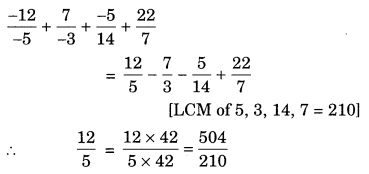

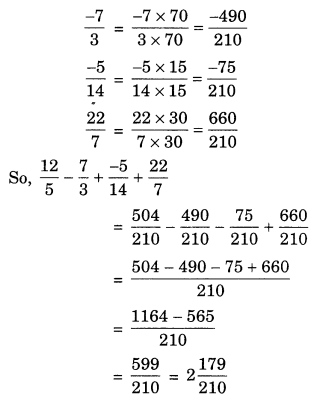

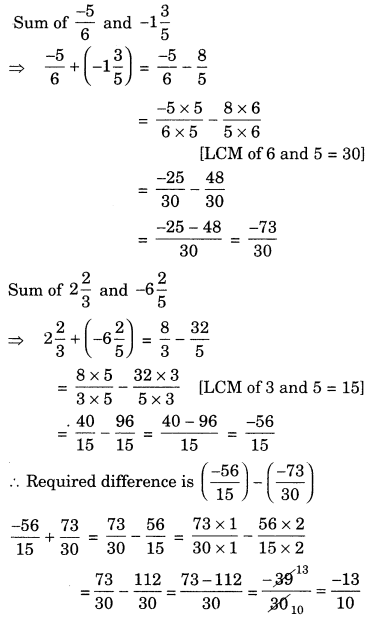
Long Answer:
- We have


- The cost of the object = ₹ 870
Discount = 20% of ₹ 870 =20100 × 870 = ₹ 174
Selling price = ₹ 870 – ₹ 174 = ₹ 696
The same object is available at other shop = ₹ 975

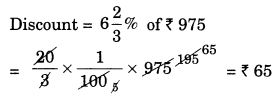
Selling price = ₹ 975 – ₹ 65 = ₹ 910
Since ₹ 910 > ₹ 696
Hence, deal at first shop is better and by ₹ 910 – ₹ 696 = ₹ 214
- Using BODMAS rule, we have
21.5 ÷ 5 – 15 of (20.5 – 5.5) + 0.5 × 8.5
= 21.5 ÷ 5 – 15 of 15 + 0.5 × 8.5
= 21.5 × 15 – 15 × 15 + 0.5 × 8.5
= 4.3 – 3 + 4.25
= 4.3 + 4.25 – 3
= 8.55 – 3
= 5.55
- Using BODMAS rule, we have
2.3 – [1.89 – {3.6 – (2.7 – 0.77)}]
= 2.3 – [1.89 – {3.6 – 1.93}]
= 2.3 – [1.89 – 1.67]
= 2.3 – 0.22
= 2.08
- Using BODMAS rule, we have